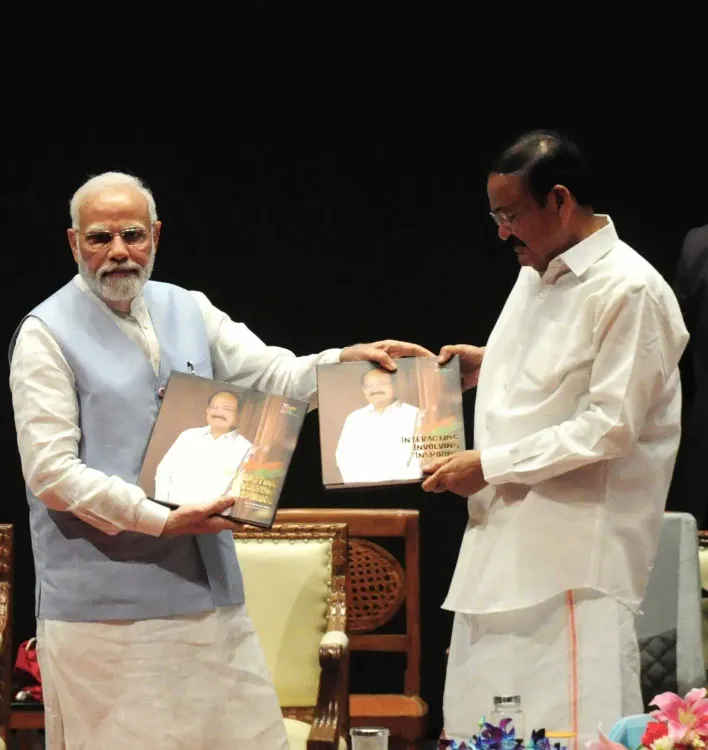
Venkaiah Naidu calls PM Modi 'Man of Destiny' as he sets tenure record
Synopsis
Former Vice President Venkaiah Naidu's tribute is more than praise — it is a political canonisation. By rechristening Modi the 'Man of Destiny for India' on the day he broke Nehru's tenure record, Naidu is framing 4,399 days not just as longevity but as historical legitimacy, drawing a direct line from a tea stall in Vadnagar to the remaking of India's welfare state, foreign policy, and constitutional architecture.
Key Takeaways
Former Vice President M.
Venkaiah Naidu called PM Narendra Modi the 'Man of Destiny for India' in an article in The Indian Express on 10 June .
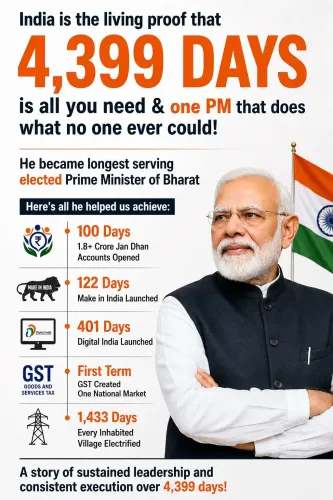
PM Modi has completed 4,399 continuous days in office, surpassing Jawaharlal Nehru's record as India's longest-serving Prime Minister.
Naidu cited welfare milestones including 12 crore toilets , 4 crore houses , ₹45 lakh crore in DBT transfers, and 80 crore food-support beneficiaries.
He credited Modi with the abrogation of Article 370 , abolition of triple talaq , GST introduction, and 33% women's reservation in Parliament.
Naidu described Operation Sindoor and surgical strikes as evidence of a strengthened national security posture under Modi.
Former Vice President M. Venkaiah Naidu has hailed Prime Minister Narendra Modi as the 'Man of Destiny for India', declaring that the country is safe and secure under his leadership. The tribute came through an article Naidu authored in The Indian Express on Wednesday, 10 June, coinciding with Modi's milestone of becoming India's longest continuously serving Prime Minister — completing 4,399 days in office and surpassing the record previously held by Jawaharlal Nehru.
The Tribute and What Naidu Said
Naidu, a former senior Bharatiya Janata Party (BJP) leader who had earlier coined the acronym 'MODI' to mean 'Making of Developed India', said he now felt compelled to go further. 'After these 12 years, I have no hesitation in rechristening MODI as the Man of Destiny for India. That destiny is Swarnim Bharat. Bharat is safe and secure in his hands. I wish Narendra Damodardas Bharat Modi all the best in his endeavours,' Naidu wrote.
He noted that achieving the longest-serving tenure is especially significant in the current era of intense political competition, shifting coalition dynamics, round-the-clock media scrutiny, and social media-driven public discourse — conditions that have shortened the political lives of many leaders globally.
From Tea Vendor to South Block: Modi's Journey
Naidu traced Modi's origins to Vadnagar, Gujarat, where he was born to parents of modest means and worked as a tea vendor alongside his father. The former Vice President described Modi's rise to the Prime Minister's Office in South Block, New Delhi, as 'an extraordinary achievement.' He credited Modi's formative years with the Rashtriya Swayamsevak Sangh (RSS), the Jana Sangh, and the BJP for shaping his organisational acumen, clarity of thought, and, in Naidu's words, 'the courage to dream of India's destiny.'
The Gujarat Model and National Governance
Naidu highlighted Modi's unbroken 12-year tenure as Chief Minister of Gujarat as foundational to his national appeal. 'The Gujarat model that emerged during his tenure captured the imagination of the people of the country. The people of Bharat yearned for a leader who could deliver. They found such a leader in Modi,' Naidu wrote.
On governance at the Centre, Naidu cited a sweeping list of welfare and infrastructure milestones attributed to the Modi government: construction of over 12 crore individual household toilets under Swachh Bharat; more than 4 crore houses built for the poor; over 57 crore bank accounts opened under the JAM framework; ₹45 lakh crore transferred directly to beneficiaries under the Direct Benefit Transfer (DBT) scheme; and LPG connections extended to over 10 crore women. He also pointed to India's position as a global leader in real-time digital payments, with over 24,000 crore UPI transactions recorded, and noted that 80 crore people received food support during the Covid-19 pandemic.
Policy Decisions and Security Record
Naidu credited Modi with several politically contested decisions, describing them as evidence that the PM 'does not believe in stereotypes.' He listed the abrogation of Article 370, the abolition of triple talaq, the introduction of the Goods and Services Tax (GST) despite significant opposition, and the passage of 33 per cent reservation for women in Parliament and state assemblies.
On national security, Naidu argued that left-wing extremism has been 'almost wiped out' and pointed to the surgical strikes and Operation Sindoor as demonstrations of India's resolve. He also credited Modi with reshaping foreign policy around national interest rather than alignment with any single country, asserting that 'the voice of Bharat now matters at all global dialogue tables.'
Education, Health, and What Comes Next
The former Vice President noted a significant expansion in educational and health institutions under Modi's watch, with IITs, IIMs, and AIIMS increasing 'manifold' across the country. He highlighted Ayushman Bharat as the world's largest publicly funded health programme. This comes amid ongoing debates about the quality and equitable distribution of these new institutions, a dimension that critics have raised separately. With Modi now in record-breaking territory, attention will turn to whether the governance agenda he has championed can be sustained and deepened through the remainder of his current term.
Point of View
Not merely a personal tribute — publishing it on the day Modi breaks Nehru's record ensures maximum symbolic resonance. The framing of Modi as 'Man of Destiny' is significant: it elevates tenure into teleology, suggesting his record in office is not just long but preordained and irreversible. What the piece does not engage with is the accountability side of 12 years — the jobs data, the state of press freedom indices, or the concerns raised by opposition parties about institutional independence. Naidu was a constitutional office-holder and a respected cross-party voice; his endorsement carries weight, but it also underscores how thoroughly the BJP's ideological framing has consolidated even among its elder statesmen.
NationPress
24 Sept 2026
Frequently Asked Questions
Why did Venkaiah Naidu call PM Modi the 'Man of Destiny for India'?
Naidu used the phrase in an article in The Indian Express on 10 June, coinciding with Modi completing 4,399 continuous days as Prime Minister — surpassing Jawaharlal Nehru's record. He said the label reflects his assessment of Modi's 12-year governance record and his vision of 'Swarnim Bharat.'
What record did PM Modi break?
PM Modi became India's longest continuously serving Prime Minister, completing 4,399 days in office and surpassing the tenure record previously held by Jawaharlal Nehru. The milestone fell on 10 June.
What governance achievements did Venkaiah Naidu highlight?
Naidu cited the construction of over 12 crore household toilets, 4 crore homes for the poor, ₹45 lakh crore in DBT transfers, 57 crore bank accounts under JAM, LPG connections for 10 crore women, and food support for 80 crore people during Covid-19, among other milestones.
What policy decisions did Naidu attribute to PM Modi?
Naidu pointed to the abrogation of Article 370, the abolition of triple talaq, the introduction of GST, and the passage of 33 per cent reservation for women in Parliament and state assemblies as key policy decisions under Modi's leadership.
What did Naidu say about India's security under Modi?
Naidu said left-wing extremism has been 'almost wiped out' and cited surgical strikes and Operation Sindoor as effective responses to external threats. He also argued that India's foreign policy under Modi is now guided purely by national interest, giving India a stronger voice in global forums.