Admiral Tripathi Praises Indian Navy's Commitment to Energy Security Amid West Asia Tensions
Synopsis
Admiral Dinesh K. Tripathi of the Indian Navy highlights the force's crucial role in ensuring energy security amidst rising tensions in West Asia. Key discussions during the Navy Commanders’ Conference 2026 focus on operational readiness and technological advancements for a future-ready naval force.
Key Takeaways
Tripathi emphasizes the role of the Navy in safeguarding India's maritime interests.
The Navy Commanders’ Conference 2026 focuses on operational readiness and inter-service cooperation.
India's Navy is actively involved in protecting oil tankers amidst tensions in West Asia .
Significant progress in capability enhancements and indigenous platform induction has been noted.
Personnel welfare initiatives are crucial for maintaining cohesion and resilience within the Navy.
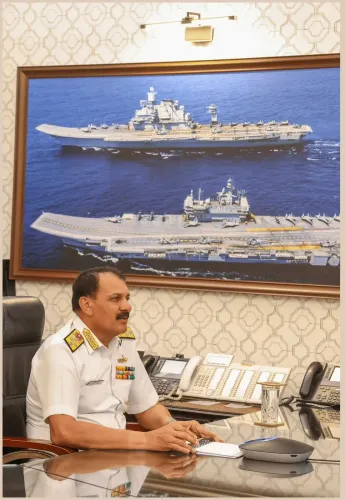
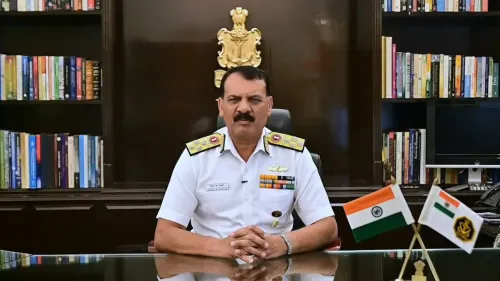
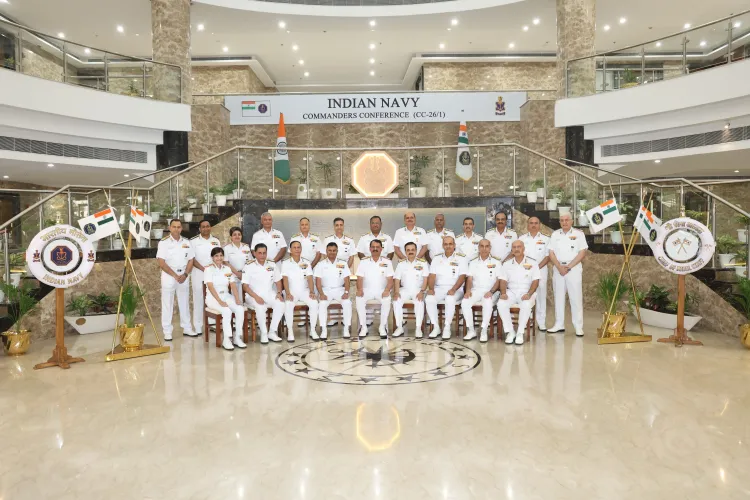
New Delhi, April 15 (NationPress) The Chief of the Indian Navy, Admiral Dinesh K. Tripathi, has praised the naval forces for their critical role in protecting India's maritime interests, especially in the context of energy security during the escalating tensions in West Asia.
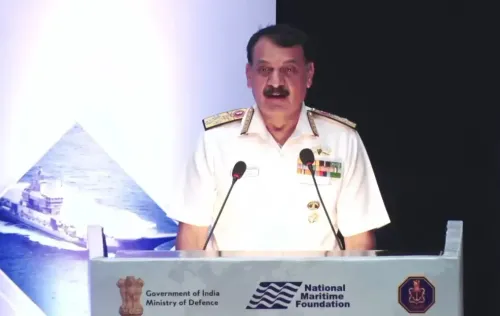
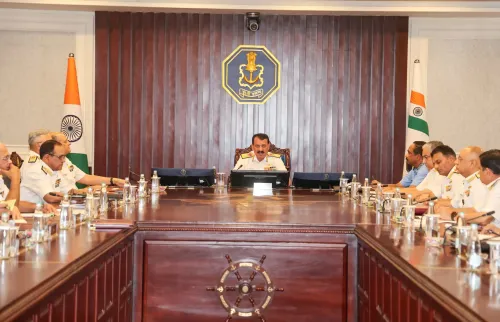
During his keynote address at the Navy Commanders’ Conference 2026 on Tuesday, he acknowledged the heightened operational activity and stressed the necessity of inter-service cooperation, while emphasizing the importance of maintaining top combat readiness and embracing emerging technologies to forge a future-ready naval force.
The Commanders’ Conference 2026 is currently underway at Nausena Bhawan, gathering senior naval leaders, including operational and regional commanders, command headquarters delegates, and staff from naval headquarters.
Admiral Tripathi highlighted the shifting global security dynamics, pointing to the ongoing instability in West Asia and its repercussions on maritime navigation. He underscored that the situation serves as a stark reminder that security is interconnected, enduring, and unyielding—where mere geographical distance from conflict does not equate to immunity from its effects.
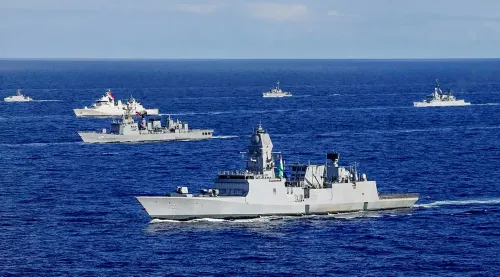
This conference is taking place amidst the Indian Navy's active deployment in the Indian Ocean, tasked with the protection of oil tankers heading towards India after passing through the Strait of Hormuz, given the current conflicts in West Asia.
He also reflected on the significant geopolitical transition, stating, "In just five years, we have shifted from a continuum of competition to one of conflict."
Ongoing conflicts, he noted, are influencing both economic and military scenarios, while also shaping public perceptions through narrative warfare, beyond just developments on the battlefield.
The Navy chief pointed out that the maritime security landscape has reached a pivotal point, influenced by simultaneous conflicts, increasing adversarial capabilities, deteriorating institutional frameworks, and reduced costs that allow non-state actors to obtain advanced systems. These elements are creating a more contested operational environment for the Navy every day.
He commended the Indian Navy on its progress towards becoming a combat-ready, credible, cohesive, and future-oriented force. Along with readiness for both offensive and defensive operations, he noted a significant increase in the deployment of naval assets over the last decade.
Efforts to enhance warfighting capabilities across surface, subsurface, and aerial domains were also highlighted, backed by infrastructure improvements, robust maintenance systems, and advancements in indigenous technology.
Admiral Tripathi cited notable achievements in capability enhancement, including full utilization of the assigned budget, the signing of over 90 capital contracts, the continuous induction of domestically designed and constructed platforms, and the anticipated delivery of more than 15 platforms this year.
He emphasized the Navy’s position as a reliable maritime partner, noting its role in ensuring the safe transit of merchant vessels from the Persian Gulf and providing reassurance to Indian seafarers through the deployment of naval warships in the area.
Among other highlights, he mentioned the inaugural journey of INSV Kaundinya and the successful execution of significant multilateral engagements such as Maritime Mahakumbh, IFR, MILAN, and the IONS Conclave of Chiefs.
The deployment of IOS Sagar-2, with participation from 16 friendly nations, was also noted as a testament to India’s expanding maritime influence and the Navy’s role in fostering it.
Furthermore, the Navy chief pointed to initiatives aimed at enhancing personnel welfare, which include advances in recruitment, training, medical support, and sports, all of which have bolstered cohesion, trust, and resilience within the force.
He also mentioned advancements in tech-driven capabilities, including the incorporation of artificial intelligence and machine learning into operational strategies, as part of initiatives to boost future readiness.
In outlining priorities for the force, he emphasized the necessity of sustaining peak combat effectiveness, bolstering force levels and capacities, improving maintenance and logistics, promoting innovation and technological integration, enhancing human resource development, increasing organizational agility, and deepening jointness and integration across military services.
Point of View
The emphasis on inter-service cooperation and technological advancement reflects a proactive stance in safeguarding national maritime interests. The Navy's commitment to maintaining operational readiness is crucial in an increasingly volatile global environment.
NationPress
19 Sept 2026
Frequently Asked Questions
What is the focus of the Navy Commanders’ Conference 2026?
The conference emphasizes operational readiness, inter-service coordination, and the adoption of emerging technologies to prepare the Indian Navy for future challenges.
How does the Indian Navy contribute to energy security?
The Indian Navy plays a vital role in protecting maritime routes, especially for oil tankers passing through critical areas like the Strait of Hormuz amid regional tensions.
What recent achievements has the Indian Navy made?
The Navy has achieved significant capability enhancements, including the signing of over 90 capital contracts and the ongoing induction of indigenously developed platforms.
Why is the situation in West Asia important for India?
Continued instability in West Asia directly impacts maritime traffic and energy security for India, making it essential for the Navy to remain vigilant.
What initiatives are in place for personnel welfare in the Navy?
The Navy has implemented various initiatives to improve recruitment, training, medical support, and sports, aimed at enhancing cohesion and resilience among personnel.