Tamil Nadu 2026 election verdict on May 4: DMK, AIADMK, TVK in four-way fight
Synopsis
Tamil Nadu's 2026 Assembly verdict on 4 May is more than a routine election count — it is a potential inflection point for Dravidian politics. With Vijay's TVK entering as a credible third force and a four-cornered contest tightening margins, the state could be moving from its familiar DMK-AIADMK binary toward a new, more fragmented political era.
Key Takeaways
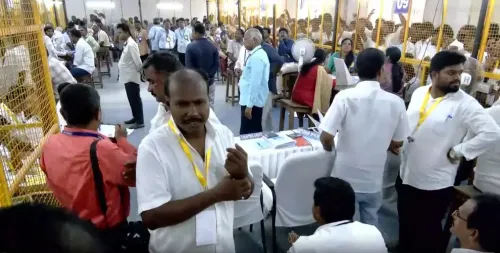
Vote counting for the Tamil Nadu 2026 Assembly elections begins on 4 May across all 234 constituencies .
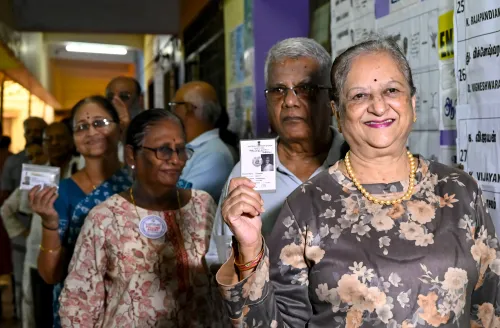
Polling on 23 April recorded 4.88 crore votes cast, as confirmed by the Election Commission of India .
Selvaperunthagai claimed the ruling front could cross 200 seats ; most exit polls placed DMK ahead.
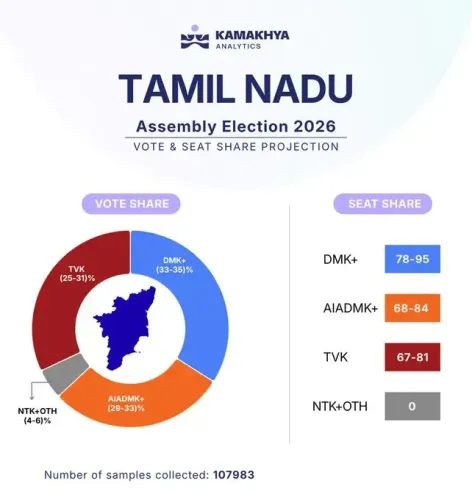
Vijay's TVK is projected by several exit polls to make a strong debut, potentially as a kingmaker in a fractured verdict.
AIADMK under Edappadi K.
Palaniswami is contesting with BJP , PMK , and AMMK in an anti-DMK alliance.
A strong TVK performance, even without power, could reshape Tamil Nadu politics ahead of the 2029 Lok Sabha elections .
Tamil Nadu stands at a decisive political crossroads as vote counting for the 2026 Assembly elections is set to begin on Monday, 4 May, in Chennai. The ruling Dravida Munnetra Kazhagam (DMK) is seeking a second consecutive term, the AIADMK-Bharatiya Janata Party (BJP) alliance is fighting to reclaim power, and actor-politician Vijay's Tamilaga Vettri Kazhagam (TVK) has emerged as the most unpredictable new force in the state's Dravidian political landscape. A fourth front, the Naam Tamilar Katchi (NTK) led by Seeman, has further complicated the arithmetic, turning this into a rare four-cornered contest.
The Stakes for Each Camp
For Chief Minister M.K. Stalin, Monday's count is a referendum on the DMK's welfare-heavy governance model, its social justice plank, and its ability to manage a broad alliance without triggering anti-incumbency. The DMK-led front has projected confidence ahead of the results. Tamil Nadu Congress President K. Selvaperunthagai claimed the ruling alliance could cross 200 seats — a figure that, if accurate, would hand Stalin a landslide mandate.
The AIADMK, led by Edappadi K. Palaniswami, has sought to consolidate anti-DMK votes through its alliance with the BJP, PMK, and AMMK. However, the BJP's presence within the alliance has sharpened ideological fault lines in a state where Dravidian politics has historically resisted the party's national narrative — a tension that analysts say may have cost the alliance votes in certain constituencies.
Vijay's TVK: The Wild Card
The most closely watched variable is Vijay's TVK. Several exit polls have indicated a strong electoral debut for the party, with at least one projection giving it a surprisingly high seat tally, even as most surveys placed the DMK in the lead. Vijay has positioned TVK as politically opposed to the DMK and ideologically opposed to the BJP, a dual-opposition stance that has drawn first-time voters and disenchanted Dravidian loyalists alike.
If the final verdict is fractured — with no alliance securing a clear majority — TVK's tally could make Vijay a potential kingmaker, a scenario that would fundamentally alter the state's coalition calculus.
Voter Turnout and Security
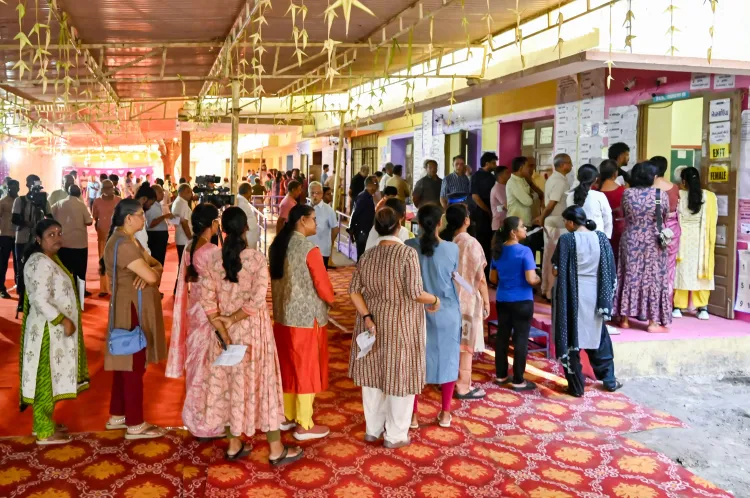
Polling was conducted on 23 April across all 234 Assembly constituencies. The Election Commission of India (ECI) confirmed that 4.88 crore voters cast their ballots. Ahead of counting, the TVK urged enhanced security at counting centres, citing incidents targeting party offices. Authorities have confirmed that security arrangements are in place across all counting locations.
What the Verdict Could Mean for Tamil Nadu
Beyond the immediate seat tally, the outcome carries long-term structural implications. A clear DMK victory would reinforce Stalin's leadership and entrench the ruling alliance's dominance heading into the 2029 Lok Sabha elections. An AIADMK-led comeback would validate Palaniswami's alliance strategy and restore his party's status as the principal opposition force.
Notably, a strong TVK performance — even without forming a government — could redraw Tamil Nadu's political grammar, introducing a credible third pole into a system that has operated on a DMK-AIADMK binary for over five decades. The central question on 4 May is no longer only who forms the government, but whether the state's long-standing Dravidian political structure is on the verge of being rewritten.
Point of View
Particularly among youth and first-time voters who feel unrepresented by both legacy Dravidian parties. The BJP's inclusion in the AIADMK alliance is a double-edged sword: it brings organisational muscle but ideological baggage in a state that has consistently rejected Hindutva-adjacent politics. If the verdict is fractured, the real story will not be who governs Tamil Nadu in 2026, but whether the two-party Dravidian consensus — the defining feature of the state's politics for half a century — has finally cracked.
NationPress
26 Sept 2026
Frequently Asked Questions
When will Tamil Nadu 2026 Assembly election results be declared?
Vote counting for the Tamil Nadu 2026 Assembly elections is scheduled for Monday, 4 May 2026, covering all 234 constituencies. Results are expected to become clear over the course of the day as counting progresses.
Who are the main contenders in the Tamil Nadu 2026 election?
The four principal forces are the ruling DMK-led alliance, the AIADMK-BJP-PMK-AMMK alliance led by Edappadi K. Palaniswami, Vijay's Tamilaga Vettri Kazhagam (TVK), and the Naam Tamilar Katchi (NTK) led by Seeman. Most exit polls have placed the DMK ahead, with TVK's debut performance being the most closely watched variable.
What is Vijay's TVK and why does it matter in this election?
Tamilaga Vettri Kazhagam (TVK) is a political party launched by actor-politician Vijay, positioning itself as opposed to both the DMK and the BJP. Several exit polls have projected a strong debut seat tally for TVK, and if the final verdict is fractured, the party could play kingmaker — a role that would mark a historic shift in Tamil Nadu's Dravidian political order.
How many voters participated in the Tamil Nadu 2026 Assembly polls?
The Election Commission of India confirmed that 4.88 crore voters cast their ballots when polling was held on 23 April 2026 across all 234 Assembly constituencies in Tamil Nadu.
What happens if no alliance wins a clear majority in Tamil Nadu?
If no alliance secures a majority in the 234-seat Assembly, Tamil Nadu could face a hung assembly scenario, potentially elevating Vijay's TVK to a kingmaker role. Such an outcome would be unprecedented in the state's post-1967 political history and could trigger coalition negotiations across ideological lines.