Tripura CM Manik Saha calls for tribal-non-tribal unity at TTAADC swearing-in
Synopsis
At the TTAADC swearing-in in Khumulwng, Tripura CM Manik Saha and Tipra Motha supremo Pradyot Bikram Manikya Debbarma called for tribal-non-tribal unity — even as the TMP's dominant 24-of-28-seat victory in April underlines a growing political divergence within the ruling coalition that the ceremony sought to paper over.
Key Takeaways
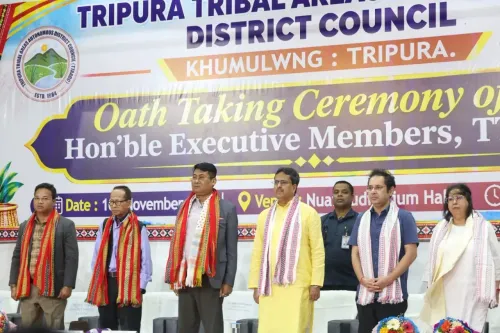
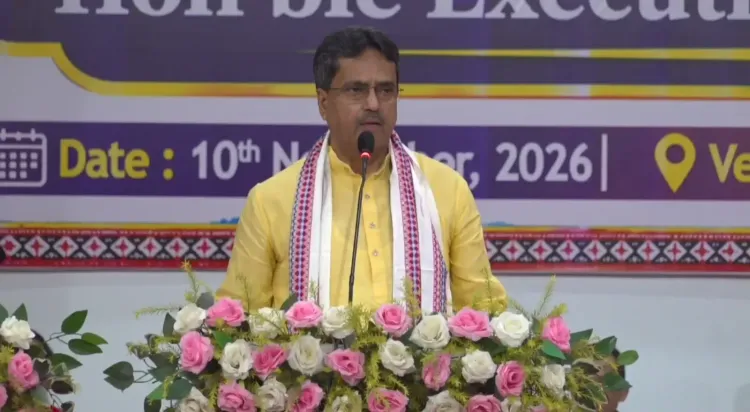
Tripura CM Manik Saha addressed the TTAADC swearing-in ceremony on 10 November 2026 in Khumulwng, West Tripura , calling for inclusive development across all communities.
Seven new Executive Members took oath — six from the Tipra Motha Party (TMP) and one from the BJP .
Piped water coverage in Tripura rose from 3% in 2018 to 86% in 2026 , according to CM Saha.
The TMP won 24 of 28 seats in the 12 April TTAADC elections ; the BJP won only 4 , while CPI(M) and Congress drew a blank.
The TTAADC administers nearly 70% of Tripura's 10,491 sq km area and is the state's second-most important constitutional body.
Tribal communities constitute nearly one-third of Tripura's 4.2 million population and play a decisive role in state politics.
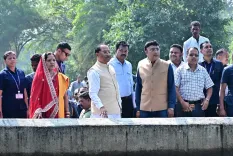
Tripura Chief Minister Manik Saha on Tuesday, 10 November 2026, called for collective efforts from all communities — tribal and non-tribal alike — to drive inclusive development across the state at the swearing-in ceremony of newly elected Executive Members of the Tripura Tribal Areas Autonomous District Council (TTAADC) held at the council headquarters in Khumulwng, West Tripura. Saha stressed that the welfare of every section of society, irrespective of caste, creed or community, must remain the common goal.
Key Developments at the Swearing-In
Seven newly elected Executive Members (EMs) took the oath of office and secrecy on Tuesday. Six of them — Kamal Kalai, Rajeshwar Debbarma, Hollywood Chakma, Kenaram Reang, Debojit Tripura, and David Murasing — represent the Tipra Motha Party (TMP), while Kaonjaong Mog was sworn in from the Bharatiya Janata Party (BJP). This follows the earlier oath-taking on 6 May by Chief Executive Member Runeil Debbarma and Executive Member Chandra Kumar Jamatia.
What the Chief Minister Said
Addressing the gathering, Chief Minister Saha highlighted the development milestones achieved since the BJP came to power in Tripura in 2018, noting progress in both tribal and non-tribal areas. He pointed to a dramatic rise in piped water supply coverage — from 3 per cent in 2018 to 86 per cent at present — as evidence of tangible improvement in living standards.
'Piped water supply coverage has increased from 3 per cent in 2018 to 86 per cent at present. Significant development has also taken place in the health and education sectors. Recently, the state government constituted a committee to recommend measures for improving the academic situation in Tripura,' Saha said.
He also cited the Sixth Schedule of the Constitution — under which the TTAADC was constituted in 1982 — as a robust framework that balances development with the preservation of tribal culture, traditions, and identity.
Tipra Motha Leader Calls for Cross-Community Cooperation
Tipra Motha Party (TMP) supremo Pradyot Bikram Manikya Debbarma, a former royal scion of the erstwhile Manikya dynasty, also addressed the ceremony, echoing the call for inclusive governance. Despite announcing his withdrawal from active politics, Debbarma made clear he would continue advocating for tribal welfare.
'I have already announced that I am no longer in politics, but I will continue working for the overall development of the tribal people. We must work together for the development and welfare of future generations, both tribal and non-tribal,' Debbarma said.
TMP's Dominant Position in the TTAADC
The swearing-in comes after the TMP's sweeping performance in the TTAADC elections held on 12 April, in which the party won 24 of 28 contested seats. The BJP secured only four seats, while the Communist Party of India (Marxist) and Congress failed to win any. Notably, the three ruling coalition partners — the BJP, the TMP, and the Indigenous People's Front of Tripura (IPFT) — had contested the polls separately after failing to reach an electoral understanding.
The 30-member TTAADC — comprising 28 elected representatives and two state government nominees — administers nearly 70 per cent of Tripura's 10,491 sq km geographical area, making it the second-most important constitutional institution in the state after the Legislative Assembly.
Why This Matters for Tripura
Tribal communities account for nearly one-third of Tripura's population of approximately 4.2 million and have historically shaped the state's political outcomes. With two consecutive victories in the TTAADC, political observers note that the TMP has further cemented its influence in Tripura's political landscape. The push for tribal-non-tribal unity at this ceremony signals an attempt by the ruling coalition to present a unified development narrative ahead of future electoral cycles.
Point of View
A junior coalition partner, comprehensively outperformed the BJP in the TTAADC elections, winning 24 of 28 seats while the BJP managed just four. That is not a partnership of equals — it is a dominant tribal party that depends on the BJP for state-level power, and a BJP that depends on the TMP for tribal legitimacy. Calls for collective development sound different when the two parties went to polls against each other. The real test is whether the TTAADC's expanded administrative footprint — covering 70 per cent of the state's area — translates into meaningful resource allocation, or remains a stage for ceremonial goodwill.
NationPress
10 Nov 2026
Frequently Asked Questions
What is the TTAADC and why is it significant in Tripura?
The Tripura Tribal Areas Autonomous District Council (TTAADC) is a constitutional body established in 1982 under the Sixth Schedule of the Indian Constitution to protect the rights, culture, and identity of tribal communities. It administers nearly 70 per cent of Tripura's 10,491 sq km geographical area and is widely regarded as the state's second-most important political institution after the Legislative Assembly.
Who were sworn in as Executive Members of the TTAADC on 10 November 2026?
Six members from the Tipra Motha Party — Kamal Kalai, Rajeshwar Debbarma, Hollywood Chakma, Kenaram Reang, Debojit Tripura, and David Murasing — along with Kaonjaong Mog of the BJP, were sworn in as Executive Members on 10 November 2026 at the council headquarters in Khumulwng.
How did the Tipra Motha Party perform in the April 2026 TTAADC elections?
The TMP secured a decisive victory, winning 24 of the 28 contested seats in the TTAADC elections held on 12 April. The BJP won the remaining four seats, while the CPI(M) and Congress failed to win a single seat.
What development claims did CM Manik Saha make at the ceremony?
Chief Minister Manik Saha stated that piped water supply coverage in Tripura had grown from 3 per cent in 2018 to 86 per cent at present, and cited improvements in health and education sectors. He also noted that the state government recently formed a committee to recommend steps for improving the academic situation in Tripura.
What is the current political relationship between the BJP and the Tipra Motha Party in Tripura?
The TMP is a junior partner in the BJP-led coalition government in Tripura. However, the two parties contested the April 2026 TTAADC elections separately — along with BJP ally IPFT — after failing to reach an electoral understanding. Despite this, both parties have maintained their coalition arrangement at the state government level.