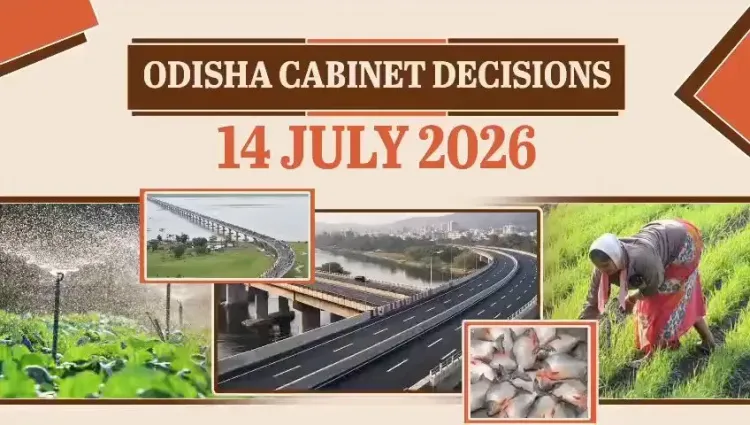
Odisha Cabinet Clears Key Decisions on Irrigation, Rural Roads
Synopsis
The Odisha State Cabinet, chaired by Chief Minister Mohan Charan Majhi, approved a package of decisions on 15 July 2026 covering irrigation, agriculture, rural connectivity, and public service delivery, advancing the government's 'Samruddha Odisha' development agenda.
Key Takeaways
The Odisha State Cabinet met on 15 July 2026 under Chief Minister Mohan Charan Majhi and cleared multiple policy decisions.
Approvals span four sectors: irrigation , agriculture , rural connectivity , and public service delivery .
The decisions are framed under the government's Samruddha Odisha (Prosperous Odisha) vision and #LokankaSarkar brand.
Farmers and rural households are the primary beneficiary groups identified in the announcement.
Specific project names, financial outlays, and implementation timelines were not disclosed in the CMO post; detailed government orders are awaited.
Mohan Charan Majhi has been Odisha's Chief Minister since June 2024 , leading the state's first BJP government.
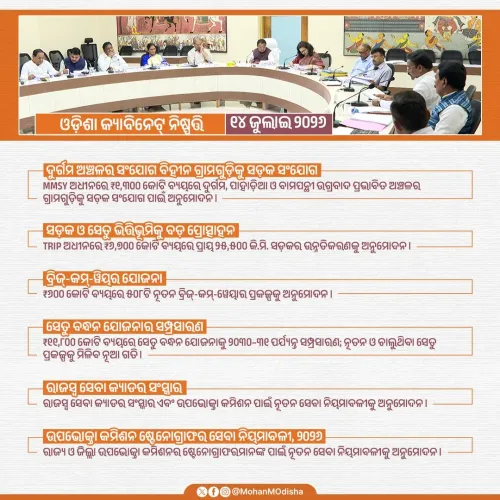
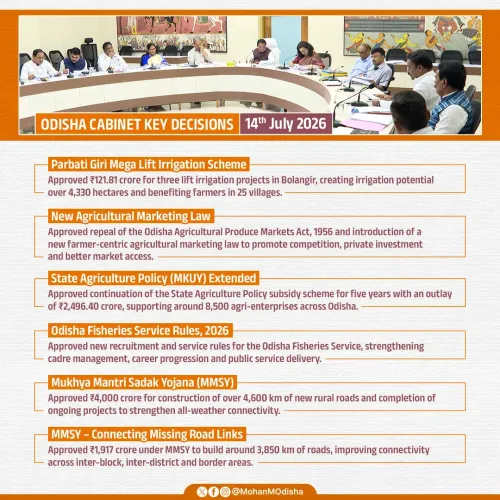
The Chief Minister's Office of Odisha announced on Wednesday, 15 July 2026 that the Odisha State Cabinet, under the leadership of Chief Minister Shri Mohan Charan Majhi, has approved a set of decisions aimed at strengthening irrigation, agriculture, rural connectivity, and public service delivery across the state.
Context
The cabinet communiqué, shared via the official CMO handle, described the approvals as 'transformative decisions' in pursuit of a Samruddha Odisha — a prosperous Odisha. The announcement underscores the BJP-led government's stated agenda of inclusive development since it came to power in June 2024, when Mohan Charan Majhi became the state's first BJP Chief Minister.
While the CMO's post did not itemise the specific projects or financial outlays cleared, it identified four broad pillars: irrigation infrastructure, agricultural support, rural road connectivity, and improvements in public service delivery.
Policy Backdrop
Odisha has a long track record of prioritising irrigation expansion and rural road networks under successive governments. The state's agricultural sector remains heavily rain-dependent, making canal and micro-irrigation projects a perennial policy priority for raising farm productivity and insulating cultivators from monsoon variability.
The previous government's KALIA scheme, launched in 2018, had set a benchmark for direct income support and crop insurance to farmers. The current administration has signalled its intent to build on and redirect such welfare frameworks under its own governance banner, encapsulated in the hashtag #LokankaSarkar — 'people's government.'
Indian state cabinets routinely clear bundles of irrigation, road, and e-governance projects aligned with five-year plan cycles and centrally sponsored scheme funding windows, and Odisha's July 2026 cabinet round appears to follow that pattern.
Stakeholders and Impact
The decisions are expected to bear most directly on farmers and rural households, who stand to benefit from expanded irrigation coverage and better-connected village roads. Improved irrigation access can lift cropping intensity and reduce dependence on erratic monsoon rainfall, while rural road projects typically open market access for agricultural produce.
Enhanced public service delivery mechanisms — the fourth pillar cited in the announcement — signal an administrative modernisation push, potentially touching e-governance portals, citizen grievance systems, or last-mile service access in tribal and remote districts where Odisha has historically faced delivery gaps.
What's Next
Detailed government orders spelling out the specific projects sanctioned, their financial outlays, and tendering timelines are expected to be released through the relevant departments in the coming days as part of the 2026-27 budget cycle. Observers will watch whether the cabinet package includes allocations under centrally sponsored schemes such as PMGSY for rural roads or PMKSY for irrigation, which would require state co-funding commitments. The pace at which tenders are floated and funds disbursed will be a key indicator of the government's implementation capacity ahead of the next electoral cycle.
Point of View
Which is still consolidating its administrative identity after ending nearly 24 years of BJD rule. By bundling irrigation, agriculture, rural roads, and service delivery into a single announcement, the BJP administration is signalling continuity with Odisha's development priorities while stamping its own 'Samruddha Odisha' brand on them. The absence of specific project details in the public announcement is typical of cabinet readouts, but the true test will be the speed and scale of implementation visible on the ground. With the next state election cycle on the horizon, delivering tangible rural infrastructure gains will be central to the BJP's bid to consolidate its 2024 electoral breakthrough.
NationPress
16 Jul 2026
Frequently Asked Questions
What did the Odisha Cabinet decide on 15 July 2026?
The Odisha State Cabinet, chaired by Chief Minister Mohan Charan Majhi, approved a set of decisions covering irrigation infrastructure, agricultural support, rural road connectivity, and public service delivery improvements, according to the Chief Minister's Office.
Who is the Chief Minister of Odisha in 2026?
Mohan Charan Majhi is the Chief Minister of Odisha. He took office in June 2024 and is the state's first BJP Chief Minister after the party won the 2024 assembly elections.
What is Samruddha Odisha?
'Samruddha Odisha' translates to 'Prosperous Odisha' and is the overarching development vision articulated by the Majhi-led BJP government for the state, emphasising inclusive growth across agriculture, infrastructure, and governance.
How does the Odisha Cabinet approve projects?
The Odisha State Cabinet is the highest executive decision-making body in the state government. It meets periodically to approve major policy proposals, expenditure decisions, and project sanctions, after which detailed government orders are issued by the relevant departments.
What is the KALIA scheme in Odisha?
The KALIA (Krushak Assistance for Livelihood and Income Augmentation) scheme was launched in 2018 by the previous Odisha government to provide direct income support and insurance coverage to farmers and agricultural labourers across the state.