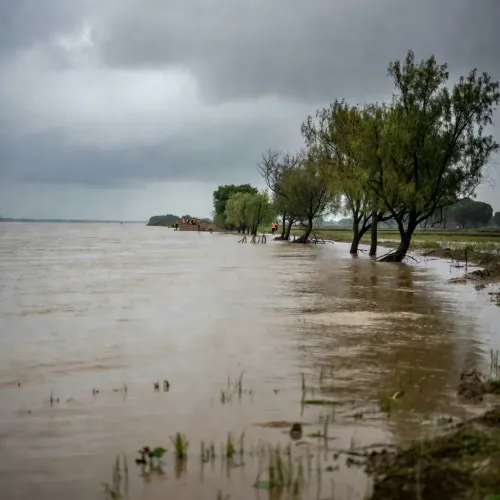
Odisha CM Majhi Aerial-Surveys 5 Flood-Hit Districts

Synopsis
Chief Minister Mohan Charan Majhi aerially surveyed 12-plus flood-hit blocks across Jajpur, Bhadrak, Balasore, Mayurbhanj and Keonjhar on 1 August 2026. Over 2.69 lakh people have been evacuated to 700 shelters, Rs 26 crore released from SDRF, and final damage reports ordered within three days of waters receding.
Key Takeaways
CM Mohan Charan Majhi conducted an aerial survey of 12-plus blocks across 5 districts on 1 August 2026 to assess flood damage firsthand.
2.69 lakh people have been evacuated to safety across the affected areas.
17 ODRAF teams, 7 NDRF teams , and 129 fire and emergency units are deployed for rescue operations.
700 relief shelters are providing food, drinking water, polythene sheets, and medical care.
Rs 26 crore has been released from the State Disaster Response Fund (SDRF) to accelerate relief.
Final damage reports are due within 3 days of floodwaters receding , triggering compensation for crop loss and damaged homes.
With floodwaters still spreading across five districts of Odisha, Chief Minister Mohan Charan Majhi took to the skies on Saturday, 1 August 2026, conducting an aerial survey of more than 12 affected blocks to assess the damage firsthand. The state government says timely pre-positioning of resources has kept casualties low — but the relief machine is running at full throttle.
Five Districts, Twelve Blocks, One Aerial Pass
CM Majhi was accompanied by Revenue and Disaster Management Minister Suresh Pujari and the Special Relief Commissioner (SRC) during the overflight. The districts surveyed were Jajpur (blocks: Dasarathpur, Bari, Binjharpur), Bhadrak (Dhamanagar, Bhandaripokhari, Chandbali), Balasore (Soro, Remuna, Balasore Sadar), Mayurbhanj (Badasahi, Udala, Kaptipada), and Keonjhar (Hatdihi). The administration is also keeping a close watch on Puri district.
These riverine corridors — drained by the Brahmani and Baitarani river systems — are perennially vulnerable during the monsoon. The aerial inspection is a standard but critical step: it allows the CM to override bureaucratic filters and see ground reality directly, a practice Odisha institutionalised after the devastating 1999 super cyclone.
2.69 Lakh Evacuated, 700 Shelters Running
The scale of the evacuation is striking. 2.69 lakh people have been moved to safety — a number that signals both the severity of the inundation and the state's capacity to mobilise fast. Rescue operations are being handled by 17 ODRAF teams, 7 NDRF teams, and 129 fire and emergency services units.
Across 700 relief shelters, the state is providing cooked and dry food, drinking water, polythene sheets, and medical care. The Odisha Disaster Rapid Action Force (ODRAF) — a state-level unit built specifically for such events — works alongside the central National Disaster Response Force (NDRF), a pairing that has become the backbone of Odisha's flood response doctrine.
Rs 26 Crore Released, Damage Reports Due in 3 Days
To accelerate relief, the state has sanctioned Rs 26 crore from the State Disaster Response Fund (SDRF) — the statutory corpus under the Disaster Management Act, 2005 that states draw on for immediate calamity relief. This is the first financial trigger; a larger compensation package may follow.
District administrations have been directed to submit final damage assessments within three days of floodwaters receding. Those reports will unlock targeted assistance for crop loss and damaged homes. The Health Department has been put on alert for post-flood waterborne disease outbreaks, and road-repair teams are on standby for damaged infrastructure.
Round-the-Clock Administration Until Waters Recede
CM Majhi has assured flood-affected citizens that the administration will remain on round-the-clock duty until the situation is fully under control, with senior officials deployed directly at the field level. The state government, in its own words, stands 'firmly beside every flood-affected citizen.'
The next 72 hours — as waters drain and damage tallies come in — will determine whether Odisha seeks additional central assistance under national disaster norms. What is already clear is that the response machinery clicked into gear fast. Whether that speed translates into effective compensation for farmers and displaced families is the question the damage reports will answer.
Point of View
Which matters because Odisha's riverine districts flood almost every monsoon. The real test comes after the waters recede: whether compensation packages for farmers and displaced families are delivered quickly and fairly will shape how flood-affected communities judge this government. If damage reports trigger a request for central NDRF funds, that will also be a signal of how badly the state's own fiscal buffers have been stretched.
NationPress
1 Aug 2026
Frequently Asked Questions
Which districts did Odisha CM Majhi survey during the flood aerial inspection?
CM Majhi surveyed flood-affected areas in Jajpur, Bhadrak, Balasore, Mayurbhanj , and Keonjhar districts, covering more than 12 blocks in total. Puri district is also under close watch.
How many people have been evacuated due to Odisha floods in 2026?
2.69 lakh people have been evacuated to safety. They are being sheltered across 700 relief camps where food, drinking water, and medical care are being provided.
How much money has Odisha released for flood relief?
The Odisha government has sanctioned Rs 26 crore from the State Disaster Response Fund (SDRF) to accelerate rescue and relief operations.
How many NDRF and ODRAF teams are deployed in Odisha floods?
7 NDRF teams, 17 ODRAF teams , and 129 fire and emergency services units are currently deployed for flood rescue and relief operations across affected districts.
When will flood-affected farmers and households in Odisha get compensation?
District administrations have been directed to submit final damage reports within 3 days of floodwaters receding . Compensation packages for crop loss and damaged homes will be released based on those reports.