Odisha CMO Flags All-Out Push for Post-Flood Recovery

Synopsis
The Chief Minister's Office of Odisha declared on 5 November 2026 that the state government is taking all measures to restore normal life post-floods, prioritising roads, electricity, drinking water, hospitals, and schools for immediate repair.
Key Takeaways
The Chief Minister's Office of Odisha announced an all-out post-flood restoration drive on 5 November 2026 .
Five sectors have been given the highest priority : roads, electricity, drinking water supply, hospitals, and educational institutions.
The government's stated goal is to both normalise daily life and restore physical infrastructure simultaneously.
Odisha experiences recurrent flooding from the Mahanadi river system, making this a recurring but practised recovery operation.
The Odisha State Disaster Management Authority , established after the 1999 super cyclone , provides the institutional backbone for such responses.
Official progress reports on restoration timelines and potential central funding allocations are expected next.
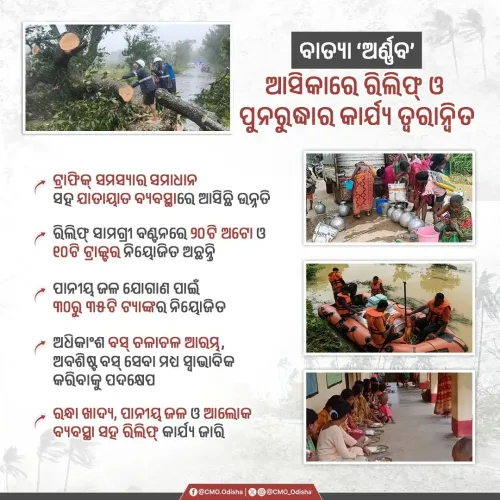
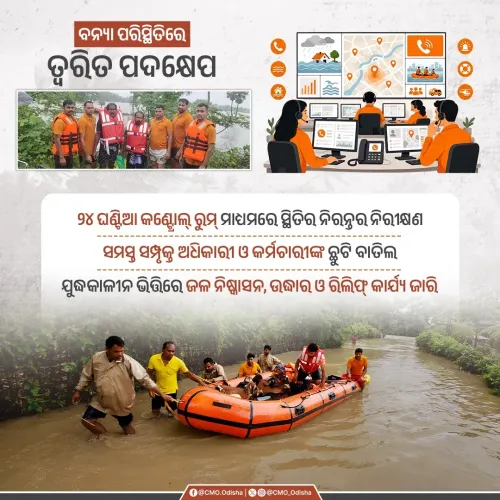
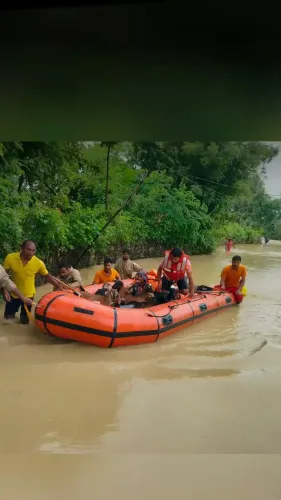
Roads, power, drinking water, hospitals, schools — Odisha's government is racing to put every broken piece back together after the latest wave of floods to sweep the state. The Chief Minister's Office of Odisha announced on Thursday, 5 November 2026 that comprehensive measures are under way to restore normal life and repair infrastructure damaged in the aftermath of the floods.
The post, shared in Odia, states: 'Banya parabartī sthitire janajeebankū swaabhāvika karibaa saha bhittibhoomira punarooddhāra pāin sarakāranka pakṣaru samasta prakāra padakṣepa niyāyāuṭhī.' — 'The government is taking all possible steps to normalise life in the post-flood situation and restore infrastructure.' Roads, electricity, drinking water supply, hospitals, and educational institutions have been given the highest priority for restoration.
Five fronts, one deadline: what 'highest priority' means on the ground
The CMO's framing is deliberate and specific: five sectors — roads, power, drinking water, hospitals, and schools — named in sequence. Each one is a lifeline. Cut roads and relief trucks can't move. Cut power and hospitals can't function. Cut water supply and disease surges behind the floodwaters. The government's decision to publicly enumerate the sectors signals both a programme of work and an accountability framework citizens and officials can measure against.
Odisha sits at the confluence of some of India's most flood-prone river systems. The Mahanadi and its tributaries drain a vast catchment that regularly swells during the monsoon, pushing water across low-lying districts and severing communities from services. The pattern is not new — but the state's institutional memory for managing it is deeper than most. The Odisha State Disaster Management Authority, forged in the crucible of the devastating 1999 super cyclone, has since built one of India's most practised disaster-response architectures.
The recovery arc Odisha has run before — and what it costs
Post-flood restoration in Odisha typically moves in phases: emergency relief first, then rapid infrastructure repair, then longer-term reconstruction funded through state budgets and central schemes. The government's signal here — that restoration is already under active execution — suggests the relief phase is giving way to the recovery phase. That transition is precisely when bureaucratic momentum matters most, and when official communication like this serves as a pressure mechanism on district administrations.
What to watch now: official timelines for each of the five priority sectors, district-wise damage assessments, and whether the state triggers additional central funding allocations under disaster relief norms. For the thousands of families whose children still cannot reach school and whose taps still run dry, the five priorities aren't a press release — they're a promise with a clock.
Point of View
' the CMO is doing more than issuing reassurance — it is setting a measurable accountability benchmark for district administrations at a moment when public patience is thin. Odisha's disaster-response machinery, hardened over decades of cyclone and flood cycles, is one of India's strongest, but institutional strength means little without political will to push the recovery phase with the same urgency as the relief phase. The post signals that transition is now. Whether that signal translates into verifiable timelines — roads reopened, schools functional, taps running — will determine how the state's governance record is read when the floodwaters are a memory.
NationPress
5 Nov 2026
Frequently Asked Questions
What steps is the Odisha government taking after the floods?
The Odisha government is taking all measures to restore normal life and repair infrastructure, with roads, electricity, drinking water supply, hospitals, and educational institutions identified as the highest priorities for restoration.
Which areas are most affected by floods in Odisha?
Odisha's flood-prone zones are largely concentrated along the Mahanadi river basin and its tributaries, which regularly overflow during the monsoon season and affect low-lying districts across the state.
What is the Odisha State Disaster Management Authority?
The Odisha State Disaster Management Authority was established in 1999 following the devastating super cyclone to coordinate flood and cyclone response and infrastructure recovery across the state.
How does Odisha typically handle post-flood infrastructure repair?
Post-flood restoration in Odisha typically follows a phased approach: emergency relief first, rapid infrastructure repair second, and longer-term reconstruction funded through state budgets and central disaster relief schemes.
What comes next after the CMO's post-flood restoration announcement?
The key developments to watch are official progress reports on restoration timelines for each of the five priority sectors, district-level damage assessments, and any additional central funding allocations for affected areas.