Odisha CM's Office Lists 12 Key Governance Wins in Two Years
Synopsis
The Chief Minister's Office of Odisha released a twelve-point governance scorecard on 12 June 2026, covering a new semiconductor and AI policy, Rs 1,616 crore in tribal student welfare, a 15-lakh-hectare irrigation target, 2028 indoor athletics hosting rights, and rural electrification for nearly 40,000 households.
Key Takeaways
Odisha has prepared a dedicated policy for semiconductors, electronics, and Artificial Intelligence .
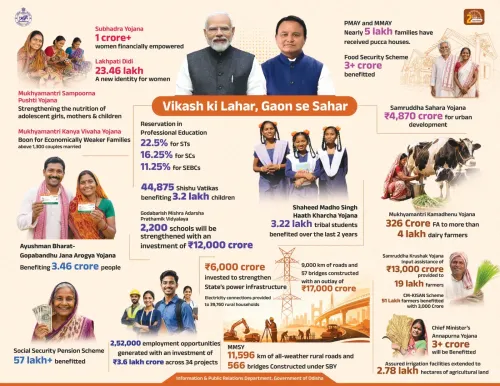
The Sahid Madho Singh Haat Kharch Yojana has disbursed over Rs 1,616 crore to more than 3.22 lakh Scheduled Tribe students in two years.
The state targets bringing 15 lakh hectares under irrigation in the next four years.
Odisha will host the World Indoor Athletics Championships 2028 and the Asian Indoor Athletics Championships 2028 .
4,479 PVTG Janman families have been electrified; total rural electrification covers 39,760 households .
208 tourism infrastructure projects worth approximately Rs 678 crore 48 lakh have been approved across the state.
The Chief Minister's Office of Odisha on Friday, 12 June 2026 published a wide-ranging governance scorecard on X, listing twelve distinct achievements spanning technology policy, tribal welfare, irrigation, drinking water, sports infrastructure, and disaster management — accompanied by a statement from the Chief Minister invoking the blessings of Lord Jagannath for Odisha's prosperity vision by 2036.
Context
The post, written in Odia, enumerates milestones across multiple sectors, offering a consolidated public account of the state government's work. The Chief Minister is quoted as saying: 'Mahaprabhu Shri Jagannathanka Odisha prati ashirbad rahichhi' — 'Lord Jagannath's blessings are with Odisha. His blessings will make us successful in every mission and help achieve the goal of a prosperous Odisha by 2036.' The statement frames the scorecard within a longer developmental arc tied to a 2036 vision for the state.
The announcement comes as the BJP-led government in Odisha, which came to power in 2024, approaches the completion of its second year in office. The twelve-point list spans sectors that have historically defined Odisha's development challenges — tribal exclusion, agrarian water stress, and industrial underdevelopment.
Policy Backdrop
Among the headline announcements is the preparation of a dedicated policy for semiconductors, electronics, and Artificial Intelligence — a significant step for a state that has traditionally focused on steel, aluminium, and IT clusters. Odisha's earlier industrial policies built electronics and IT parks in Bhubaneswar, and the new framework signals an intent to move up the technology value chain.
On irrigation, the government has set a target of bringing 15 lakh hectares of farmland under irrigation over the next four years. This builds on multiple irrigation missions from the 2010s that sought to reduce Odisha's dependence on monsoon rainfall. The state also reports that more than 3 lakh 52 thousand families have received tap water connections, with over 15,200 homes receiving piped water supply in the past two years.
The Sahid Madho Singh Haat Kharch Yojana, a welfare scheme providing pocket-money support to Scheduled Tribe students, has disbursed more than Rs 1,616 crore over two years, benefiting over 3 lakh 22 thousand ST students. Separately, an 11.25 per cent reservation has been introduced for Socially and Educationally Backward Classes (SEBC) students. Both measures continue a long-standing pattern of expanding social protection for marginalised communities in the state.
Stakeholders and Impact
The post highlights that 4,479 Particularly Vulnerable Tribal Group (PVTG) Janman families have been electrified, while a total of 39,760 rural households have received electricity connections. PVTGs are among India's most isolated communities, and their electrification has been a central plank of both state and central government tribal welfare programmes.
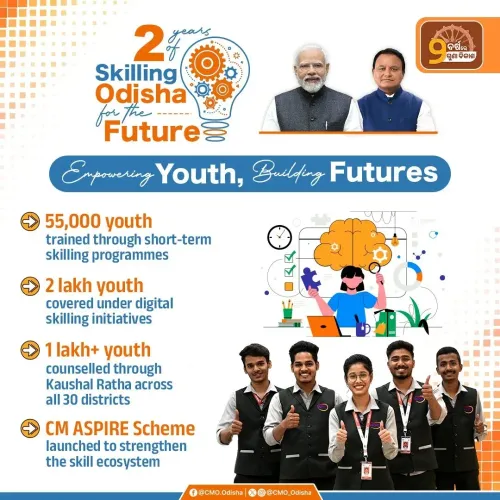
On skill development, the government has approved two new campuses of the World Skill Center — in Sambalpur and Brahmapur — to expand vocational training capacity beyond the state capital. Tourism infrastructure has also received a significant push, with 208 tourism projects approved across the state at an investment of approximately Rs 678 crore 48 lakh. The Jagannath Temple in Puri was allocated Rs 500 crore in the government's first cabinet meeting, signalling early political and cultural priorities.
On grievance redressal, the government claims that 95 per cent of complaints received through its public hearing programme have been resolved. Odisha has also been recognised at a BRICS nations meeting for its disaster management capabilities — a nod to the state's established reputation for cyclone preparedness, built over more than two decades.
What's Next
Odisha has been assigned hosting rights for the World Indoor Athletics Championships 2028 and the Asian Indoor Athletics Championships 2028, continuing the state's strategy of securing major international sporting events — a path it charted with the 2023 Men's Hockey World Cup. Venue development and preparatory infrastructure will be closely watched over the next two years.
The rollout of the semiconductor-electronics-AI policy, the pace of irrigation expansion to reach the 15-lakh-hectare target, and the operationalisation of the two new World Skill Center campuses will serve as key indicators of whether the governance scorecard translates into measurable ground-level change. With the 2036 prosperity vision now publicly anchored, each of these programmes carries both developmental and political weight for the administration.
Point of View
Designed to consolidate the BJP government's narrative ahead of the second anniversary of its 2024 electoral win in Odisha. By bundling tribal welfare data, international recognition from BRICS, and a forward-looking technology policy into a single post, the CMO is signalling both administrative depth and ideological breadth — reaching simultaneously to ST/SEBC communities, industry, and sports fans. The 2036 prosperity vision, invoked through a religious idiom tied to Lord Jagannath, gives the government a long-horizon benchmark that is politically difficult to contest. The real test will be whether the semiconductor policy attracts investment and whether the irrigation target survives the implementation bottlenecks that have historically slowed similar Odisha programmes.
NationPress
26 Oct 2026
Frequently Asked Questions
What is the Sahid Madho Singh Haat Kharch Yojana in Odisha?
The Sahid Madho Singh Haat Kharch Yojana is an Odisha state welfare scheme that provides financial pocket-money support to Scheduled Tribe students. The government has stated that over Rs 1,616 crore was disbursed under this scheme in two years, benefiting more than 3.22 lakh ST students.
Why was Odisha praised at the BRICS meeting?
Odisha was praised at a BRICS nations meeting for its notable capabilities in disaster management. The state has built a strong reputation for cyclone preparedness and emergency response over more than two decades.
Will Odisha host the 2028 World Indoor Athletics Championships?
Yes, Odisha has been assigned hosting rights for both the World Indoor Athletics Championships 2028 and the Asian Indoor Athletics Championships 2028, continuing the state's track record of securing major international sporting events.
What is Odisha's new technology policy about?
Odisha has prepared a dedicated policy for semiconductors, electronics, and Artificial Intelligence. This represents a shift from the state's earlier focus on steel, aluminium, and conventional IT, moving towards high-value technology industries.
What is Odisha's 2036 vision?
Odisha's 2036 vision is a long-term development goal articulated by the Chief Minister, aimed at making Odisha a prosperous state by the year 2036. The Chief Minister has publicly linked this vision to the blessings of Lord Jagannath and framed it as the overarching goal of the current government's programmes.