Odisha CMO: Paddy Farmers Get ₹3,100/Quintal Under Samruddha Krushak Yojana
Synopsis
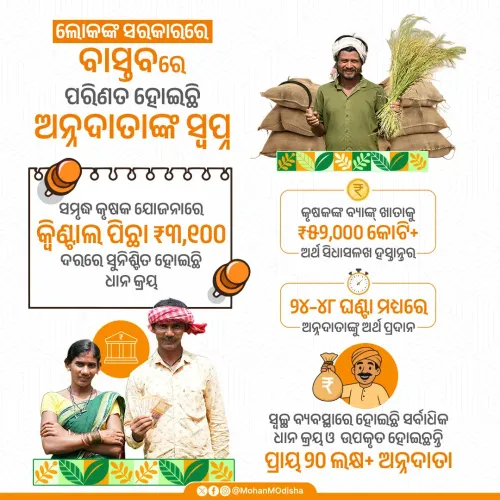
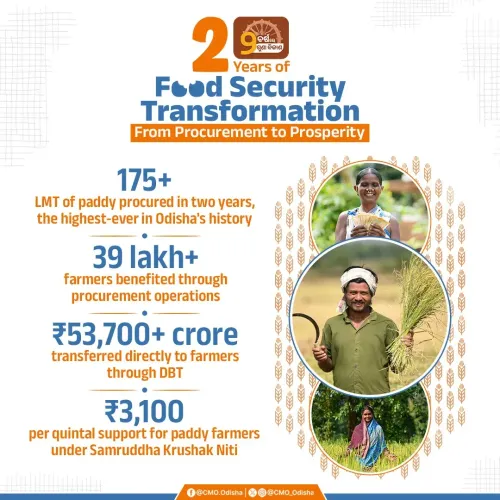
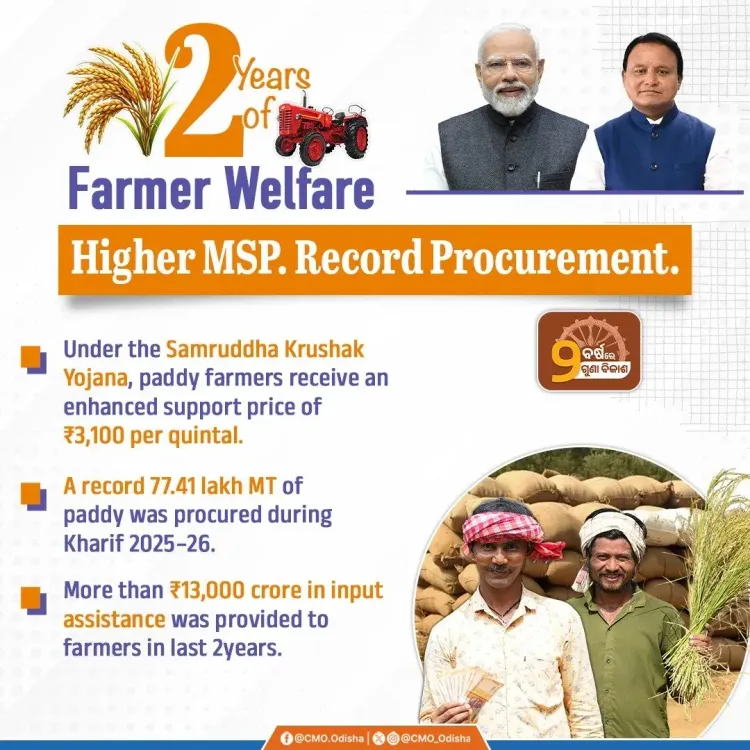
The Chief Minister's Office of Odisha has announced that paddy farmers are receiving ₹3,100 per quintal under the Samruddha Krushak Yojana, with record procurement and over ₹13,000 crore in input assistance marking two years of the current government's farm welfare push.
Key Takeaways
The Chief Minister's Office of Odisha announced the milestone on 10 July 2026 , marking two years of the current state government.
Paddy farmers in Odisha are receiving ₹3,100 per quintal under the state's Samruddha Krushak Yojana , a rate above the central MSP framework.
The government claims over ₹13,000 crore in input assistance has been provided to agricultural households across the state.
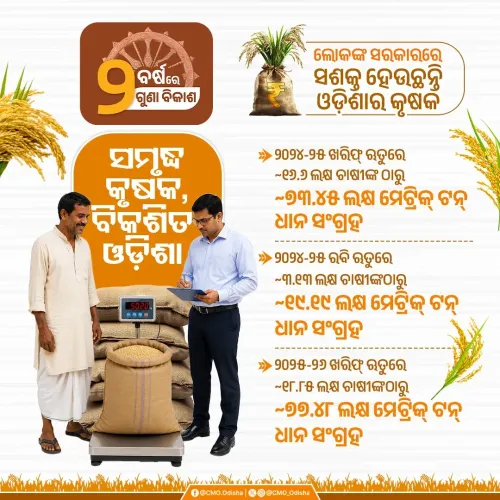
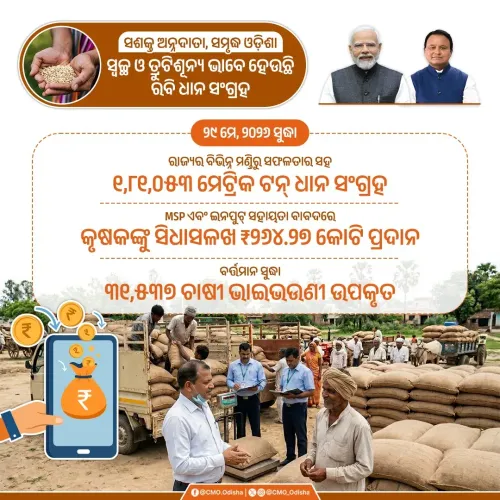
Record paddy procurement has been cited as a key achievement, reducing farmer dependence on private traders who often pay below MSP.
The Samruddha Krushak Yojana follows the earlier KALIA scheme (2018) as part of Odisha's evolving direct-benefit approach to farm welfare.
Kharif 2026 procurement targets and the next state budget will be critical tests of the programme's sustainability.
The Chief Minister's Office of Odisha on Friday, 10 July 2026, announced that the state government has significantly strengthened farmer welfare over the past two years, citing record paddy procurement, enhanced price support of ₹3,100 per quintal under the Samruddha Krushak Yojana, and over ₹13,000 crore in input assistance disbursed to agricultural households across the state.
Context
The announcement, shared on the official CMO Odisha social media handle, marks the two-year milestone of the current state government, referenced in the post under the hashtags #2YearsofLokankaSarakar and #2YearsofKrushakSamruddhi — broadly translating to 'two years of the people's government' and 'two years of farmer prosperity.' The post states that paddy farmers are receiving ₹3,100 per quintal under the Samruddha Krushak Yojana, a state-level scheme designed to provide price support and input assistance beyond the central government's Minimum Support Price framework.
Odisha is one of eastern India's largest paddy-producing states, and agricultural procurement policy has historically been a central pillar of governance for successive administrations. The CMO's statement positions the current dispensation's farm outreach as both a continuation and an expansion of that tradition.
Policy Backdrop
State-level supplementation of central MSP norms has a long history in Odisha. The previous state government had launched the KALIA scheme in 2018 to deliver direct income support and insurance to farmers — a programme that drew national attention as a model for targeted agricultural welfare. The current government's Samruddha Krushak Yojana represents the successor policy architecture, shifting emphasis toward procurement-linked price guarantees and input cost support.
Across rice-producing states in eastern and southern India, post-election agricultural packages have become a recurring pattern, with state governments using enhanced procurement and direct benefit transfers to address farmer income volatility. Odisha's approach — combining a higher per-quintal rate with a large input assistance corpus — mirrors strategies adopted by comparable states in recent years.
Stakeholders and Impact
The primary beneficiaries of these measures are paddy farmers and agricultural households across Odisha, a demographic that constitutes a substantial share of the state's rural economy. The ₹13,000 crore in input assistance cited by the CMO's office, if fully disbursed, would represent one of the larger state-funded agricultural support outlays in the region in recent years.
For smallholder and marginal farmers — who are most exposed to price volatility during harvest seasons — the guaranteed rate of ₹3,100 per quintal under Samruddha Krushak Yojana provides a price floor that can meaningfully reduce income uncertainty. Record procurement volumes, as claimed by the government, also suggest higher offtake from state agencies, reducing dependence on private traders who often transact below MSP.
What's Next
Attention will now turn to the Kharif 2026 procurement season, where actual offtake figures and disbursement timelines will test the government's stated commitments. Any revision to the input assistance quantum in the forthcoming state budget will be a closely watched indicator of the programme's fiscal trajectory.
The government's ability to sustain the ₹3,100 per quintal support rate through the next procurement cycle — and to expand coverage to a larger share of Odisha's farming population — will determine whether the two-year milestone translates into durable structural gains for the state's agricultural sector.
Point of View
100 rate holds through Kharif 2026 and whether ₹13,000 crore in input support reaches the most marginal farmers will define the programme's legacy beyond the headline numbers. The hashtag strategy, invoking both governance and farmer prosperity milestones simultaneously, signals that farm welfare will remain central to the government's political messaging heading into the next electoral cycle.
NationPress
10 Jul 2026
Frequently Asked Questions
What is the Samruddha Krushak Yojana in Odisha?
The Samruddha Krushak Yojana is an Odisha state government scheme that provides paddy farmers with price support and input assistance beyond the central government's Minimum Support Price, with the current rate set at ₹3,100 per quintal.
How much input assistance has Odisha given to farmers in two years?
According to the Chief Minister's Office of Odisha, the state government has provided over ₹13,000 crore in input assistance to agricultural households over the past two years.
What is the paddy price farmers get in Odisha in 2026?
Paddy farmers in Odisha are receiving ₹3,100 per quintal under the Samruddha Krushak Yojana, as announced by the CMO Odisha on 10 July 2026.
How is Samruddha Krushak Yojana different from the KALIA scheme?
The KALIA scheme, launched in 2018 by the previous Odisha government, focused on direct income support and insurance for farmers, while the Samruddha Krushak Yojana centres on procurement-linked price guarantees and input cost assistance.
What is the significance of record paddy procurement in Odisha?
Record paddy procurement by state agencies means more farmers can sell at the guaranteed rate of ₹3,100 per quintal, reducing their dependence on private traders who often pay below the Minimum Support Price.