Odisha signs tripartite MoU to launch Project BLESS, covering 8.81 lakh families
Synopsis
Odisha has signed a three-way agreement to launch Project BLESS — a structured, mobile-app-driven intervention to stop distress migration before it starts. Covering 8.81 lakh families across 8 chronically migration-prone districts, it is one of the most comprehensive state-level responses yet to a problem that has long sent Odisha's rural poor to brick kilns and construction sites across India.
Key Takeaways
Mission Shakti Department signed a tripartite MoU with CRISP and NSE Foundation on 6 August to launch Project BLESS .
The three-year project covers 69 blocks across 8 districts : Balangir, Bargarh, Kalahandi, Gajapati, Kandhamal, Koraput, Nabarangpur and Rayagada.
Approximately 8.81 lakh rural families and 86,468 SHGs are targeted for coverage.
550 Jeevika Sakhis from SHGs will support grassroots implementation.
A mobile app-based vulnerability assessment will identify at-risk households before migration occurs.
Support will extend to children of migrant families, covering nutrition, healthcare and pre-primary education .
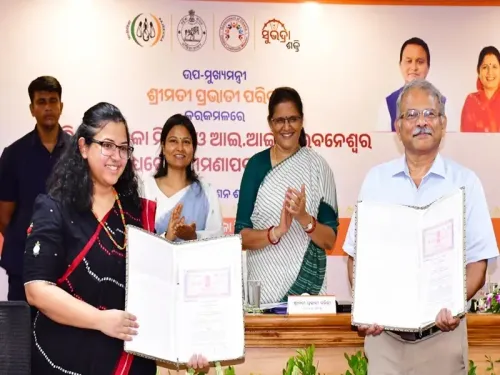
The Odisha Mission Shakti Department on Thursday, 6 August signed a tripartite Memorandum of Understanding (MoU) with the Centre for Research in Schemes and Policies (CRISP) and the NSE Foundation to launch Project BLESS, a three-year initiative designed to prevent distress migration by building sustainable livelihood options, skill development and entrepreneurship among vulnerable rural households across the state.
Where and How the MoU Was Signed
The agreement was executed at Lok Seva Bhawan in Bhubaneswar in the presence of Chief Secretary Anu Garg and Mission Shakti Secretary Manasi Nimbhal. The project will be implemented in close collaboration with the Odisha Livelihoods Mission (OLM), which already operates an extensive grassroots network across the state.
Scope and Coverage
Project BLESS will span 69 blocks across eight districts — Balangir, Bargarh, Kalahandi, Gajapati, Kandhamal, Koraput, Nabarangpur and Rayagada. The programme is expected to benefit approximately 8.81 lakh rural families and 86,468 Self-Help Groups (SHGs). Around 550 Jeevika Sakhis, drawn directly from SHGs, will anchor implementation at the grassroots level.
Execution will flow through SHGs, Cluster Level Federations (CLFs) and Gram Panchayat Level Federations (GPLFs) — a layered community structure that the state has built over years of SHG mobilisation.
What the Project Will Do
A mobile application-based vulnerability assessment will be conducted at the household level to identify families at risk of migration before they leave their villages. Based on each family's assessed needs, the project will connect them with livelihood opportunities, market-driven skill training, credit facilities and relevant government welfare schemes.
The department noted that the initiative aims to 'address the root causes of distress migration by creating long-term livelihood opportunities in rural areas.' Where migration is unavoidable, the project will extend support covering fair wages, legal assistance and social security benefits at destination locations.
Support for Migrant Families and Women
The programme includes a dedicated component to ensure continuity of nutrition, healthcare and pre-primary education services for children of migrant families — a dimension often overlooked in migration-focused interventions. It will also work to strengthen SHGs and their federations as a vehicle for women's economic empowerment.
This comes amid longstanding concern over seasonal and distress migration from Odisha's western and southern districts, where agrarian stress and limited non-farm employment have historically pushed workers to construction sites and brick kilns in other states. Project BLESS represents one of the more structured state-level responses to that cycle, with a three-year horizon and a multi-partner architecture. How effectively the vulnerability assessment tool identifies at-risk households — and how quickly families can be linked to viable income sources — will determine whether the initiative moves beyond intent.
Point of View
Reaching workers after they have already left. Project BLESS attempts a structural shift: identify vulnerable households before departure, not after. The mobile-app vulnerability assessment is the critical pivot; if the data is accurate and the follow-through on skill linkages is real, this could be a replicable model. But the eight target districts also happen to be among the state's most administratively challenging, and 550 Jeevika Sakhis for 8.81 lakh families is a thin frontline. The three-year timeline will test whether a tripartite MoU translates into measurable reduction in distress outflows — or remains a well-designed document.
NationPress
7 Aug 2026
Frequently Asked Questions
What is Project BLESS in Odisha?
Project BLESS is a three-year initiative launched by Odisha's Mission Shakti Department in partnership with CRISP and the NSE Foundation to prevent distress migration. It aims to identify at-risk rural families before they migrate and connect them with livelihoods, skill training, credit and government welfare schemes across 8 districts.
Which districts are covered under Project BLESS?
The project covers 69 blocks across eight districts: Balangir, Bargarh, Kalahandi, Gajapati, Kandhamal, Koraput, Nabarangpur and Rayagada — all areas with historically high rates of distress migration.
How many families and SHGs will Project BLESS benefit?
The project is designed to benefit approximately 8.81 lakh rural families and 86,468 Self-Help Groups. Around 550 Jeevika Sakhis selected from SHGs will support grassroots-level implementation.
What happens if migration cannot be prevented under Project BLESS?
Where migration is unavoidable, the project will support workers with access to fair wages, legal assistance and social security benefits at their destination locations, ensuring they are not left without recourse.
Who signed the MoU for Project BLESS and where?
The tripartite MoU was signed at Lok Seva Bhawan in Bhubaneswar on 6 August, in the presence of Chief Secretary Anu Garg and Mission Shakti Secretary Manasi Nimbhal, with CRISP and the NSE Foundation as co-signatories.