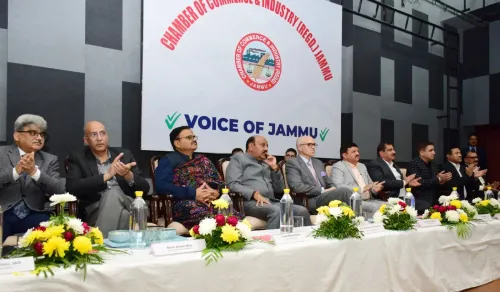
Omar Abdullah Launches New Sher-e-Kashmir Cricket Jersey and Wildlife Publication

Synopsis
Jammu and Kashmir's Chief Minister, Omar Abdullah, has unveiled the Sher-e-Kashmir Cricket Club jersey while also launching a wildlife publication that highlights the region's biodiversity and conservation efforts.
Key Takeaways
Omar Abdullah unveiled the Sher-e-Kashmir Cricket Club jersey.
The event emphasized the government's support for sports and youth engagement.
A wildlife publication was launched, documenting the region's mammalian species.
The Kashmir Hangul is a key species highlighted in the publication.
Conservation efforts are critical for preserving local biodiversity.
Jammu, April 17 (NationPress) The Chief Minister of Jammu and Kashmir, Omar Abdullah, on Friday introduced the new jersey for the Sher-e-Kashmir Cricket Club and launched a wildlife publication.
This unveiling took place during a ceremony here, attended by Satish Sharma, the Minister for Youth Services and Sports, Nasir Aslam Wani, an Advisor to the Chief Minister, along with club members.
The Chief Minister praised the club's efforts in advancing cricket within the region and reaffirmed the government's dedication to providing extensive support for sports initiatives that foster young talent throughout Jammu and Kashmir.
During the event, Aman Cheema, the President of the SCC, shared the club’s accomplishments, emphasizing its participation in numerous tournaments and victories. He remarked on the club's positive influence in diverting youth from negative behaviors, such as drug abuse, by promoting sports as a productive outlet.
Additionally, the Chief Minister unveiled a wildlife magazine titled Checklist of Mammals of Jammu and Kashmir, India. A group of wildlife ecologists led by Muzaffar Kichloo provided insights on their current and future projects.
He acknowledged their vital work and stressed the significance of scientific research and conservation for safeguarding the diverse ecosystem of the region.
The April 2026 Checklist of Mammals of Jammu and Kashmir, India, released by Chief Minister Omar Abdullah, serves as a thorough directory documenting 111 mammalian species across 28 families.
This publication underscores 13 species that are globally threatened and 10 that are Near Threatened, based on verified records from various habitats in Jammu, Kashmir, and Ladakh.
Notably, some wildlife, such as the Kashmir Hangul, a unique subspecies of red deer, is endemic to Kashmir. Its habitat is primarily within the Dachigam National Park, located on the outskirts of Srinagar.
The Hangul can also be found in the Tral Wildlife Sanctuary, where it receives protection; however, it is at greater risk elsewhere.
In the 1940s, the Hangul population ranged from 3,000 to 5,000. Unfortunately, due to habitat destruction, overgrazing by livestock, and poaching, their numbers have significantly declined. As of 2025, the population has slightly increased to 323 from 197 in 2004.
This majestic animal is recognized as the state animal of Jammu and Kashmir and is the last surviving Asiatic subspecies of the red deer family.
Point of View
The unveiling of the Sher-e-Kashmir Cricket Club's jersey and the wildlife publication underscores the commitment of local leadership towards sports and environmental conservation. These initiatives reflect a broader aim to engage youth positively and preserve the region's unique biodiversity, which is essential for sustainable development.
NationPress
22 Sept 2026
Frequently Asked Questions
What was unveiled by Omar Abdullah?
Omar Abdullah unveiled the Sher-e-Kashmir Cricket Club jersey and a wildlife publication.
Who attended the unveiling event?
The event was attended by Minister Satish Sharma, Advisor Nasir Aslam Wani, and club members.
What does the wildlife publication document?
The publication documents 111 mammalian species across 28 families in Jammu and Kashmir.
What is the significance of the Kashmir Hangul?
The Kashmir Hangul is the state animal of Jammu and Kashmir and is a unique subspecies of red deer, found only in this region.
How has the population of the Hangul changed over the years?
The Hangul population has experienced a decline, now numbering 323 as of 2025, up from 197 in 2004.