ONGC targets 7-8% gas output growth as new wells come online in FY27
Synopsis
ONGC's chairman says gas output could grow 7-8% annually as new wells ramp up — with 'new well gas' already at a quarter of total production and heading toward 36%. Backed by ₹33,000 crore in offshore investment and a BP tie-up, India's largest upstream producer is betting on gas to offset flat oil output and ageing fields.
Key Takeaways
ONGC projects 7 to 8 per cent annual natural gas production growth as new wells come on stream in the next financial year. 'New well gas' currently accounts for about a quarter of total output and could reach 30 to 36 per cent in the near term.
The company drills around 500 wells annually and reported a reserve replacement ratio of over 1.1 in FY25-26 .
Offshore projects worth ₹33,000 crore are underway; Western Offshore assets are being upgraded via a TSP with BP .
Mozambique LNG is targeting completion by 2028 ; ONGC Green is targeting nearly 3 gigawatts of renewable capacity next year.
Government policy support — reduced royalties, market-linked pricing, and deepwater funding — has improved upstream sector economics, Singh said.
Oil and Natural Gas Corporation (ONGC) is projecting annual natural gas production growth of 7 to 8 per cent as new wells are scheduled to come on stream during the next financial year, Chairman Arun Kumar Singh said on 21 June. The state-owned energy major is betting on a sharp ramp-up in output from newer fields to offset the natural decline of its ageing producing assets.
New Wells Driving the Growth Story
Singh noted that production from 'new well gas' is already rising sharply, currently accounting for roughly a quarter of total gas output. He said this share could climb to 30 to 36 per cent in the near term and is expected to eventually dominate ONGC's gas portfolio as mature fields continue their natural decline.
ONGC continues to drill approximately 500 wells annually, spanning both exploratory and producing categories. The corporation reported a reserve replacement ratio of over 1.1 in FY25-26, signalling that new reserves added exceeded volumes extracted — a positive indicator for long-term supply security.
Offshore Investment and BP Partnership
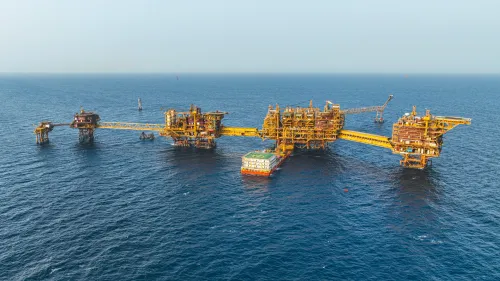
The company is currently executing offshore projects with a combined investment of around ₹33,000 crore, aimed at sustaining and increasing production. A significant focus is on improved recovery from mature fields, particularly Western Offshore assets, which account for the bulk of current output.
Western Offshore operations are undergoing a major Technical Service Partnership (TSP) programme with global oil major BP, and Singh said early operational gains from the collaboration are already visible. This comes amid broader industry efforts to apply advanced reservoir management techniques to ageing Indian offshore blocks.
Policy Tailwinds Boosting Sector Economics
Singh highlighted that government policy support has meaningfully improved the economics of upstream oil and gas. Measures including reduced royalties, continued market-linked pricing reforms, and a push to fund deepwater exploration have left more revenue with producers, he said. While oil production is likely to remain flat, the rising gas trajectory is expected to compensate.
Global Portfolio and Diversification
On ONGC's overseas assets, Singh said production from Russia's Sakhalin field remains stable. The Mozambique LNG project is advancing and could potentially reach completion by 2028, while output from Venezuela could increase if regulatory conditions improve.
Domestically, ONGC is also eyeing a turnaround at its petrochemicals arm OPaL, and expects growth from its renewable energy subsidiary ONGC Green, which is targeting nearly 3 gigawatts of capacity in the next year — a signal that the state giant is hedging its long-term energy mix even as it doubles down on gas.
What This Means for India's Energy Mix
India has been pushing to raise natural gas's share in its primary energy mix from around 6 per cent to 15 per cent by 2030. A sustained 7-8 per cent annual growth rate from ONGC — the country's largest upstream producer — would be a meaningful contribution toward that target. The next financial year will be a key test of whether the new-well pipeline can deliver at the pace the chairman has projected.
Point of View
But reserve additions and actual production ramp-ups are different curves. The BP partnership on Western Offshore is the most consequential near-term variable: if TSP yields the efficiency gains promised, it could stabilise the mature-field decline that has long pressured ONGC's numbers. The deeper question is whether the 7-8 per cent growth target accounts for execution risk in deepwater, where India's track record is mixed. With India's gas-share-in-energy-mix target of 15 per cent by 2030 still a distant goal at around 6 per cent today, ONGC's delivery in FY27 will be a litmus test for the entire upstream sector's credibility.
NationPress
21 Jun 2026
Frequently Asked Questions
What is ONGC's natural gas production growth target?
ONGC is targeting annual natural gas production growth of 7 to 8 per cent, driven by new wells scheduled to come on stream during the next financial year. Chairman Arun Kumar Singh said 'new well gas' production is already rising sharply and could account for 30 to 36 per cent of total output in the near term.
What is ONGC's reserve replacement ratio and why does it matter?
ONGC reported a reserve replacement ratio of over 1.1 in FY25-26, meaning it added more reserves than it extracted during the year. A ratio above 1.0 is considered healthy and signals long-term production sustainability for an upstream oil and gas company.
What is the BP Technical Service Partnership with ONGC?
ONGC has entered a Technical Service Partnership (TSP) with global oil major BP to improve recovery from its Western Offshore assets, which currently account for the bulk of production. Singh said early operational gains from the partnership are already visible.
When could ONGC's Mozambique LNG project be completed?
The Mozambique LNG project is advancing and is targeting potential completion by 2028, according to ONGC Chairman Arun Kumar Singh. Output from Venezuela could also rise if regulatory conditions in that country improve.
What is ONGC Green and what capacity is it targeting?
ONGC Green is ONGC's renewable energy subsidiary, targeting nearly 3 gigawatts of capacity in the next year. It represents the state-owned energy giant's push to diversify beyond fossil fuels as India accelerates its energy transition.