Why do open defecation, child marriage and child pregnancy continue in North K’taka?
Click to start listening
Synopsis
In a pressing address, Karnataka CM Siddaramaiah highlights the ongoing issues of open defecation, child marriage, and child pregnancies in North Karnataka, emphasizing the need for more effective solutions despite existing government schemes.
Key Takeaways
- Open defecation remains a critical issue despite government efforts.
- Child marriage and pregnancies are ongoing challenges in the region.
- Government initiatives need to be more effective to address these social issues.
- Economic empowerment is crucial in a caste-based society.
- Per capita income disparities exist across different districts in Karnataka.
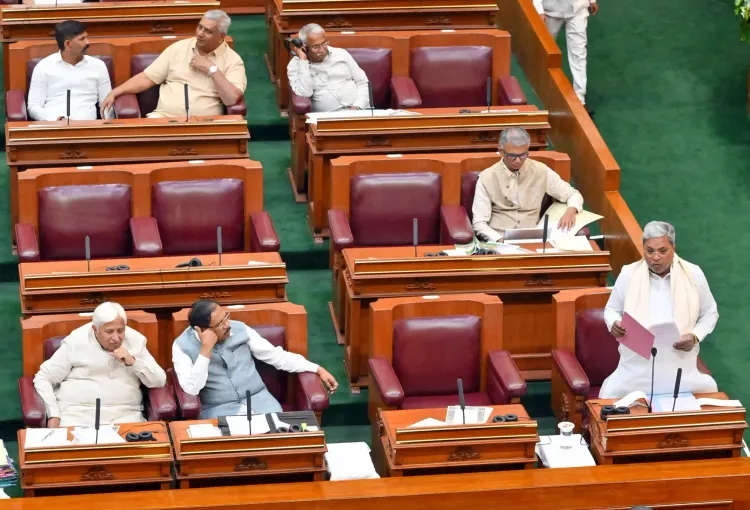
Belagavi, Dec 19 (NationPress) The Chief Minister of Karnataka, Siddaramaiah, expressed on Friday that open defecation, child marriage, and teen pregnancies continue to prevail in the northern regions of Karnataka despite various initiatives and reforms.
“The legislator representing our Jewargi constituency is advocating for the construction of boundary walls to deter women from resorting to open defecation. I inquired if toilets were already available. He responded that the community fails to utilize them. What can we say to this?” Siddaramaiah disclosed in the Assembly while addressing concerns raised by leaders from both ruling and opposition parties regarding North Karnataka.
The Chief Minister noted that the government has allocated funding for toilet construction, highlighting that through the Jal Jeevan Mission, taps have been installed to ensure water supply.
“However, people still refrain from utilizing the toilets. How do we tackle this issue? These are complex challenges that require effective solutions,” he stated.
Siddaramaiah mentioned that there are laws against child marriage, with stringent penalties in place, yet such marriages are conducted by circumventing the entire administrative framework.
“Consequently, there is a rise in child pregnancies. Infants born to young mothers suffer from severe malnutrition-related issues. Despite public awareness, these practices persist. This is why I consistently bring this issue up in meetings with deputy commissioners and chief executive officers, emphasizing the need for strict prevention measures,” he explained.
The Chief Minister remarked that in a rigid caste-based society, both economic and social empowerment are crucial to eliminate stagnation.
He pointed out that literacy rates were as low as 10-12% before Independence, now reaching 76%, yet the caste system remains entrenched.
“Even medical professionals hold beliefs in fate and karma. A mindset of servitude rooted in the caste system has pervaded society. The implementation of guarantee schemes is aimed at addressing this,” he remarked.
Additionally, he observed that inadequate milk production in the six districts of Kalyana Karnataka contributes to lower per capita income in the area.
“Kalaburagi is recognized as the most backward district concerning per capita income. Despite financial allocations, why hasn’t development occurred?” he queried.
He asserted that the previous UPA government aimed to effectively execute the Nirmal Bharat Abhiyan.
“In the 2013-14 budget, Rs 4,260 crore was designated for the initiative. By 2013, toilets were completed in approximately 38 to 40% of rural households. Prime Minister Modi subsequently rebranded the Nirmal Bharat Abhiyan as the Swachh Bharat Mission,” he stated.
The Chief Minister mentioned that reports indicate that by 2019-20, nearly 90% of households had toilets constructed.
He remarked that various opposition leaders, among others, have alluded to per capita income.
“In comparison to other regions of the state, the per capita income of individuals in the Kalyana Karnataka districts is lower. The most recent comprehensive per capita income statistics are for the year 2023-24,” he said.
According to this data, the average per capita income in the state stands at Rs 3,39,813.
“There are six districts where the per capita income surpasses this average: Bengaluru Urban, Mangaluru, Udupi, Chikkamagaluru, Bengaluru Rural, and Shivamogga, all exceeding Rs 3.4 lakh,” he elaborated.
The Chief Minister stated that 10 districts are close to this range, with per capita incomes between Rs 2.5 lakh and Rs 3.4 lakh, including Mandya, Tumakuru, Kodagu, Hassan, Ballari, Ramanagara, Karwar, Dharwad, Chamarajanagar, and Bagalkot.
He noted that four districts fall within the Rs 2 lakh to Rs 2.5 lakh per capita income category: Mysuru, Chikkaballapur, Kolar, and Davanagere. Additionally, 11 districts have per capita incomes below Rs 2 lakh, which include Chitradurga, Gadag, Haveri, Raichur, Vijayanagara, Vijayapura, Bidar, Belagavi, Koppal, Yadgir, and Kalaburagi,” he elaborated.
The Chief Minister emphasized the need for the government to prioritize improvements in districts falling into the fourth income group.
“Out of the 14 districts in North Karnataka, 10, along with Chitradurga, are in this category. The per capita income of Mysuru, Kolar, Chikkaballapur, and Davanagere in the south and central regions is also nearly at par with the fourth group,” he concluded.
Upon examining the reasons for the low per capita income in 10 districts of North Karnataka, particularly in Kalyana Karnataka, it is evident that regions with weak dairy farming also witness low per capita incomes.
Point of View
It is clear that while government initiatives exist, the societal challenges are complex and require comprehensive strategies. The focus on economic and social empowerment, alongside strict enforcement of existing laws, is crucial for driving meaningful change in the region.
NationPress
20/12/2025