Is the Name Change of MGNREGA to VB-G RAM G a Threat to Employment?
Click to start listening
Synopsis
The recent introduction of the VB-G RAM G Bill has sparked a fierce protest in the Lok Sabha as opposition leaders, especially Priyanka Gandhi, voice concerns over its potential to undermine the MGNREGA's employment guarantees. This pivotal debate raises crucial questions about the future of rural employment in India.
Key Takeaways
- Opposition protests against VB-G RAM G Bill
- Concerns over employment guarantees
- Priyanka Gandhi questions government motives
- Call for parliamentary scrutiny of the Bill
- Importance of MGNREGA in rural economy
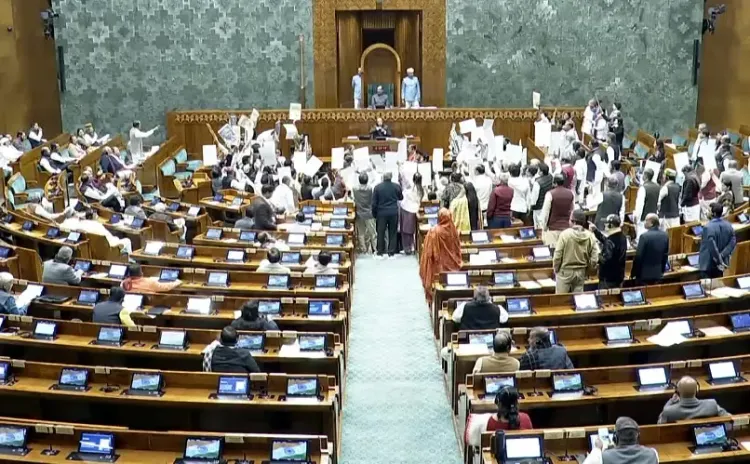
New Delhi, Dec 16 (NationPress) As the Lok Sabha resumed on Tuesday, the opposition launched a vigorous protest against the proposed introduction of the Viksit Bharat Guarantee for Rozgar and Ajeevika Mission (Gramin) (VB-G RAM G), 2025, aimed at replacing the Mahatma Gandhi National Rural Employment Guarantee Act (MGNREGA).
The opposing MPs voiced strong objections regarding the renaming of this vital rural employment initiative and insisted that the proposed legislation undergo detailed examination by a parliamentary committee.
Union Minister Shivraj Singh Chouhan presented the Bill in the House, after which opposition members challenged the logic of stripping Mahatma Gandhi's name from a significant welfare program that has been operational for nearly 20 years.
Leading the protest, Congress MP Priyanka Gandhi Vadra criticized the government's move to substitute MGNREGA, cautioning that the new legislation could potentially weaken the original Act's assurance of 100 days of employment for the most impoverished segments of society.
She also expressed her concerns over what she termed the Centre's obsession with renaming established schemes.
"MGNREGA was a groundbreaking Bill that was met with admiration from all political factions upon its introduction. This Bill is crucial for bolstering the rural economy and providing 100 days of employment on demand," Priyanka asserted during her address in the House.
She highlighted that the current Act is demand-driven, with funding increasing in line with the number of job seekers.
In contrast, she contended that the VB-G RAM G sets annual allocation limits and shifts additional financial burdens onto states, with only 60% of expenses covered by the Centre.
"The core principle of our Constitution is that governance should be vested in every citizen, and this principle is echoed in the Panchayati Raj system. This Bill contradicts that fundamental principle. Its provisions that undermine the legal right to employment are in conflict with our Constitution," Priyanka expressed.
Throughout the heated exchanges and frequent interruptions from both sides, she made a heartfelt appeal in defense of the scheme's legacy.
"Mahatma Gandhi may not be from my family, but he feels like family to me, and this sentiment resonates across the nation," she stated.
While firmly opposing the Bill's introduction, Priyanka urged the government to retract the proposed legislation and present a revised version, which should then be analyzed by a special committee for broader consultation and assessment.
Point of View
It is essential to recognize the implications of the proposed VB-G RAM G Bill. While the government seeks to innovate rural employment schemes, the strong opposition highlights valid concerns about potential risks to existing employment guarantees. It is crucial for the government to engage in meaningful dialogue with all stakeholders to ensure that rural employment initiatives remain effective and inclusive.
NationPress
16/12/2025
Frequently Asked Questions
What is the VB-G RAM G Bill?
The VB-G RAM G Bill is proposed legislation aimed at replacing the Mahatma Gandhi National Rural Employment Guarantee Act (MGNREGA) with a new scheme focused on rural employment and livelihood.
Why are opposition leaders protesting this bill?
Opposition leaders argue that the VB-G RAM G Bill could weaken the employment guarantees provided by MGNREGA, particularly the assurance of 100 days of work for the poorest citizens.
What are the implications of changing the name of the scheme?
Changing the name of the scheme raises concerns about the government's commitment to the principles of the original MGNREGA and could lead to diminished trust among rural communities reliant on these employment guarantees.