Opposition shifts goalposts on NEET crisis amid UP poll calculations
Synopsis
The Modi government tabled a toughened anti-malpractice law on 27 July even as Dharmendra Pradhan had already resigned — yet the Opposition blockade continued, fuelled less by NEET reform demands and more by the Congress-SP alliance's Uttar Pradesh Assembly election arithmetic.
Key Takeaways
The Lok Sabha was adjourned on 27 July as the Opposition extended its Monsoon Session blockade into a second week.
The Public Examinations (Prevention of Unfair Means) Amendment Bill, 2026 was tabled on Monday to strengthen action against paper leaks and cheating.
Former Education Minister Dharmendra Pradhan had already resigned — the Opposition's stated principal demand — yet protests continued.
A dedicated expert task force and fast-track courts were also constituted as part of the government's NEET response.
Rahul Gandhi and Akhilesh Yadav have been staging joint protests, widely seen as consolidating a Congress-SP alliance ahead of Uttar Pradesh Assembly elections .
The SP won 37 of 80 UP Lok Sabha seats in 2024; in Assembly elections, however, it has historically performed better contesting alone.
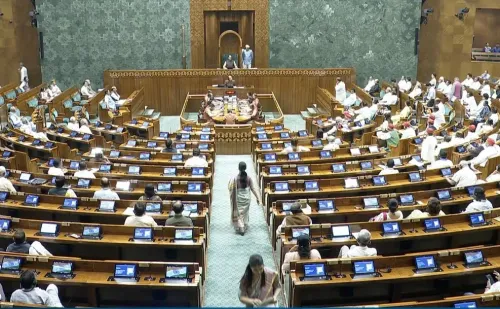
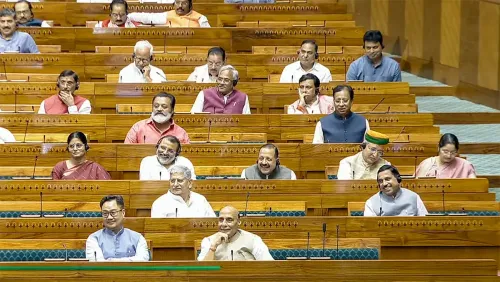
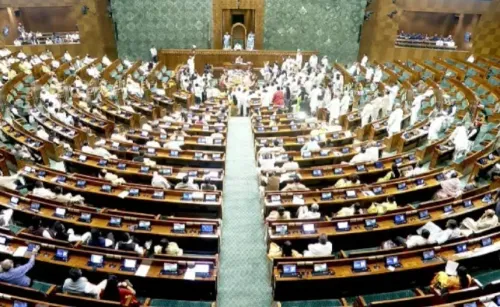
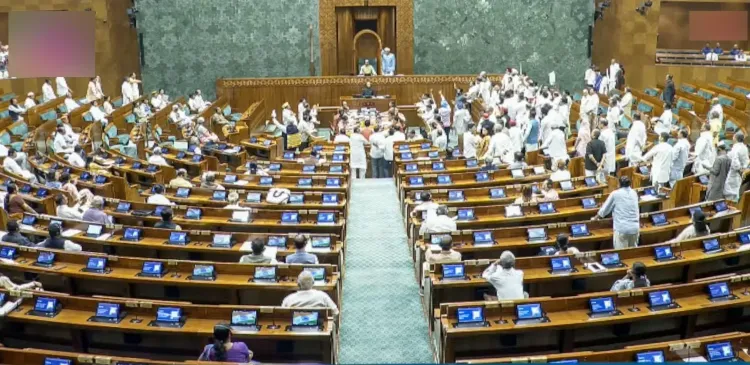
The Lok Sabha remained paralysed on Monday, 27 July as the Opposition pressed its Parliamentary blockade into the second week of the Monsoon Session, even as the Narendra Modi government tabled a toughened Public Examinations (Prevention of Unfair Means) Amendment Bill, 2026 — the latest in a series of structural responses to the NEET paper leak controversy.
What the Government Has Done
Since the examination irregularities came to light, the Centre has moved on multiple fronts. The Education Secretary was replaced to enforce institutional accountability. Former Education Minister Dharmendra Pradhan — whose resignation had been the principal demand of both protesting students and Opposition benches — stepped down from the Union Council of Ministers, reportedly on his own volition. A dedicated expert task force was constituted to examine systemic gaps, and fast-track courts were set up to ensure time-bound trials within months rather than years. On Monday, the expanded anti-malpractice bill was being introduced when Opposition sloganeering forced the Speaker to adjourn the House around noon.
The Opposition's Parliamentary Blockade
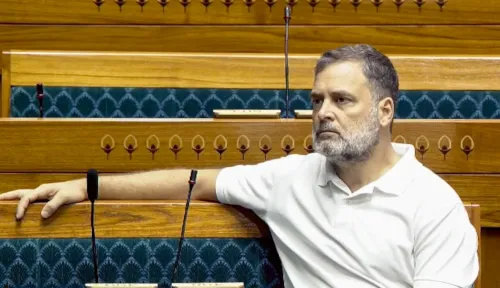
High-decibel sloganeering filled the chamber as several Opposition members were seen moving toward the Speaker's Chair. The disruption persisted despite the government's concessions, with Leader of Opposition Rahul Gandhi continuing to press the confrontation beyond the original NEET grievances. Critics argue Gandhi has expanded the agitation to broader political complaints — including institutional critiques and law-and-order friction — that go well beyond the examination reform agenda. This pattern of widening demands, even after core ones are met, has drawn accusations of goalpost-shifting from treasury benches.
The Congress-SP Alliance Calculus
Behind the Parliamentary theatre lies a sharper electoral calculation. A visible camaraderie has developed between Gandhi and Samajwadi Party (SP) chief Akhilesh Yadav, widely read as groundwork for an alliance targeting the upcoming Uttar Pradesh Assembly elections. The two leaders have been marching together, courting detentions near high-security zones, and staging coordinated street protests — moves analysts see as an attempt to re-energise cadre and consolidate an anti-incumbency narrative in India's most populous state.
The 2024 Lok Sabha Baseline
The alliance's confidence draws partly from its 2024 Lok Sabha performance in Uttar Pradesh. Of the state's 80 parliamentary seats, the SP contested 61 and the Indian National Congress (Congress) contested 17, with the remaining two going to smaller allies. The SP won 37 seats — up 32 from its previous tally — while the Congress secured 6 seats, gaining five over its lone 2019 win. That shared success has given both leaderships reason to attempt a repeat at the Assembly level.
The Assembly Election Reality Check
However, the state-election arithmetic is more complicated. In the 2017 Uttar Pradesh Assembly elections, the SP won just 47 seats out of 403; that figure rose to 111 in the subsequent Assembly election. The Congress fared worse — falling from 7 seats to 2. Historically, the SP has performed significantly better contesting independently than in alliance with the Congress. Nevertheless, buoyed by 2024's parliamentary result, both leaders appear intent on giving the joint arrangement another run. How the student agitation narrative holds through the Assembly campaign cycle remains the critical variable.
Point of View
Joint marches, shared optics — is Assembly-election choreography dressed as student solidarity. The real question mainstream coverage is missing: whether the SP, which has historically outperformed in UP when contesting alone, will find the Congress alliance a net asset or a liability once booth-level arithmetic is tested. Parliament's loss of a legislative week on a bill that both sides ostensibly want is the collateral cost of that calculation.
NationPress
26 Oct 2026
Frequently Asked Questions
What is the Public Examinations (Prevention of Unfair Means) Amendment Bill, 2026?
It is a toughened anti-malpractice law introduced in the Lok Sabha on 27 July 2026 to strengthen action against paper leaks and cheating in public examinations. The bill expands on existing provisions and is part of the government's structural response to the NEET paper leak controversy.
Why did Dharmendra Pradhan resign as Education Minister?
Dharmendra Pradhan stepped down from the Union Council of Ministers to take political ownership of the NEET paper leak crisis. His resignation had been the principal demand of both protesting students and the Opposition; reports indicate he took the decision on his own initiative.
Why is the Opposition continuing its Parliament blockade despite government concessions?
Critics argue the Opposition — led by Rahul Gandhi — has shifted its demands beyond the original NEET grievances to broader political and institutional complaints. Analysts suggest the blockade is also driven by Congress-SP electoral consolidation ahead of the Uttar Pradesh Assembly elections.
What is the Congress-SP alliance's track record in Uttar Pradesh?
In the 2024 Lok Sabha elections, the SP won 37 of the 80 UP seats and the Congress won 6, making it a strong performance for the alliance. However, in state Assembly elections the SP has historically fared significantly better contesting independently, winning 111 of 403 seats in its last Assembly outing compared to just 47 in 2017.
What other steps has the government taken to address the NEET paper leak?
Beyond the new anti-malpractice bill, the Centre replaced the Education Secretary, constituted an expert task force to examine systemic gaps, and set up fast-track courts to ensure time-bound trials within months. Dharmendra Pradhan's resignation as Education Minister was also part of the government's response package.