Owaisi Questions Why Saifai Got Colleges, Not Azamgarh
Synopsis
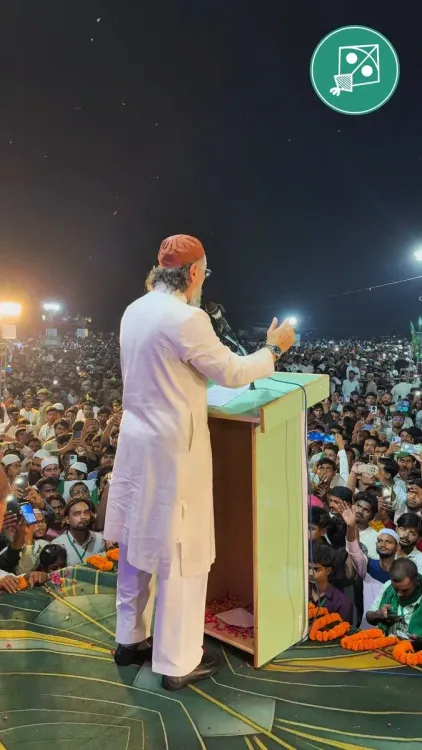
AIMIM president Asaduddin Owaisi on October 13, 2026, asked why Uttar Pradesh built medical and sports colleges in Saifai — ancestral home of Mulayam Singh Yadav — while Azamgarh, a densely populated eastern district, was left without comparable facilities.
Key Takeaways
AIMIM president Asaduddin Owaisi posted on October 13, 2026 , asking why medical and sports colleges were built in Saifai but not in Azamgarh .
Saifai in Etawah district is the ancestral village of the late Mulayam Singh Yadav ; its institutions were developed during his tenure as UP chief minister in the mid-2000s.
Azamgarh is a large, densely populated district in eastern Uttar Pradesh with historically limited state-funded higher education and sports infrastructure.
The post continues a pattern of opposition leaders questioning whether UP infrastructure investment follows need or political loyalty.
Owaisi's question implicitly targets both the Samajwadi Party legacy and the current state government's development priorities.
Any forthcoming UP government announcements on medical or sports colleges in eastern districts will be measured against this critique.
A pointed question — seven words in Hindi — and AIMIM president Asaduddin Owaisi has once again put a spotlight on one of Uttar Pradesh's most enduring political fault lines: why does infrastructure follow political clout rather than population need?
Posting on Tuesday, October 13, 2026, Owaisi asked in Hindi: 'Jab Saifai mein Medical aur Sports College banaye gaye, toh Azamgarh mein kyun nahin banaye gaye?' — 'When Medical and Sports Colleges were built in Saifai, why were they not built in Azamgarh?'
Saifai's rise and Azamgarh's wait
The answer, critics have long argued, is geography — specifically political geography. Saifai, a village in Etawah district of western Uttar Pradesh, is the ancestral home of the late Mulayam Singh Yadav, the Samajwadi Party patriarch who served multiple terms as the state's chief minister. During his tenure in the mid-2000s, Saifai received a cluster of high-profile institutions: a medical college and a sports facility that transformed a small village into a landmark of state-funded development.
Azamgarh, by contrast, sits in the heart of eastern Uttar Pradesh — a densely populated, historically underserved district with a substantial Muslim population. The infrastructure gap between the two districts has become a recurring reference point in debates about whether development in UP tracks genuine need or electoral arithmetic.
A pattern opposition leaders keep returning to
Owaisi's post is not an isolated jab — it is the latest data point in a steady drumbeat from opposition politicians who argue that higher education and sports infrastructure in Uttar Pradesh has been concentrated in politically connected pockets rather than distributed across all regions equitably. Eastern UP, home to tens of millions of residents, has repeatedly featured in this critique.
The broader stakes are real. Access to a state medical college can define career trajectories for thousands of young people. A government-funded sports college can be the only pathway to elite athletic training for students from families who cannot afford private alternatives. When those institutions land in one district and not another, the consequences compound across generations.
What Owaisi's question demands
By framing his post as a question rather than a declaration, Owaisi places the burden of explanation squarely on the ruling establishment. The query implicitly challenges both the Samajwadi Party — which built the Saifai institutions — and the current Uttar Pradesh government to account for the distribution of state investment. Whether either responds, and what any forthcoming infrastructure announcements for eastern districts might look like, will determine whether this remains a rhetorical point or becomes a policy pressure.
Seven words that have been waiting decades for a straight answer.
Point of View
Where flagship institutions have historically landed near the home turf of sitting chief ministers rather than in areas of greatest population need. By invoking the Saifai-Azamgarh contrast, he simultaneously pressures the Samajwadi Party on its own governance record and signals to eastern UP voters — including a large Muslim constituency — that their region's infrastructure deficit is a political choice, not an accident of geography. The post is calibrated to stay relevant well beyond a single news cycle: it sets a benchmark against which any future UP infrastructure announcement in eastern districts will be judged.
NationPress
13 Oct 2026
Frequently Asked Questions
Why did Owaisi ask about Saifai and Azamgarh?
Owaisi questioned why Uttar Pradesh built a medical college and sports college in Saifai — the ancestral home of SP patriarch Mulayam Singh Yadav — while Azamgarh, a large eastern UP district, received no comparable state-funded institutions.
What institutions were built in Saifai?
A medical college and sports facilities were established in Saifai, Etawah district, during Mulayam Singh Yadav's tenure as Uttar Pradesh chief minister in the mid-2000s, transforming the village into a hub of state-funded infrastructure.
Where is Azamgarh and why is it significant?
Azamgarh is a district in eastern Uttar Pradesh with a large, densely populated area and a substantial Muslim population. It is frequently cited as an example of uneven regional development within the state.
What is AIMIM president Owaisi's broader argument here?
Owaisi argues — implicitly — that infrastructure investment in Uttar Pradesh has followed political patronage rather than genuine need, and that districts like Azamgarh have been systematically shortchanged compared to regions with stronger ruling-party ties.
What should we watch for after Owaisi's post?
Watch for any Uttar Pradesh government announcements on new medical or sports colleges in eastern districts, as well as responses from Samajwadi Party or other opposition leaders to the Saifai development comparison.