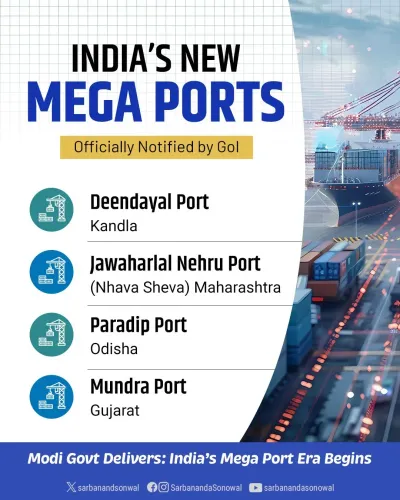
Paradip Port gets Mega Port status under Indian Ports Act 2025
Synopsis
The Chief Minister's Office of Odisha announced that Paradip Port has been designated a 'Mega Port' under the Indian Ports Act, 2025 — a classification set to accelerate infrastructure investment, strengthen coastal and international trade, and anchor Odisha's growing maritime economy.
Key Takeaways
Paradip Port has been officially recognised as a 'Mega Port' under the Indian Ports Act, 2025 .
The designation is expected to boost port infrastructure, coastal connectivity, and both domestic and international trade volumes.
Paradip, located in Jagatsinghpur district, Odisha , is a key bulk-cargo hub handling coal, iron ore, and fertilizers.
The announcement aligns with the broader Sagarmala Project vision of port-led national development launched in 2015 .
The Government of Odisha framed the recognition as integral to achieving 'Samridha Odisha' and 'Viksit Bharat' goals.
Rollout of new infrastructure projects and cargo throughput growth at Paradip will be the key metrics to watch.
A single legislative stamp has just redrawn Odisha's place on India's maritime map. The Chief Minister's Office of Odisha announced on Saturday, 26 September 2026 that Paradip Port has been recognised as a 'Mega Port' under the Indian Ports Act, 2025 — a designation that signals accelerated infrastructure investment, stronger coastal connectivity, and a bigger role in international trade for one of India's most cargo-intensive harbours.
The CMO post declared in Odia: 'ଓଡ଼ିଶାର ସାମୁଦ୍ରିକ କ୍ଷେତ୍ରକୁ ମିଳୁଛି ନୂଆ ଗତି ଓ ନୂଆ ପରିଚୟ' — 'Odisha's maritime sector is getting new momentum and a new identity.' The office called the recognition a landmark achievement for the state's maritime capability and framed it as a building block toward both a 'Samridha Odisha' (Prosperous Odisha) and a 'Viksit Bharat' (Developed India).
Paradip's cargo clout and why 'Mega' matters
Paradip Port, situated in Jagatsinghpur district on Odisha's coast, is already one of India's principal bulk-cargo gateways, handling commodities such as coal, iron ore, and fertilizers that are lifeblood inputs for the country's industrial heartland. The new Mega Port classification, introduced through the updated legal framework of the Indian Ports Act, 2025, is designed to unlock a fresh tier of governance flexibility and investment prioritisation at select harbours. It places Paradip in a category earmarked for faster clearances, upgraded berth infrastructure, and deeper integration with hinterland logistics corridors.
The Ministry of Ports, Shipping and Waterways oversees port development nationally and has been the driving force behind legislative modernisation that the 2025 Act represents. The classification is expected to attract enhanced capital allocation and position Paradip to compete more aggressively for international shipping lines.
Sagarmala's long shadow — and the policy arc behind this moment
This recognition does not arrive in a vacuum. India's Sagarmala Project, launched in 2015, laid the ideological and infrastructural groundwork — port-led development, hinterland connectivity, coastal shipping — that successive policy upgrades have since built upon. The Indian Ports Act, 2025 is the latest legislative expression of that ambition, replacing older statutes with a classification system that rewards scale and strategic importance. Paradip's Mega Port tag is, in many ways, Sagarmala's dividend arriving in legislative form.
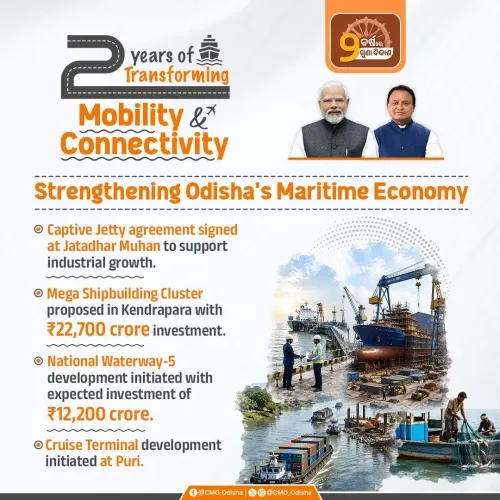
What to watch now is concrete: how quickly infrastructure projects at Paradip are tendered and executed, whether cargo throughput climbs measurably over the next two to three years, and whether the designation translates into new shipping route announcements by major carriers. The Government of Odisha has signalled it intends to leverage this status to deepen the state's maritime economy — a sector that touches fisheries, coastal trade, employment in port-adjacent communities, and the broader ease-of-doing-business calculus for manufacturers who depend on bulk imports.
Paradip is no longer just a port. It is, officially, a Mega Port — and for Odisha, that is the opening line of a much larger story.
Point of View
But its true significance will be measured in steel and tonnage — berths built, trade lanes added, and throughput numbers. The Indian Ports Act, 2025 gives Odisha a policy hook it can use to attract private port operators and industrial investors, fitting squarely into the Centre's port-led growth doctrine. For Chief Minister Mohan Majhi's administration, the timing is politically useful: it provides a concrete, infrastructure-grounded narrative ahead of Odisha's budget season and reinforces the BJP-led state government's alignment with New Delhi's 'Viksit Bharat' framing. The real test is whether the Mega Port tag accelerates project timelines or remains an administrative label.
NationPress
26 Sept 2026
Frequently Asked Questions
What is a Mega Port under the Indian Ports Act 2025?
The Indian Ports Act, 2025 introduced a classification system for Indian ports, with 'Mega Port' being a designation for large-scale, strategically significant harbours meant to receive prioritised infrastructure investment and governance support. The precise criteria for the designation are part of the updated legislative framework.
Why is Paradip Port important for Odisha?
Paradip Port in Jagatsinghpur district is one of India's leading bulk-cargo ports, handling coal, iron ore, and fertilizers. It is central to Odisha's coastal economy and serves as a critical logistics gateway for industries across eastern and central India.
What is the Sagarmala Project and how is it connected to this?
The Sagarmala Project, launched in 2015 by the Government of India, promotes port-led development and modernisation of India's coastline. Paradip's Mega Port recognition builds on the infrastructure and policy groundwork that Sagarmala established, representing a new legislative phase of that long-running push.
What will change at Paradip Port after the Mega Port designation?
The designation is expected to unlock enhanced capital investment in port infrastructure, better hinterland connectivity, faster regulatory clearances, and greater competitiveness for international shipping traffic. Key indicators to watch include new infrastructure tenders and cargo throughput growth.
Which ministry oversees Paradip Port's development?
The Ministry of Ports, Shipping and Waterways is the central government body responsible for national port development, shipping policy, and maritime infrastructure, and it oversees the rollout of the Indian Ports Act, 2025 framework.