Pilot Accuses BJP of Silencing Free Speech, Cites Democratic Erosion
Synopsis
Congress general secretary Sachin Pilot on October 22, 2026 accused the BJP of suppressing freedom of expression, warning that a government fearing free speech has abandoned democracy's core. The sharp post deepens the Congress-BJP battle over civil liberties and institutional autonomy.
Key Takeaways
Congress general secretary Sachin Pilot posted a direct attack on the BJP on October 22, 2026 , accusing it of suppressing freedom of expression.
Pilot framed the alleged silencing as evidence of the BJP's 'insecurities' rather than strength — a deliberate rhetorical inversion.
He warned that a government fearing free speech has 'forgotten the very essence of democracy.' The statement fits a sustained Congress narrative, active since at least 2014 , targeting the BJP's record on press freedom and civil-society space.
Pilot holds the post of Congress in-charge for Chhattisgarh , giving the statement both national and state-level political resonance.
No specific triggering incident was cited; watch for BJP rebuttals and possible echo in upcoming parliamentary or campaign forums.
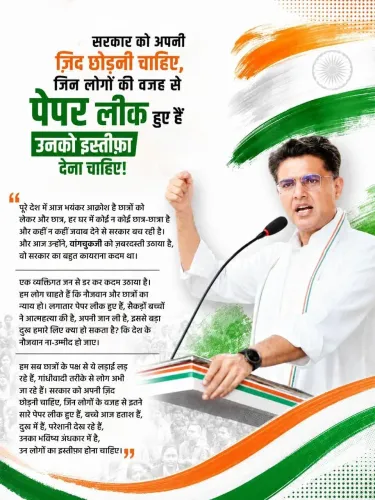
When a government fears its own citizens' voices, Congress leader Sachin Pilot argues, it has already lost the argument. On Thursday, October 22, 2026, the Indian National Congress general secretary and Chhattisgarh in-charge took to X with a pointed broadside against the BJP, accusing the ruling party of systematically suppressing freedom of expression — and, in doing so, revealing its own vulnerabilities.
Pilot's post was unambiguous: 'Silencing expression is what the BJP does best. But in doing so, they have only exposed their own insecurities. A government that fears freedom of speech and expression has forgotten the very essence of democracy. The power of truth and courage will always prevail.' The words carry the cadence of a prepared political statement — measured, sweeping, and squarely aimed at the Narendra Modi-led central government.
A Familiar Charge, a Sharpening Edge
This is not the first time opposition leaders have levelled such accusations at the BJP, which has governed India since 2014. Congress and allied parties have, over successive election cycles, built a sustained narrative that the ruling establishment deploys legal tools, regulatory pressure, and institutional influence to blunt critical voices in media and civil society. Pilot's post fits squarely within that pattern — but its tone signals that the opposition is not softening the charge; it is intensifying it.
The language Pilot chose — 'insecurities,' 'fears,' 'forgotten the very essence of democracy' — is designed to frame the BJP not as powerful but as brittle. It is a rhetorical inversion: the party that controls government is cast as the anxious one, and truth and dissent as the durable forces. Whether or not a specific triggering incident prompted the post, the message is aimed at a national audience primed by years of debate over press freedom, sedition law, and civil-society regulation.
Opposition Voices, Journalists, and the Stakes of the Debate
The stakeholders in this ongoing argument extend well beyond party lines. Journalists, civil-society organisations, and legal advocates have repeatedly flagged concerns about the operating environment for independent reporting in India. Opposition parties — Congress chief among them — have tried to amplify those concerns into a broad democratic-values argument ahead of electoral contests. Pilot's standing as a national general secretary gives his words institutional weight beyond a personal opinion.
The BJP has consistently rejected such characterisations, arguing that legal processes apply equally to all and that press freedom in India remains robust. Expect party spokespersons to push back, and watch whether this exchange surfaces in upcoming parliamentary sessions or state-level campaign rhetoric in Chhattisgarh, where Pilot holds party charge.
Truth and courage may always prevail, as Pilot insists — but in Indian politics right now, the battle over who gets to define both has never been louder.
Point of View
' Pilot softens the attack just enough to appeal to undecided voters while keeping base sentiment fired up. The absence of a named incident is deliberate: the charge is meant to be cumulative, not episodic. Watch whether the BJP responds at all — silence would confirm the narrative; a sharp rebuttal risks amplifying it.
NationPress
22 Oct 2026
Frequently Asked Questions
What did Sachin Pilot say about the BJP and free speech?
Sachin Pilot posted on X on October 22, 2026, accusing the BJP of 'silencing expression' and arguing that a government fearing free speech has 'forgotten the very essence of democracy,' adding that truth and courage would ultimately prevail.
Why is Sachin Pilot criticising the BJP over freedom of expression?
Pilot, as Congress general secretary, is part of a broader opposition effort to frame the BJP government as hostile to independent voices in media and civil society — a charge Congress has raised consistently since 2019.
What is Sachin Pilot's current role in the Congress party?
Sachin Pilot is the Indian National Congress general secretary and the party's in-charge for Chhattisgarh. He previously served as Deputy Chief Minister of Rajasthan.
Has the BJP responded to Congress's free speech allegations?
The BJP has historically rejected such characterisations, maintaining that legal processes apply equally to all citizens and that press freedom in India remains intact. No specific rebuttal to this post has been reported yet.
Is there a specific incident behind Sachin Pilot's October 2026 free speech post?
The post does not reference a specific incident. It reads as a broad political statement, consistent with the Congress party's ongoing democratic-values critique of the BJP-led central government.