Pilot demands Rajasthan govt act on contractual nurses' crisis

Synopsis
Congress leader Sachin Pilot has demanded the Rajasthan government listen sensitively to the family of Deepak Kharwal, a contractual nurse at Jaipur's Sanganeri Gate Women's Hospital who died by suicide over job termination stress, and reconsider its policy on contractual nursing staff.
Key Takeaways
Deepak Kharwal , a contractual nurse at Sanganeri Gate Women's Hospital, Jaipur , died by suicide reportedly due to mental distress over job termination.
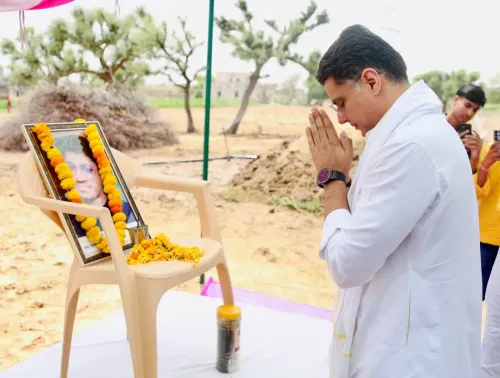
Congress leader Sachin Pilot condemned the Rajasthan government's decision to remove contractual nursing staff, calling it 'insensitive.' Pilot demanded the government address the bereaved family's demands 'with seriousness and sensitivity.' He also called for a reconsideration of the demands and problems of all contractual nursing workers in the state.
Widespread anger among contractual nursing staff had already been building before Kharwal's death, according to Pilot's account.
The incident reignites the broader debate on regularisation of contractual health workers hired under schemes such as the National Health Mission (NHM) .
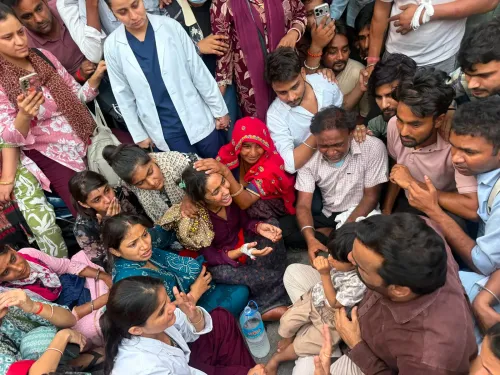
Congress leader Sachin Pilot on Friday, June 12, 2026, called on the Rajasthan government to urgently address the demands of contractual nursing staff after Deepak Kharwal, a contractual nurse at Sanganeri Gate Women's Hospital in Jaipur, died by suicide, reportedly driven by mental distress over the termination of his job.
Context
Pilot, in his post, stated that Kharwal — संविदा पर कार्यरत नर्सिंगकर्मी (a contractual nursing worker) — took his life due to the mental stress arising from the loss of his job. He described the incident as exposing the state government's 'insensitive attitude' (असंवेदनशील रवैया), and said that widespread anger had already been simmering among contractual nursing staff before this tragedy occurred.
The Congress leader urged the government to 'listen to the demands of the bereaved family with seriousness and sensitivity' and to 'reconsider the demands and problems of contractual nursing workers.' Pilot also linked to a news report covering the incident.
Policy Backdrop
Contractual health workers in Rajasthan — many of them hired under the National Health Mission (NHM), a central government programme that funds frontline health positions across states — have long faced cycles of job insecurity. The state government's decision to remove contractual nursing staff had already triggered broad protests before Kharwal's death.
Across Indian states, the regularisation of NHM and state-funded contractual workers has remained a persistent and unresolved policy fault line. Opposition parties have repeatedly used termination decisions and delayed salaries to highlight what they characterise as government apathy toward frontline healthcare workers.
Stakeholders and Impact
The immediate impact falls on contractual nursing staff across Rajasthan, whose job security remains contingent on state budget decisions and periodic policy reviews. Kharwal's death has, according to Pilot's account, deepened anger and disillusionment among this workforce statewide.
The bereaved family's demands — left unspecified in Pilot's post — are now at the centre of the political pressure being mounted on the state administration. Health workers' unions and associations are among the key stakeholders watching the government's response.
What's Next
Attention will now turn to the Rajasthan health department and whether it issues any policy communication on the status of contractual nursing appointments. Any discussion in the state assembly or formal engagement with employee associations will be closely watched.
Pilot's intervention signals that the Congress intends to keep pressure on the ruling dispensation in Rajasthan. If the government does not respond to the family's demands and the broader regularisation question, the issue is likely to intensify ahead of any legislative session.
Point of View
He maximises both moral and electoral pressure. The episode fits a recurring national pattern where contractual health worker crises — amplified by individual tragedies — force state governments into reactive, often ad hoc, policy responses. The Rajasthan government's next move on regularisation will determine whether this remains a short-term controversy or a sustained political liability.
NationPress
29 Jul 2026
Frequently Asked Questions
Who was Deepak Kharwal and what happened to him?
Deepak Kharwal was a contractual nursing worker at Sanganeri Gate Women's Hospital in Jaipur . He reportedly died by suicide due to mental stress caused by the termination of his contractual job, according to Congress leader Sachin Pilot's post.
What did Sachin Pilot demand from the Rajasthan government?
Sachin Pilot demanded that the Rajasthan government listen to the bereaved family's demands with seriousness and sensitivity, and reconsider its decision to remove contractual nursing staff from state hospitals.
Why were contractual nurses being removed in Rajasthan?
The Rajasthan government took a decision to remove contractual nursing staff from public hospitals. The specific administrative or budgetary reasons behind the order have not been detailed in Pilot's post, but the move had already triggered widespread protests among nursing workers before Kharwal's death.
What is the National Health Mission and its role in contractual health jobs?
The National Health Mission (NHM) is a central government programme that funds frontline health worker positions — including nurses and paramedics — across Indian states. Many contractual health workers in states like Rajasthan are employed under NHM funding, making their jobs vulnerable to policy and budget changes.
What is the broader issue of contractual health workers in India?
Contractual health workers across India face recurring job insecurity due to dependence on state and central budget allocations. The demand for regularisation of such workers has been a persistent issue, with multiple states seeing protests, strikes, and political disputes over terminations and delayed salaries.