CM Pinarayi backs Delhi protest, demands CEC Gyanesh Kumar resign
Synopsis
Kerala Chief Minister Pinarayi Vijayan endorsed the Ramlila Maidan protest on November 1, demanding CEC Gyanesh Kumar's resignation and a halt to alleged voter deletions under SIR, while reviving calls for ballot-paper restoration ahead of elections.
Key Takeaways
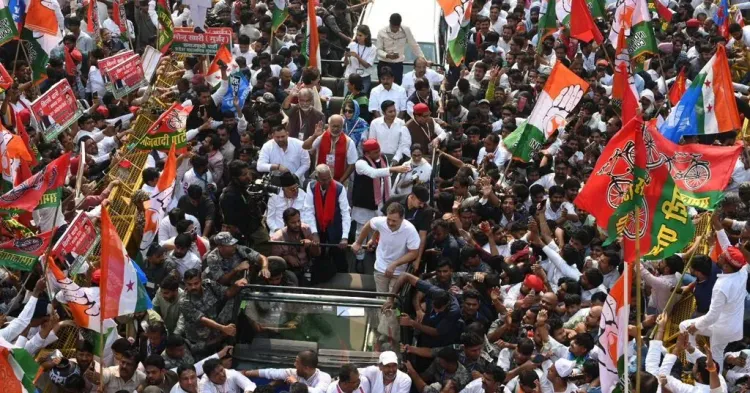
Kerala CM Pinarayi Vijayan backed a mass protest at Delhi's Ramlila Maidan on November 1, 2026 , calling it a defence of democracy and the Constitution.
He demanded the resignation of Chief Election Commissioner Gyanesh Kumar over alleged systematic voter-name deletions under a process called SIR .
Vijayan declared that 'not a single eligible voter must be denied their democratic right.' He renewed the opposition demand for the restoration of ballot papers , a call that has recurred since EVMs became standard in the early 2000s .
Ramlila Maidan , historically associated with India's largest public mobilisations, lends the protest significant symbolic weight.
As a CPI(M) Politburo member and sitting Chief Minister, Vijayan's intervention elevates the controversy to a national-party-level challenge against the Election Commission.
A mass protest at Delhi's Ramlila Maidan is drawing national political attention — and Kerala Chief Minister Pinarayi Vijayan has thrown his full weight behind it, calling the demonstration a 'call to defend our democracy, Constitution and the right to vote.' Writing on Sunday, November 1, 2026, Vijayan trained his fire squarely on the Election Commission of India, demanding the resignation of Chief Election Commissioner Gyanesh Kumar and a halt to what he described as the 'systematic deletion of voters' names under SIR.'
The charges against SIR and voter-roll deletions
At the centre of Vijayan's statement is a process he refers to as SIR — which opposition voices allege is being used to strip eligible citizens off electoral rolls ahead of upcoming elections. 'Not a single eligible voter must be denied their democratic right,' he wrote, framing the controversy not as an administrative dispute but as a constitutional emergency. The periodic revision of electoral rolls is a standard function of the Election Commission, but such exercises have historically ignited political controversy when conducted close to polling cycles, with opposition parties arguing that marginalised and minority voters bear a disproportionate share of deletions.
Vijayan also amplified a demand that has coursed through Indian opposition politics for nearly two decades: the restoration of ballot papers. Since Electronic Voting Machines were rolled out nationwide in the early 2000s, opposition parties have periodically questioned their integrity and pushed for a paper-based system they argue is more verifiable and tamper-proof. Pairing that call with the voter-roll row in a single statement signals a coordinated effort to mount a broad electoral-integrity challenge.
Ramlila Maidan's weight in Indian protest politics
Ramlila Maidan is not an incidental backdrop — it is a loaded choice. The vast open ground in central Delhi has hosted some of the most consequential public mobilisations in post-Independence India, from Anna Hazare's anti-corruption agitation to campaigns that reshaped electoral outcomes. When an opposition movement plants its flag there, it is making a statement about scale and seriousness. Vijayan's endorsement of this particular gathering lifts it from a local or regional protest into the orbit of a national CPI(M)-backed political campaign.
A senior Politburo voice enters the national fight
As a sitting Chief Minister and CPI(M) Politburo member, Vijayan carries institutional heft that goes beyond commentary. His call for CEC Gyanesh Kumar to resign is among the sharpest interventions a sitting state executive can make against an independent constitutional authority — a move that will almost certainly invite formal responses from the Election Commission and ruling-party leadership. 'Protecting the right to vote is a collective responsibility of every citizen who believes in democracy,' he closed, framing compliance as a civic duty rather than a partisan act.
Whether the Commission responds publicly, whether the courts are moved through petitions on electoral-roll accuracy, and whether the opposition can sustain this pressure into the next election cycle — these are now the questions every political observer will be watching.
Point of View
The CPI(M) is attempting to consolidate a multi-front electoral-integrity narrative before the next major polling cycle. The invocation of Ramlila Maidan signals an effort to give the campaign mass-movement credentials that go beyond parliamentary opposition. Demanding the exit of a constitutional functionary is a high-stakes move that tests how far the opposition bloc is willing to push institutional confrontation. If the Election Commission stays silent, the opposition gains momentum; if it responds sharply, the controversy deepens — either way, the political pressure intensifies.
NationPress
1 Nov 2026
Frequently Asked Questions
What is the SIR process that Pinarayi Vijayan is protesting against?
SIR refers to a voter-roll revision process that opposition leaders allege is being used to systematically delete eligible voters' names from electoral rolls ahead of elections. The exact scope and methodology of SIR have not been independently verified, and the Election Commission conducts periodic roll revisions as a standard constitutional function.
Why is Pinarayi Vijayan demanding Chief Election Commissioner Gyanesh Kumar's resignation?
Vijayan has linked Kumar's tenure to what he describes as the systematic deletion of voters' names and a lack of transparency in electoral administration. He argues that the CEC must be held accountable for what the opposition frames as an assault on the right to vote.
What is the significance of the Ramlila Maidan protest?
Ramlila Maidan in central Delhi is one of India's most iconic protest venues, historically associated with mass mobilisations that have shaped national politics. Holding a major demonstration there signals scale, seriousness, and a bid for broad public attention.
Why does the opposition want ballot papers restored?
Opposition parties have questioned the verifiability of Electronic Voting Machines since their nationwide rollout in the early 2000s, arguing that paper ballots provide a more transparent and auditable record of votes. The demand resurfaces regularly in the lead-up to elections.
Can a Chief Minister demand the resignation of the Chief Election Commissioner?
A Chief Minister can publicly call for such a resignation, as Vijayan has done, but the Chief Election Commissioner is a constitutional authority removable only through a process akin to the removal of a Supreme Court judge. The demand is therefore political rather than legally binding.