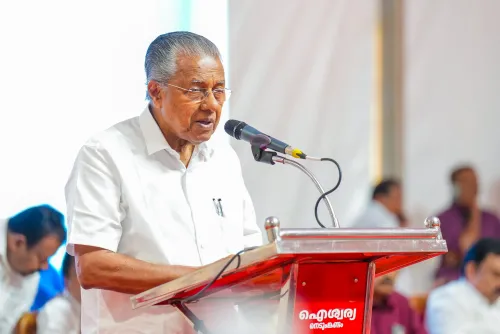
Kerala CM Pinarayi Vijayan demands Centre hold US accountable over Gulf of Oman sailor deaths

Synopsis
Kerala Chief Minister Pinarayi Vijayan has called on the Union Government to hold the United States accountable for the deaths of Indian sailors in the Gulf of Oman, demanding an end to regional military aggression and the protection of international shipping lanes.
Key Takeaways
Kerala CM Pinarayi Vijayan on June 12, 2026 demanded the Centre hold the United States accountable over the deaths of Indian sailors in the Gulf of Oman .
Vijayan accused the Union Government of a 'subservient approach' toward Washington on regional security matters.
He called for India to firmly demand a halt to 'regional military aggression' and the protection of international shipping routes.
The Gulf of Oman is a critical corridor for global energy and cargo shipments, with thousands of Indian seafarers employed on vessels transiting the region.
India's SAGAR maritime doctrine and the annual Malabar naval exercises with the US form the current policy framework for Indian Ocean security.
The Ministry of External Affairs has yet to issue a formal response to the reported sailor deaths as of publication.
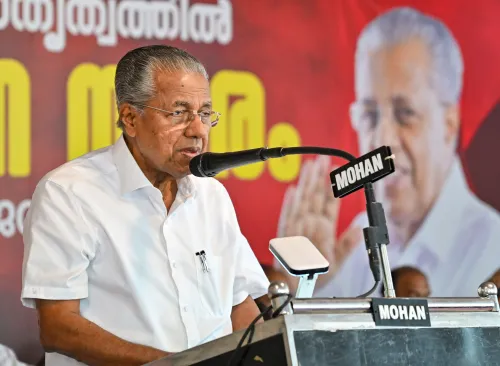
Kerala Chief Minister Pinarayi Vijayan on Friday, June 12, 2026, called on the Union Government to hold the United States accountable for what he described as regional military aggression in the Gulf of Oman, following the reported deaths of Indian sailors in the strategically vital waterway. The CPI(M) Politburo member urged New Delhi to abandon what he termed a 'subservient approach' towards Washington and to firmly demand safe international shipping routes.
Context
Vijayan's post stated: 'The tragic loss of Indian sailors in the Gulf of Oman is deeply distressing. The Union Govt must abandon its subservient approach towards the US and hold it accountable. India must firmly demand a halt to regional military aggression and insist on safe international shipping routes.'
The Gulf of Oman is a critical maritime corridor linking the Persian Gulf to the Arabian Sea, through which a significant share of global energy shipments and merchant cargo transits each year. Attacks on commercial vessels and escalating military activity in the broader West Asian region have periodically disrupted this route, placing Indian seafarers — tens of thousands of whom serve on international merchant fleets — in direct danger.
Policy Backdrop
India's SAGAR (Security and Growth for All in the Region) doctrine, announced in 2015, commits New Delhi to cooperative maritime security and the protection of sea lanes across the Indian Ocean Region. Despite this framework, critics from opposition parties have argued that India's expanding strategic partnership with the United States — including joint naval exercises such as the annual Malabar drills conducted since 1992 — has not translated into sufficient American restraint in regions where Indian commercial interests are at risk.
The India-US relationship has deepened considerably under the 2+2 Ministerial Dialogue format, which brings together the two countries' foreign and defence ministers to coordinate on security issues including maritime domain awareness in the Indo-Pacific. Vijayan's statement implicitly challenges the premise that this partnership adequately protects Indian lives and shipping interests in the Gulf.
Stakeholders and Impact
Indian seafarers constitute one of the largest national cohorts in the global merchant shipping workforce, making maritime security in the Gulf of Oman and the wider Arabian Sea a matter of direct livelihood concern for thousands of families — many of them in coastal states including Kerala, Goa, and Andhra Pradesh. The merchant shipping sector, which underpins a large share of India's trade in hydrocarbons and goods, is acutely sensitive to any escalation in the region.
Opposition-ruled states have increasingly used foreign policy statements to draw contrasts with the Narendra Modi government's handling of India's strategic partnerships. Vijayan's intervention follows a pattern of state-level leaders from Left and Congress-aligned formations questioning New Delhi's perceived tilt toward Washington on West Asian security questions, even as the Centre maintains that strategic autonomy remains the cornerstone of Indian foreign policy.
What's Next
Attention will now turn to the Ministry of External Affairs for any formal statement on the reported sailor deaths, a diplomatic demarche, or a call for a joint investigation into the incident. Any forthcoming India-US 2+2 ministerial meeting could become a platform where maritime security in the Gulf is formally raised. Vijayan's post is likely to intensify parliamentary and public pressure on the government to articulate a clearer position on protecting Indian nationals in conflict-adjacent maritime zones.
Point of View
A move that carries particular resonance given Kerala's large seafaring community and the CPI(M)'s long-standing ideological wariness of Indian alignment with American strategic interests. By framing New Delhi's posture as 'subservient,' he is directly contesting the government's narrative of strategic autonomy, seeking to widen the political cost of any perceived inaction. The statement fits a broader pattern in which Left and opposition leaders use high-visibility tragedies to challenge the Centre's management of the India-US relationship, especially when Indian lives are at stake in West Asian flashpoints. How the Ministry of External Affairs responds — or declines to respond — will itself become a political signal about the government's priorities in balancing alliance management against the protection of Indian nationals abroad.
NationPress
26 Oct 2026
Frequently Asked Questions
What happened to Indian sailors in the Gulf of Oman in 2026?
Kerala Chief Minister Pinarayi Vijayan described the deaths of Indian sailors in the Gulf of Oman as 'tragic,' though the exact circumstances and casualty figures had not been officially confirmed by the Union Government at the time of his post on June 12, 2026.
Why is Pinarayi Vijayan criticising the Union Government over the Gulf of Oman incident?
Vijayan, a CPI(M) Politburo member, accused the Centre of adopting a 'subservient approach' toward the United States and failing to hold Washington accountable for what he called regional military aggression that has endangered Indian sailors.
What is India's policy on maritime security in the Gulf of Oman?
India's SAGAR doctrine, announced in 2015, commits New Delhi to cooperative maritime security and the protection of sea lanes across the Indian Ocean Region, including the Gulf of Oman which links the Persian Gulf to the Arabian Sea.
How does the India-US relationship relate to Gulf of Oman security?
India and the United States conduct annual Malabar naval exercises and hold 2+2 Ministerial Dialogues on defence and foreign policy, but critics argue this partnership has not produced sufficient American restraint in regions where Indian commercial shipping and seafarers face risk.
What is the significance of the Gulf of Oman for India?
The Gulf of Oman is a vital maritime corridor for global energy and cargo trade; thousands of Indian seafarers work on merchant vessels that transit the route, making any escalation in the region a direct concern for Indian livelihoods and national trade interests.