Will Places Linked to Lord Krishna in Dhar and Jhabua Become Pilgrimage Sites?
Click to start listening
Synopsis
Madhya Pradesh's Chief Minister Mohan Yadav is set to transform locations associated with Lord Krishna in the tribal districts of Dhar and Jhabua into significant pilgrimage sites. This initiative aims to boost spiritual tourism and honor the rich heritage of the region.
Key Takeaways
- Madhya Pradesh plans to develop pilgrimage sites linked to Lord Krishna.
- Key locations include Sandipani Ashram and Narayan Dham.
- The initiative aims to boost spiritual tourism in tribal districts.
- CM Mohan Yadav emphasizes cultural heritage and community welfare.
- The project aligns with the broader trend of honoring India's spiritual legacy.
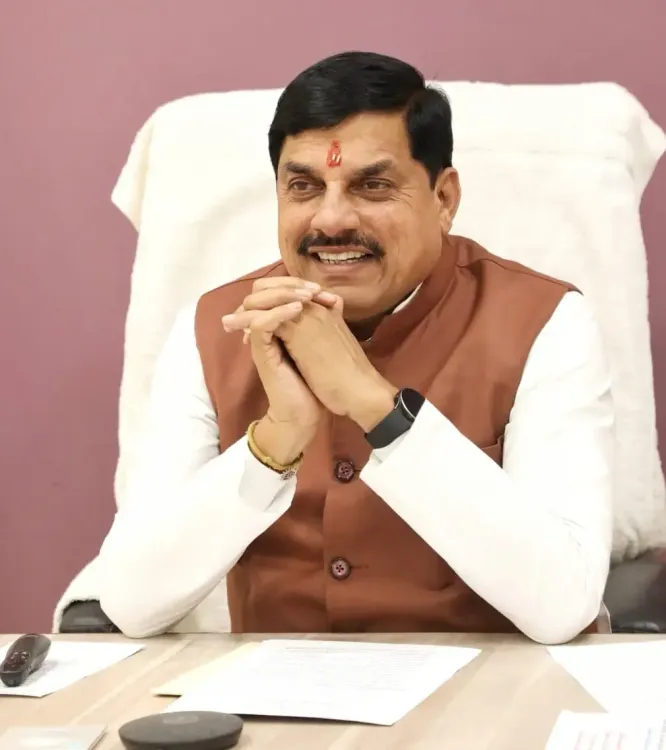
Bhopal, Dec 12 (NationPress) The Chief Minister of Madhya Pradesh, Mohan Yadav, announced on Friday that regions connected to Lord Krishna in the tribal areas of Dhar and Jhabua will be integrated into the 'Sri Krishna Patheya' pilgrimage initiative in the state.
This declaration was made during the 'Krishna Dharma Mahotsav' event held at a village in Jhabua district, organized by the Pranami Sampradaya.
The 'Krishna Patheya' project represents an ambitious effort by Chief Minister Yadav to enhance locations tied to Lord Krishna as pilgrimage destinations, similar to the 'Ram Gaman Path' initiative being developed collaboratively by Uttar Pradesh and Madhya Pradesh.
The state government has identified four significant locations in Madhya Pradesh where Lord Krishna is believed to have visited on various occasions.
These sites include Sandipani Ashram, Narayan Dham, Amjhera Dham, and Janapav Dham, each situated in distinct areas of the state.
It is thought that Lord Krishna received his education at Sandipani Ashram in Ujjain.
Narayan Dham, found in Dhar district, celebrates the friendship between Lord Krishna and his impoverished Brahmin companion, Sudama.
Amjhera Dham, also in Dhar district, is where it is believed that Lord Krishna triumphed over Rukmi, the brother of Goddess Rukmini, and 'abducted' her with her approval.
During the virtual address from Bhopal, Chief Minister Yadav remarked, "The Pranami Dharma embodies a journey rooted in the devotion to Lord Krishna, spiritual insight, and the tenets of universal brotherhood. This festival is a remarkable fusion of tradition, decoration, social reform, and spiritual unity."
The Chief Minister highlighted that the Pranami sect was significantly promoted by Swami Prananath and his disciple Maharaja Chhatrasal.
Among the three main dhams of the Pranami Sampradaya, one is Padmavati Puri, situated in Panna district.
Concluding his remarks, Chief Minister Yadav extended his heartfelt wishes for the 'Dharma Mahotsav' and its followers of the Pranami Sampradaya.
Point of View
The development of pilgrimage sites in Madhya Pradesh is a commendable initiative that aligns with the growing trend towards spiritual tourism in India. Chief Minister Mohan Yadav's efforts to honor cultural heritage while promoting local economies through tourism are noteworthy. It reflects a broader commitment to enhancing community welfare and preserving historical narratives.
NationPress
13/12/2025
Frequently Asked Questions
What is the 'Sri Krishna Patheya' project?
The 'Sri Krishna Patheya' project is an initiative launched by Madhya Pradesh's Chief Minister Mohan Yadav aimed at developing locations associated with Lord Krishna as pilgrimage sites.
Which districts are involved in this initiative?
The initiative focuses on the tribal-dominated districts of Dhar and Jhabua.
What are the key sites included in the project?
The four main sites are Sandipani Ashram, Narayan Dham, Amjhera Dham, and Janapav Dham.
How does this initiative relate to spiritual tourism?
This initiative is expected to boost spiritual tourism by attracting devotees to the historical and cultural sites associated with Lord Krishna.
Who promoted the Pranami sect?
The Pranami sect was significantly propagated by Swami Prananath and his disciple Maharaja Chhatrasal.