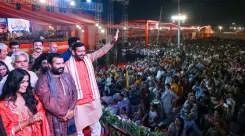
PM Modi Launches Road, Power and Industrial Projects in Surat
Synopsis
Prime Minister Narendra Modi on 5 June 2026 launched a set of transformative projects in road, power and industrial sectors from Surat, Gujarat. The initiatives are designed to strengthen connectivity, improve power supply and boost industrial growth, building on established national programmes including Bharatmala Pariyojana and Make in India.
Key Takeaways
Prime Minister Narendra Modi announced the launch of road, power and industrial projects from Surat on 5 June 2026 .
The projects span three sectors — roads, power and industry — reflecting the central government's integrated infrastructure strategy.
Surat , a major textile and diamond hub in Gujarat , has been a Smart City since 2015 and a recurring venue for central project launches.
The announcements align with national programmes including Bharatmala Pariyojana (2015) and Make in India (2014).
Key beneficiaries include Surat's residents, local industries, and logistics operators across southern Gujarat .
Progress will be tracked through parliamentary oversight and future Union Budget allocations under the National Infrastructure Pipeline .
Prime Minister Narendra Modi on Friday, 5 June 2026, announced the launch of a series of transformative infrastructure projects spanning the road, power and industrial sectors from Surat, Gujarat. The initiatives are aimed at driving economic growth and improving the 'Ease of Living' for residents of the city and the broader region.
Context
In his post on X, Prime Minister Modi stated that 'a series of transformative projects in the road, power and industrial sectors are being launched from Surat today' and that 'these initiatives will drive growth and improve Ease of Living for the people.' The announcement places Surat at the centre of a fresh wave of central government infrastructure investment, continuing a pattern of using the Gujarat city as a venue for high-profile project launches.
Surat is one of India's fastest-growing urban centres, widely recognised for its textile and diamond industries and its designation as a Smart City in 2015. The city's existing industrial base makes it a natural focal point for integrated infrastructure upgrades that link road connectivity, power supply reliability and manufacturing capacity.
Policy Backdrop
The projects announced on 5 June 2026 sit within a well-established policy architecture. The Bharatmala Pariyojana, announced in 2015, has driven the expansion of national highways and multimodal logistics corridors across Gujarat and other states, with the explicit goal of reducing logistics costs for industry. Road upgrades in and around Surat would directly benefit the city's export-oriented manufacturing clusters.
On the power side, the central government's restructuring of state distribution companies under frameworks introduced since 2015 has sought to improve supply reliability — a critical input for energy-intensive industries like textiles and diamond processing that dominate Surat's economy. The Make in India initiative, launched in September 2014, provides the overarching industrial policy framework within which new industrial-sector projects in Gujarat are typically positioned. Together, these three pillars — roads, power and manufacturing — reflect the central government's integrated approach to raising industrial competitiveness.
Gujarat has repeatedly served as a launch venue for central infrastructure programmes, a pattern that analysts link both to the state's mature industrial ecosystem and to Prime Minister Modi's prior tenure as Chief Minister of Gujarat from 2001 to 2014.
Stakeholders and Impact
The most immediate beneficiaries are Surat's estimated 7 million-plus residents, who stand to gain from improved road access, more reliable electricity and new industrial employment opportunities. Logistics firms operating freight corridors through southern Gujarat are also likely to see reduced transit times and costs if highway components of the package are expedited.
For Gujarat's broader industrial community — spanning small and medium textile units, diamond polishing enterprises and chemical manufacturers — stable power supply and better road linkages translate directly into lower input costs and improved export competitiveness. The Smart Cities Mission framework, under which Surat has received urban infrastructure funding since 2015, adds an urban-liveability dimension to what might otherwise be viewed purely as industrial investment.
What's Next
Attention will now turn to project commissioning timelines and the allocation of funds in the forthcoming Union Budget and Gujarat state budget. Parliamentary standing committees are expected to track utilisation of funds earmarked for Surat-linked projects under the National Infrastructure Pipeline, which was unveiled in 2019 and has since been revised upward in successive budgets. The degree to which these projects accelerate private industrial investment in Surat will be a key indicator of their medium-term impact on the city's growth trajectory.
Point of View
Power and industrial projects into a single announcement from Surat is consistent with the Modi government's decade-long practice of presenting infrastructure investment as an integrated 'Ease of Living' package rather than sector-specific spending. Choosing Surat — a city that already anchors Gujarat's export economy — signals that the centre is targeting high-multiplier locations where existing industrial density can amplify the impact of new public investment. The framing also reinforces the government's political messaging ahead of any state or national electoral cycle, given Gujarat's symbolic importance to the BJP's governance narrative. Whether the projects translate into measurable improvements in logistics costs and power reliability will determine how the announcement is ultimately judged by industry and voters alike.
NationPress
21 Oct 2026
Frequently Asked Questions
What projects did PM Modi launch in Surat on 5 June 2026?
Prime Minister Modi announced a series of projects in the road, power and industrial sectors from Surat on 5 June 2026, though specific project names and costs were not detailed in the official post.
Why is Surat chosen for central government infrastructure launches?
Surat is one of India's fastest-growing cities, home to major textile and diamond industries, and has been a Smart City since 2015. Its existing industrial base makes it a high-impact venue for infrastructure investment.
What is the Bharatmala Pariyojana and how does it relate to Surat?
Bharatmala Pariyojana is a national highway development programme launched in 2015 to expand road connectivity and reduce logistics costs. Road projects in Gujarat, including around Surat, fall under this umbrella.
How do these projects improve Ease of Living in Surat?
Better roads reduce commute times and freight costs, improved power supply benefits households and businesses, and new industrial projects create employment — together these raise the quality of daily life for Surat residents.
What is the National Infrastructure Pipeline and what is its relevance here?
The National Infrastructure Pipeline, announced in 2019, is a government framework listing infrastructure projects across sectors for phased investment. Projects launched in Surat are likely to be tracked and funded under this pipeline.