PM Modi Hails International Yoga Day as Proof of Yoga's Global Reach
Synopsis
Prime Minister Narendra Modi marked International Yoga Day on 22 June 2026 by declaring its global success proof that yoga is making crores of people physically healthier and inspiring confident, positive living — quoting a classical Sanskrit verse to anchor the message in ancient yogic philosophy.
Key Takeaways
PM Modi posted on 22 June 2026 celebrating the success of International Yoga Day , observed annually on 21 June .
He stated that yoga is inspiring crores of people worldwide to live physically healthier and more positive lives.
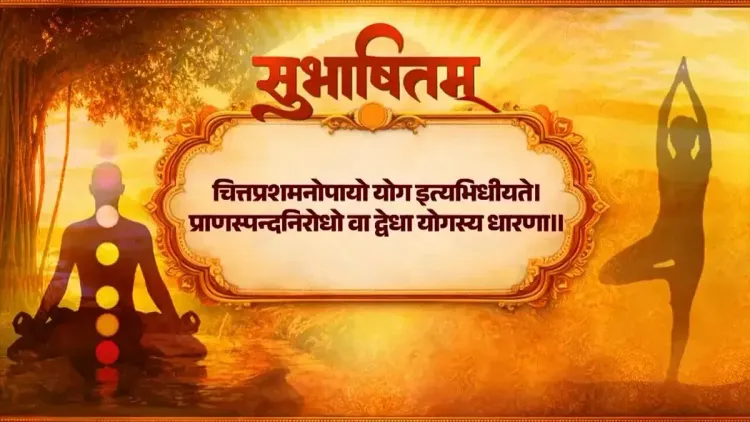
Modi quoted a Sanskrit verse defining yoga as a means to calm the mind through two paths: restraint of mental fluctuations and of vital breath.
International Yoga Day was established by the UN General Assembly via Resolution 69/131 on 11 December 2014 , following Modi's proposal at the UN General Assembly in September 2014 .
India has positioned yoga as a tool of cultural diplomacy and soft power since 2015, with events coordinated by Indian missions across dozens of countries each year.
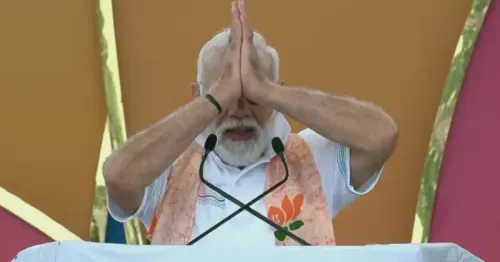
Prime Minister Narendra Modi on Monday, 22 June 2026 took to X to celebrate the growing success of International Yoga Day, calling it proof that yoga is not only improving physical health for crores of people worldwide but also inspiring them to lead confident and positive lives.
In his post, written in Hindi, Modi stated: 'Antarrashtriya Yoga Divas ki badi safalta is baat ka praman hai ki yoga na keval duniyabhar mein croro logo ko sharirik roop se swasth bana raha hai, balki unhe aatmavishwas ke saath sakaratmak jeevan jeene ke liye prerit bhi kar raha hai.' ('The great success of International Yoga Day is proof that yoga is not only making crores of people across the world physically healthy, but also inspiring them to live positive lives with confidence.')
He accompanied the message with a Sanskrit verse — 'Chittaprashamanopayo yoga ityabhidhiyate. Pranaspandanirodhah va dvedha' — a classical definition describing yoga as a means to calm the mind, with two-fold paths: restraint of mental fluctuations and restraint of vital breath.
Context
International Yoga Day is observed every year on 21 June. The observance was formally established by the United Nations General Assembly through Resolution 69/131, adopted on 11 December 2014, following a proposal made by Prime Minister Modi during his address to the UN General Assembly in September 2014.
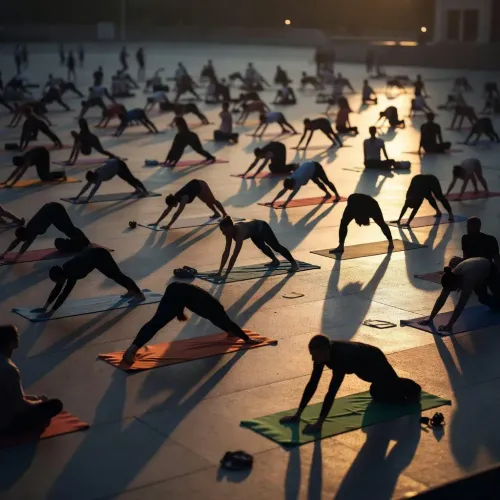
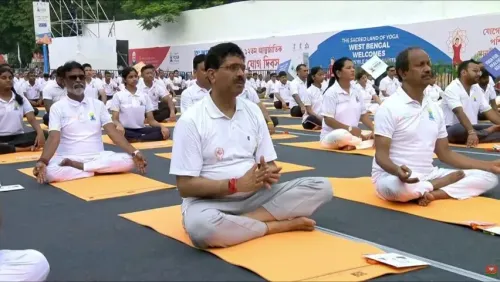
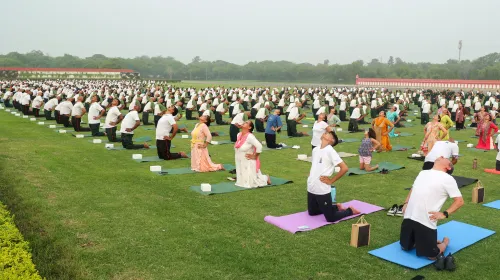
The initiative positioned India as the originator of a globally recognised wellness tradition. Since its first observance in 2015, the day has been marked by mass yoga sessions, government-coordinated events, and participation from Indian diplomatic missions across dozens of countries.
Policy Backdrop
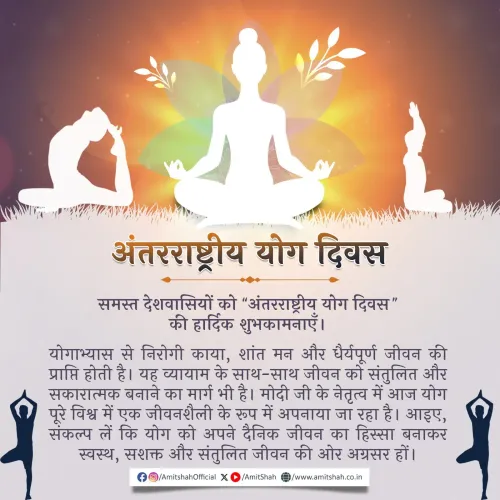
India has consistently framed International Yoga Day as an instrument of cultural diplomacy and soft-power projection. Ministries at the central level, along with state governments and Indian missions abroad, coordinate events annually, embedding yoga within a broader narrative of India's civilisational heritage.
The Sanskrit verse cited by Modi draws from classical yogic philosophy, underscoring the government's effort to anchor the modern wellness movement in ancient textual tradition. This pairing of contemporary health messaging with classical scholarship has been a recurring feature of how the current administration communicates on yoga.
Stakeholders and Impact
The primary beneficiaries of the global yoga movement include millions of practitioners across continents, Indian diaspora communities who use the occasion to connect with cultural roots, and domestic yoga institutions and trainers whose visibility grows with each annual cycle.
For India as a state actor, the sustained global uptake of yoga reinforces a diplomatic narrative that links the country's ancient knowledge systems to contemporary global wellness priorities — a framing that successive governments have found strategically useful in multilateral forums.
What's Next
Attention will now turn to the scale and thematic focus of events held across the country and at Indian missions abroad in the days following 21 June 2026. Policymakers and observers will also watch for any new central or state-level schemes aimed at expanding yoga training infrastructure and integrating yoga into public health programmes.
As the observance enters its second decade, the government's challenge will be to deepen institutional infrastructure around yoga — moving beyond annual visibility events toward sustained, measurable health outcomes for citizens at scale.
Point of View
The Prime Minister signals that the government's yoga diplomacy is as much about projecting civilisational depth as it is about public health. The consistent annual cadence of high-visibility yoga events has allowed India to maintain a soft-power narrative that transcends bilateral friction and resonates across geopolitical lines. As the observance matures, the test will be whether this cultural capital translates into concrete policy gains — in multilateral health forums, diaspora engagement, or domestic wellness infrastructure.
NationPress
20 Sept 2026
Frequently Asked Questions
When is International Yoga Day celebrated?
International Yoga Day is celebrated every year on 21 June . It was declared by the United Nations General Assembly through Resolution 69/131 on 11 December 2014 .
Who proposed International Yoga Day at the United Nations?
Prime Minister Narendra Modi proposed the creation of International Yoga Day during his address to the UN General Assembly in September 2014 , leading to its formal adoption by the UN later that year.
What did PM Modi say about International Yoga Day in 2026?
On 22 June 2026 , PM Modi posted on X saying that the great success of International Yoga Day proves yoga is making crores of people physically healthy and inspiring them to live confident, positive lives. He also quoted a classical Sanskrit verse on yoga's definition.
What is the Sanskrit verse PM Modi quoted about yoga?
Modi quoted 'Chittaprashamanopayo yoga ityabhidhiyate. Pranaspandanirodhah va dvedha' — a classical definition that describes yoga as a means to calm the mind, with two paths: restraint of mental fluctuations and restraint of vital breath.
How does India use International Yoga Day for diplomacy?
India has used International Yoga Day as a soft-power tool since 2015, with Indian diplomatic missions worldwide coordinating annual events to promote India's civilisational heritage and wellness traditions on a global stage.