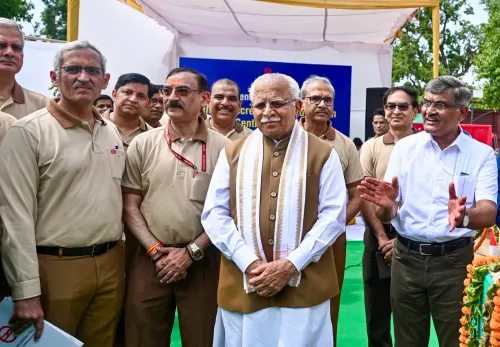
Power Minister Khattar: India ready to supply 284 GW, eyes 300 GW next year
Synopsis
Union Power Minister Manohar Lal Khattar announced India has met a historic peak electricity demand of 270.8 GW, with current supply capacity at 284 GW and a firm plan to reach 300 GW by next year — marking a significant milestone in India's power sector expansion.
Key Takeaways
India met its highest-ever peak electricity demand of 270.8 GW , according to Union Power Minister Manohar Lal Khattar .
The grid is currently capable of supplying up to 284 GW , providing a buffer above the record peak.
The Ministry of Power has already planned to ensure 300 GW supply capacity for the next year.
India is the world's third-largest electricity producer , with peak demand rising steadily alongside economic growth and urbanisation.
The 300 GW target represents an approximately 11 percent step-up from the current record, requiring parallel generation and transmission additions.
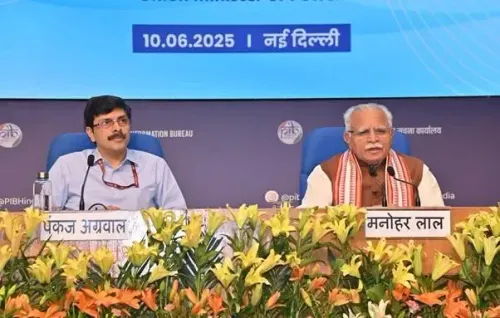
India's power grid just logged a record it has never seen before — and Union Power Minister Manohar Lal Khattar wants the country to know the system held. On Monday, 10 August 2026, Khattar announced that India had successfully met a historic peak electricity demand of 270.8 GW, and that the grid is already primed to handle up to 284 GW — with a firm plan to scale that ceiling to 300 GW by next year.
A record peak — and the grid didn't blink
Khattar's post, written in Hindi, stated plainly: 'हमने इस बार पॉवर की highest ever peak demand 270.8 GW की आपूर्ति की है' — 'This time we have supplied the highest ever peak power demand of 270.8 GW.' For a country that has historically struggled with summer blackouts and demand-supply mismatches, the claim carries real weight. Meeting peak demand without load-shedding is the grid's hardest test, and 270.8 GW sets a new benchmark in India's electricity history.
284 GW ready today, 300 GW locked in for next year
The minister did not stop at celebrating what was. He signalled that supply capacity already exceeds the record peak — the system can deliver up to 284 GW right now, building in a buffer above the historic high. More significantly, he said planning for 300 GW supply capacity for the next fiscal year is already in place. That is not an aspiration; Khattar framed it as a commitment already in motion.
Why these numbers matter for India's energy story
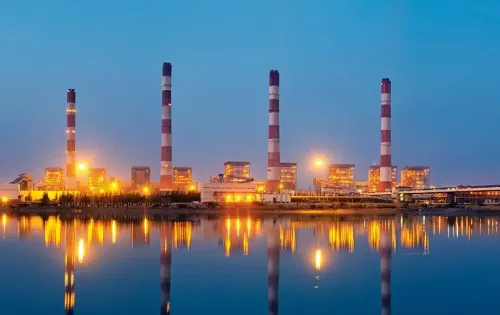
India is the world's third-largest electricity producer, and its peak demand has climbed relentlessly alongside GDP growth, rising appliance penetration, and rapid urbanisation. For years, the gap between demand and reliable supply was the grid's Achilles heel — a gap that cost industry, commerce, and households dearly every summer. The Ministry of Power has pursued a multi-pronged response: capacity additions across both renewable and thermal segments, grid-strengthening under the Revamped Distribution Sector Scheme (2021), and advance planning tied to India's broader pledge of 500 GW non-fossil fuel capacity by 2030, made at COP26.
Khattar's announcement fits squarely into that arc — but with a sharper near-term edge. The jump from 270.8 GW met to 300 GW planned is a roughly 11 percent step-up in a single year, a pace that demands both generation additions and transmission upgrades running in parallel.
What the 300 GW target demands next
The Central Electricity Authority's upcoming demand forecast report will be the first external check on whether the ministry's projections align with independent modelling. Analysts and state distribution companies — the discoms that actually deliver power to homes and factories — will watch closely for announcements on new generation projects and transmission corridors that must be commissioned to back the 300 GW promise. A target without matching infrastructure is just arithmetic.
India's grid has come a long way from the days of scheduled cuts and cascading failures. If the 300 GW supply plan holds, the country will enter next summer with a power sector that looks less like a chronic bottleneck and more like a competitive infrastructure asset.
Point of View
Where domestic supply reliability and renewable scale-up must advance together. The credibility of the 300 GW pledge will ultimately rest on whether transmission infrastructure and discom finances keep pace with generation ambitions.
NationPress
10 Aug 2026
Frequently Asked Questions
What is India's highest ever peak electricity demand?
Union Power Minister Manohar Lal Khattar announced that India successfully met a highest-ever peak electricity demand of 270.8 GW in 2026.
What is India's current power supply capacity?
According to Minister Khattar, India's grid is currently prepared to supply up to 284 GW , exceeding the record peak demand already met.
What is India's electricity supply target for next year?
The Ministry of Power has planned to ensure supply capacity of 300 GW for the next year, as announced by Union Minister Manohar Lal Khattar.
Why is India's peak power demand rising so fast?
India's peak electricity demand has grown consistently due to GDP growth, rapid urbanisation, and rising appliance penetration across households and industry.
What is the Revamped Distribution Sector Scheme?
The Revamped Distribution Sector Scheme , launched in 2021 , is a central government programme to strengthen electricity distribution companies (discoms) and improve supply reliability across India.