Pradhan Welcomes Odisha's Bonus for Kendu Leaf Workers

Synopsis
Union Education Minister Dharmendra Pradhan on 13 July 2026 welcomed the Odisha government's decision to grant additional bonus and incentives to kendu leaf pluckers, binders, and seasonal staff, and cited a TCS rate cut for traders, calling the steps a reflection of the 'double engine government's' antyodaya commitment.
Key Takeaways
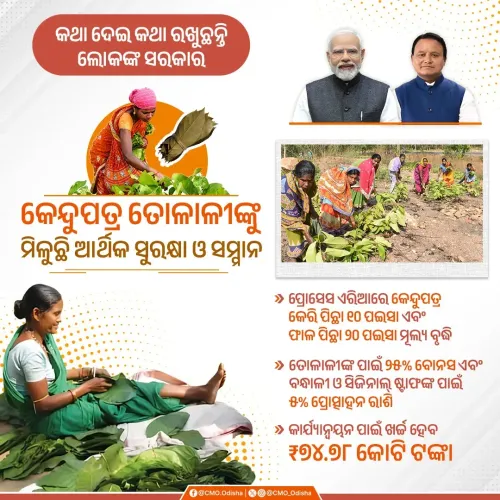
The Odisha state government announced additional bonus and incentive payments for kendu leaf pluckers ( tolali ), binders ( bandhali ), and seasonal staff ( sijinal staff ).
Union Education Minister Dharmendra Pradhan thanked Prime Minister Narendra Modi and Chief Minister Mohan Charan Majhi for the decision.
A reduction in the TCS (Tax Collected at Source) rate for kendu leaf traders was cited alongside the bonus as a relief measure.
Pradhan framed both steps as expressions of the 'double engine government's' commitment to antyodaya — welfare for the poorest.
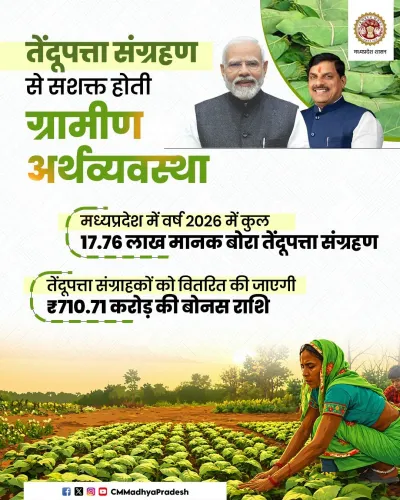
Kendu leaves are a major minor forest produce in Odisha , supporting hundreds of thousands of tribal and forest-dwelling families.
The announcement follows the BJP 's formation of the Odisha state government after the 2024 assembly elections, aligning it with the BJP -led central government.
Union Education Minister Dharmendra Pradhan on Monday, 13 July 2026, welcomed the Odisha state government's announcement of additional bonus and incentive payments for kendu leaf pluckers, binders, and seasonal staff, thanking Prime Minister Narendra Modi and Chief Minister Mohan Charan Majhi for the decision.
Writing in Odia, Pradhan said the announcement would especially benefit bhai o bhaunimane (brothers and sisters) engaged in the kendu leaf trade. He also cited a reduction in the TCS (Tax Collected at Source) rate for kendu leaf traders as a further measure of relief, framing both steps as evidence of what he called the 'double engine government's' commitment to the welfare of the poor.
Context
Kendu leaves — used as the outer wrapper in beedi-making — are one of Odisha's most economically significant minor forest produces. Hundreds of thousands of tribal and forest-dwelling families in the state depend on the seasonal collection and processing of kendu leaves for a substantial part of their annual income. The state government procures and markets the leaves through a regulated system, with pluckers, binders, and seasonal staff paid through a fixed-rate structure that includes periodic bonuses.
The announcement of an additional bonus and incentive amount — alongside a reported reduction in the TCS rate applicable to kendu leaf traders — is aimed at putting more money directly in the hands of those at the base of this supply chain.
Policy Backdrop
Support for minor forest produce (MFP) economies has been a recurring theme in central and state policy over the past decade. The Minimum Support Price for Minor Forest Produce scheme, launched nationally in 2013, was designed to protect tribal collectors of items such as kendu leaves from price exploitation. The Pradhan Mantri Van Dhan Yojana, launched in 2018, further sought to promote value addition and better marketing of MFP by tribal self-help groups.
Odisha, with one of the largest scheduled tribe populations in India, has been a key state for such interventions. The BJP formed the state government in Odisha after winning the 2024 assembly elections, creating the 'double engine' alignment — the same party in power at both the Centre and the state — that Pradhan referenced in his post.
Stakeholders and Impact
The primary beneficiaries are kendu leaf pluckers (tolali), binders (bandhali), and seasonal staff (sijinal staff) — categories that represent the most economically vulnerable participants in the kendu leaf economy. These workers, many of them from tribal communities in Odisha's forested districts, depend on the bonus component of their earnings as a critical income supplement at the end of the procurement season.
Kendu leaf traders, who operate in a regulated market, stand to benefit from any reduction in the TCS rate, which affects their working capital and compliance burden. Pradhan described both measures together as an expression of the antyodaya principle — welfare directed at the last person in the economic chain.
What's Next
Formal state government notifications are expected to detail the exact bonus amounts, the revised TCS rate, and the disbursement mechanism for eligible workers. The Odisha government's implementation of these measures will be closely watched by forest produce economies in neighbouring states such as Chhattisgarh and Jharkhand, where similar kendu leaf and minor forest produce systems operate. If the bonus and tax relief translate into measurable income gains for pluckers and binders, the model could inform broader MFP welfare policy at the national level.
Point of View
Economically vulnerable tribal constituency in Odisha. The 'double engine government' framing — a recurring BJP motif — is deployed here to reinforce the electoral dividend of party alignment between Delhi and Bhubaneswar after the 2024 Odisha assembly win. By invoking 'antyodaya,' a concept rooted in Deendayal Upadhyaya's philosophy and central to BJP's ideological self-presentation, Pradhan connects a state-level administrative decision to a broader national narrative of inclusive growth. The post also signals Pradhan's continued political investment in Odisha, his home state, even as he holds a national portfolio.
NationPress
12 Oct 2026
Frequently Asked Questions
What is the Odisha government's announcement about kendu leaf workers?
The Odisha state government announced additional bonus and incentive payments for kendu leaf pluckers, binders, and seasonal staff. The measure is aimed at improving the income of tribal and forest-dwelling families dependent on kendu leaf collection and processing.
Who are kendu leaf pluckers and why do they need government support?
Kendu leaf pluckers are workers — many from tribal communities — who collect kendu leaves from forests in states like Odisha. The leaves are used as wrappers in beedi-making. These workers are among the most economically vulnerable, and government bonuses form a critical part of their seasonal income.
What is the TCS rate reduction for kendu leaf traders?
Union Minister Dharmendra Pradhan cited a reduction in the Tax Collected at Source (TCS) rate applicable to kendu leaf traders as an additional relief measure. Exact revised figures are yet to be confirmed through a formal state government notification.
What is the 'double engine government' that Pradhan referred to?
'Double engine government' is a BJP phrase describing a situation where the same party governs both at the Centre and in a particular state, suggesting better coordination on welfare and development. Pradhan used it to credit both PM Modi's central government and CM Mohan Majhi's Odisha government for the kendu leaf bonus.
What is antyodaya and why did Pradhan mention it?
Antyodaya — meaning 'upliftment of the last person' — is a welfare philosophy rooted in the ideology of Deendayal Upadhyaya and central to BJP's political narrative. Pradhan invoked it to frame the kendu leaf bonus and TCS relief as part of a broader commitment to the poorest sections of society.