Pradhan Hails 12 Years of Modi Govt, Cites NEP 2020
Synopsis
Union Education Minister Dharmendra Pradhan marked 12 years of the Modi government on 26 May 2026, praising NEP 2020 as a cornerstone of the Viksit Bharat 2047 vision and citing flagship welfare schemes from housing to digital inclusion as milestones of the administration's record.
Key Takeaways
Union Education Minister Dharmendra Pradhan posted on X on 26 May 2026 marking 12 years of the Modi-led central government .
He highlighted NEP 2020 — which replaced a 34-year-old policy from 1986 — as foundational to the Viksit Bharat 2047 developed-nation goal.
Schemes cited include Pradhan Mantri Awas Yojana , Ayushman Bharat (up to Rs 5 lakh health cover per family), PM Jan Dhan Yojana , Ujjwala Yojana , PM Kisan Samman Nidhi , Startup India and Digital India .
Pradhan linked education reform directly to zero-tolerance security policy, digital transformation and women's empowerment as integrated pillars of the government's record.
State-level adoption of NEP 2020 provisions in the 2026-27 academic year and Viksit Bharat 2047 monitoring mechanisms remain key areas to watch.
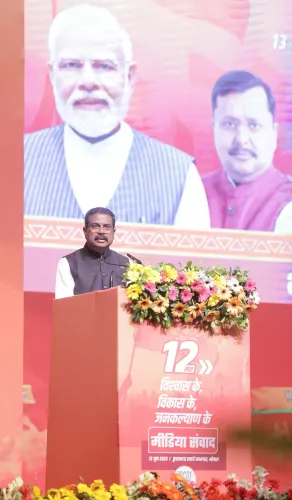
Union Education Minister Dharmendra Pradhan on Tuesday, 26 May 2026, took to X to mark the completion of 12 years of the Narendra Modi-led central government, crediting the administration with establishing new benchmarks in self-reliance, digital transformation, infrastructure, women's empowerment and education reform.
Context
Posting in Hindi, Pradhan wrote that the central government had completed '12 aitihasik varsh' ('12 historic years') under Prime Minister Modi's leadership, guided by the values of 'rashtra seva' (national service), good governance and public welfare as the highest priority. He extended his 'heartfelt felicitations' to the Prime Minister for this 'transformative journey' that has turned the 'Viksit Bharat 2047' resolve into a mass movement.
The post arrives as BJP and its allied governments across states mark the anniversary of Modi's first swearing-in on 26 May 2014, with senior ministers and party leaders issuing tributes across social media platforms.
Policy Backdrop
Pradhan specifically highlighted the National Education Policy 2020 (NEP 2020), approved in July 2020, as having given 'a new direction to mother tongue instruction, skill development, innovation and modern education.' The policy replaced a 34-year-old framework dating to 1986 and introduced a 5+3+3+4 curricular structure, with an emphasis on vocational integration from early schooling.
The minister described NEP 2020 as 'the cornerstone of a strong future for Viksit Bharat,' aligning his education portfolio directly with the government's overarching goal of making India a developed nation by 2047, the centenary of independence.
Among the flagship schemes Pradhan cited were Pradhan Mantri Awas Yojana (housing), Ayushman Bharat (health insurance providing up to Rs 5 lakh cover per family), PM Jan Dhan Yojana (financial inclusion, launched August 2014), Ujjwala Yojana (LPG access for below-poverty-line women, launched May 2016), PM Kisan Samman Nidhi (farmer income support), Startup India (announced January 2016) and Digital India.
Stakeholders and Impact
The schemes referenced in Pradhan's post collectively target students, rural households, women beneficiaries, farmers and aspiring entrepreneurs — constituencies the BJP has consistently framed as the primary beneficiaries of the NDA government's welfare delivery model. Ayushman Bharat alone was designed to cover tens of crore families in its secondary and tertiary care insurance component.
Pradhan's framing also invokes a zero-tolerance policy against terrorism and a 'cultural renaissance,' situating security and identity alongside economic and educational metrics as pillars of the 12-year record. As Education Minister, his emphasis on NEP 2020 underscores the policy's centrality to the government's human-development narrative ahead of the 2026-27 academic year, when state-level adoption of new textbooks and vocational courses is under close watch.
What's Next
Implementation of NEP 2020 provisions — particularly mother-tongue-medium instruction and expanded vocational tracks — at the state level will be a key indicator of how the policy vision translates into classroom reality in the coming academic cycle. Budget allocations and parliamentary updates on monitoring mechanisms for the Viksit Bharat 2047 roadmap are also expected to draw scrutiny in the months ahead.
As the government enters what it is marking as its thirteenth year, the convergence of education reform, welfare delivery and the 2047 developed-nation target is likely to remain the dominant frame through which senior ministers, including Pradhan, communicate the administration's agenda to the public.
Point of View
He positions education reform not as a standalone policy but as the human-capital engine of an economic and civilisational project. The enumeration of welfare schemes signals the BJP's continued reliance on direct-benefit-transfer optics as its primary voter-communication tool. The tribute also reflects a coordinated party-wide messaging exercise timed to the May 26 anniversary, consistent with the BJP's pattern of using ministerial social-media reach to amplify government milestones.
NationPress
19 Sept 2026
Frequently Asked Questions
Why is 26 May 2026 significant for the Modi government?
26 May 2026 marks 12 years since Narendra Modi was first sworn in as Prime Minister on 26 May 2014 , making it an anniversary milestone that senior BJP leaders and ministers have been publicly commemorating.
What did Dharmendra Pradhan say about NEP 2020?
Pradhan described NEP 2020 as having given 'a new direction to mother tongue instruction, skill development, innovation and modern education,' calling it 'the cornerstone of a strong future for Viksit Bharat .'
What is Viksit Bharat 2047?
Viksit Bharat 2047 is the Indian government's official vision to make India a fully developed nation by 2047 , the centenary of independence, encompassing economic growth, infrastructure, welfare delivery and human development targets.
Which schemes did Pradhan highlight in his post?
Pradhan cited Pradhan Mantri Awas Yojana , Ayushman Bharat , PM Jan Dhan Yojana , Ujjwala Yojana , PM Kisan Samman Nidhi , Startup India and Digital India as 'historic initiatives' that have delivered development to the last person.
What changes did NEP 2020 introduce to India's education system?
NEP 2020 , approved in July 2020 , replaced the 1986 education policy and introduced a 5+3+3+4 curricular framework, emphasis on mother-tongue-medium instruction in early years, vocational skill integration and a multidisciplinary approach to higher education.