Pradhan pays tribute to 'Gadajata Gandhi' Sarangadhar Das
Synopsis
Union Education Minister Dharmendra Pradhan marked the birth anniversary of Sarangadhar Das, the 'Gadajata Gandhi' of Odisha, honouring the freedom fighter's leadership of the Gadajata Praja Andolan that fought for democratic rights across Odisha's 26 princely states before their merger with India in 1949.
Key Takeaways
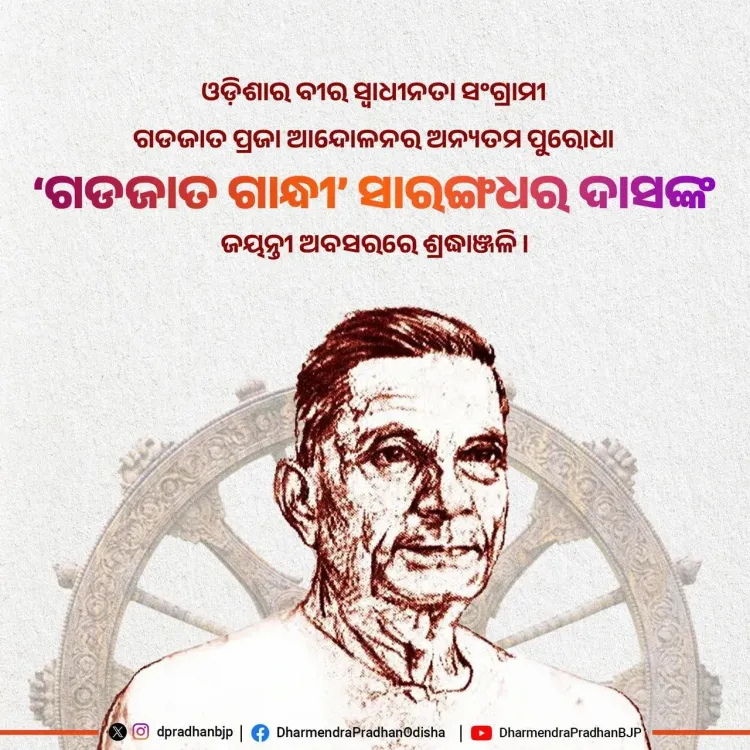
Dharmendra Pradhan offered tribute to Sarangadhar Das on his birth anniversary on 17 October 2026 , posting in Odia on X.
Sarangadhar Das is popularly known as the 'Gadajata Gandhi' for his leadership of the Gadajata Praja Andolan.
The Gadajata Praja Andolan was a popular people's movement across Odisha's 26 princely states in the 1930s–1940s demanding democratic rights and merger with independent India.
Sustained Prajamandal agitations helped complete the merger of Odisha's princely states with the Indian Union by 1949 .
Pradhan's tribute, posted in Odia, reflects a broader pattern of acknowledging Odisha's distinct and often under-recognised contributions to the national freedom struggle.
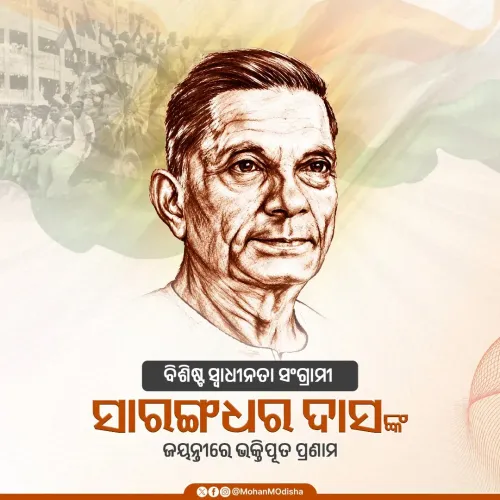
A freedom fighter who stood up for ordinary people inside Odisha's princely states — and paid a steep personal price for it — was remembered on his birth anniversary on Saturday, 17 October 2026. Union Education Minister Dharmendra Pradhan offered homage to Sarangadhar Das, the revered Odia independence activist hailed as the 'Gadajata Gandhi', acknowledging his towering role in the Gadajata Praja Andolan.
Posting in Odia on the occasion, Pradhan described Das as 'ଓଡ଼ିଶାର ବୀର ସ୍ଵାଧୀନତା ସଂଗ୍ରାମୀ' — 'a brave freedom fighter of Odisha' — and as a foremost leader of the Gadajata Praja movement, offering his shraddhanjali (respectful tribute) on the activist's birth anniversary.The man who challenged Odisha's princely order
Sarangadhar Das earned his Gandhian epithet the hard way. In the 1930s and 1940s, Odisha was a patchwork of 26 princely states — feudal territories outside direct British administration — where ordinary peasants and subjects had few democratic rights and little recourse against autocratic rulers. The Gadajata Praja Andolan (literally, 'the people's movement of the princely states') rose to challenge exactly this order, demanding civil liberties, democratic governance, and eventually, merger with an independent India. Das was among its most prominent architects. The agitation was part of a wider Prajamandal movement that swept the princely states of the Indian subcontinent in the decades leading up to independence — but in Odisha it carried its own distinct texture, rooted in the Odia language, culture, and a fierce sense of regional identity. By 1949, sustained pressure from these movements helped complete the merger of Odisha's princely states with the Indian Union, stitching together a state that now stands as one of India's most culturally distinct.Pradhan's Odia identity and the politics of remembrance
Dharmendra Pradhan, himself a senior leader from Odisha who has held cabinet portfolios across two Modi governments — from Petroleum to Education — has consistently used occasions like these to speak to his home state in its own language. Posting in Odia rather than Hindi or English is a deliberate signal: regional pride, rooted belonging, and a recognition that Odisha's contribution to the national freedom struggle runs deeper than the names that dominate mainstream textbooks. The broader pattern among BJP leaders with Odisha roots is to surface state-level freedom fighters who rarely appear in national narratives — a cultural and political project that reinforces both Odia identity and the party's outreach in a state where it has steadily expanded its footprint. As Odisha's school curricula and cultural institutions debate which local heroes deserve more prominent placement, the spotlight on figures like Sarangadhar Das is a reminder that independence was won not just on the banks of the Sabarmati, but in the forests and fields of Odisha's forgotten princely territories too.Point of View
Invoking the Gadajata Gandhi carries cultural currency in a state the party has worked hard to consolidate. The fact that Pradhan posted in Odia signals an awareness that linguistic authenticity matters as much as the tribute itself. As debates over school curricula and regional identity intensify, such moments quietly shape whose story gets told as 'India's freedom struggle.'
NationPress
17 Oct 2026
Frequently Asked Questions
Who was Sarangadhar Das?
Sarangadhar Das was an Odia freedom fighter and a leading figure of the Gadajata Praja Andolan, the popular movement for democratic rights across Odisha's princely states in the 1930s and 1940s. He is popularly called the 'Gadajata Gandhi.'
What was the Gadajata Praja Andolan?
The Gadajata Praja Andolan was a series of people's movements across Odisha's 26 princely states in the 1930s–1940s that demanded civil liberties, democratic governance, and eventual merger with independent India. The princely states completed their merger with the Indian Union by 1949.
Why is Sarangadhar Das called 'Gadajata Gandhi'?
Sarangadhar Das earned the epithet 'Gadajata Gandhi' for leading non-violent, Gandhian-style agitations inside Odisha's feudal princely states, championing the rights of ordinary people against autocratic rulers.
Why did Dharmendra Pradhan pay tribute to Sarangadhar Das?
Pradhan posted on X on 17 October 2026 to mark Sarangadhar Das's birth anniversary, describing him as a brave freedom fighter of Odisha and paying his respects in the Odia language.
When were Odisha's princely states merged with India?
The merger of Odisha's princely states with the Indian Union was completed by 1949, following sustained Prajamandal and Gadajata agitations that pressured the states to accede.