Pralhad Joshi extends Vijayadashami wishes, honours Shami tree tradition
Synopsis
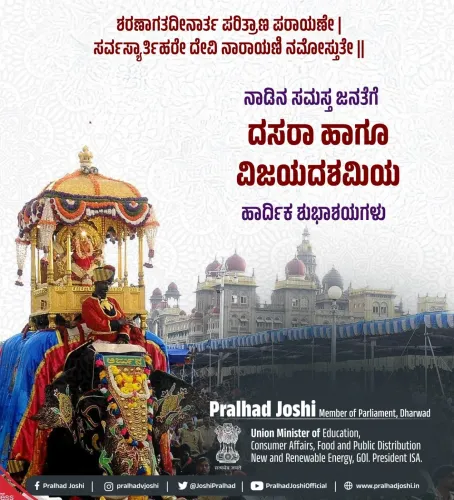
Union Minister Pralhad Joshi posted Vijayadashami greetings in Kannada, citing a classical Sanskrit shloka on the Shami tree, invoking the Karnataka tradition of Banni mara worship and the exchange of leaves as a symbol of gold and shared prosperity.
Key Takeaways
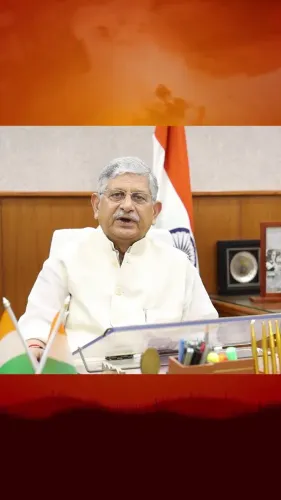
Pralhad Joshi , Union Minister of Consumer Affairs and New and Renewable Energy, posted Vijayadashami greetings on 20 October 2026 .
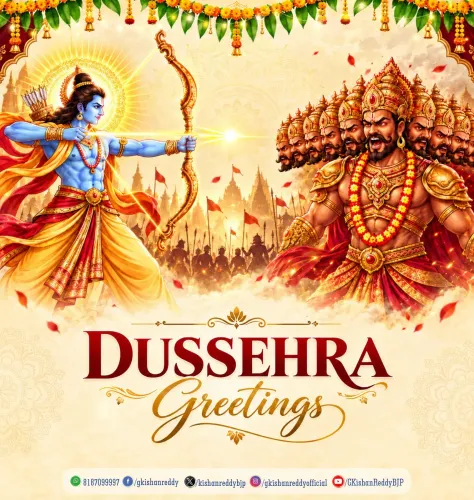
He cited a Sanskrit shloka linking the Shami (Banni) tree to both Arjuna's bow and Lord Rama's worship before battle.
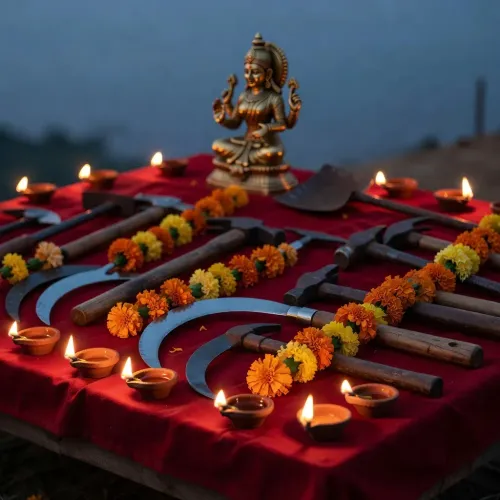
The post invoked Karnataka's distinct tradition of Banni mara puje — worshipping the Shami tree and exchanging its leaves as symbolic gold.
Joshi wished all citizens happiness, peace, prosperity, health, and success, framing the festival as a victory of dharma over evil.
The post was written in Kannada , targeting Karnataka's regional audience, and included the hashtags #Vijayadashami , #Dasara .
On the auspicious morning of Vijayadashami 2026, Union Consumer Affairs Minister Pralhad Joshi reached out to the people of Karnataka with a heartfelt invocation rooted in ancient Sanskrit verse — a reminder that the festival is as much about living tradition as it is about celebration.
Joshi opened his post with a classical Sanskrit shloka honouring the Shami tree: 'Shami shamyate papam, Shami shatruvinashini' — 'The Shami tree destroys sin; the Shami tree destroys enemies' — lines that link the tree to both Arjuna, who hid his bow in a Shami before the war of Kurukshetra, and to Lord Rama, who is said to have worshipped it before his campaign against Ravana. The verse is a staple of Karnataka's Vijayadashami liturgy, recited as families offer prayers to the tree before exchanging its leaves as a symbol of gold.
The Banni tree, gold, and Karnataka's Dasara identity
The minister specifically invoked the Kannada custom of Banni mara puje — worship of the Shami tree, locally called Banni — and the folk saying that those who exchange Banni leaves on this day will be as prosperous as gold: 'Navu-neevu Banni togond bangaaradanga irona' — 'Let us, by exchanging Banni, be like gold to each other.' This phrase captures the communal warmth of the festival, where neighbours and relatives exchange the sacred leaves as a token of goodwill and shared fortune.
In Karnataka, Dasara is not merely a day — it is a ten-day state festival centred on Mysuru, climaxing with the grand torchlight parade and the illuminated Mysore Palace. The Banni tree ritual adds a distinctly agrarian, epics-rooted dimension to the celebrations, setting Karnataka's observance apart from the Ravan-effigy traditions more common further north.
Victory of dharma, a minister's message
Joshi's full message wished every citizen happiness, peace, prosperity, good health, and success, framing Vijayadashami as the symbol of 'dushta shaktiyala samhara, dharmada vijaya hagu satyada jaya' — the annihilation of evil forces, the triumph of righteousness, and the victory of truth. It is a message that echoes the festival's core mythology across its many regional avatars.
For Karnataka's BJP, Dasara also carries political resonance — the party has historically sought to identify with the Mysore Dasara pageant and its royal heritage. A senior Kannada-speaking Union minister invoking the festival's classical verse in his native language reinforces that cultural connect with a regional audience ahead of ongoing state political cycles.
As marigolds garland the Banni saplings across Karnataka this morning, Joshi's post serves as a bridge between the ancient shloka and the social-media feed — tradition, travelling at the speed of a notification.
Point of View
With classical verse intact, on one of Karnataka's most important festivals. It fits a well-established BJP pattern of using festival occasions to reinforce civilisational identity alongside political visibility. The specific invocation of Shami-tree mythology — connecting Arjuna, Rama, and local Banni worship — shows an awareness of Karnataka's distinct Dasara traditions rather than a generic national template. As the party navigates state-level political pressures, such culturally fluent outreach to Kannada speakers remains a low-cost, high-frequency tool of constituency maintenance.
NationPress
20 Oct 2026
Frequently Asked Questions
What is the significance of the Shami tree on Vijayadashami?
The Shami tree, called Banni in Kannada, is worshipped on Vijayadashami because Arjuna hid his weapons in it before the battle of Kurukshetra and Lord Rama prayed to it before fighting Ravana. Exchanging its leaves symbolises prosperity and is considered as auspicious as gifting gold.
What did Pralhad Joshi post on Vijayadashami 2026?
Pralhad Joshi posted a Kannada-language Vijayadashami greeting that included a classical Sanskrit shloka on the Shami tree, invoked Karnataka's Banni mara worship tradition, and wished all citizens happiness, peace, prosperity, health, and success.
What is the meaning of the shloka 'Shami shamyate papam'?
The shloka means: 'The Shami tree destroys sin, the Shami tree destroys enemies; it is the bearer of Arjuna's bow and the beloved sight of Lord Rama. As I undertake my journey, may you, worshipped by Sri Rama, ensure there are no obstacles.'
How is Vijayadashami celebrated differently in Karnataka?
Karnataka's Vijayadashami, especially in Mysuru, features a grand state festival with palace illuminations and a torchlight parade. Distinctively, Kannada tradition emphasises the Banni (Shami) tree worship and the exchange of Banni leaves among neighbours and family as a symbol of shared gold-like prosperity.
Why do BJP leaders frequently post festival greetings in regional languages?
Posting in regional languages on major festivals allows national leaders to signal cultural fluency and connect with state-level audiences. For a Kannada-speaking senior minister like Pralhad Joshi, addressing Karnataka constituents in Kannada on Dasara reinforces both regional identity and political presence.