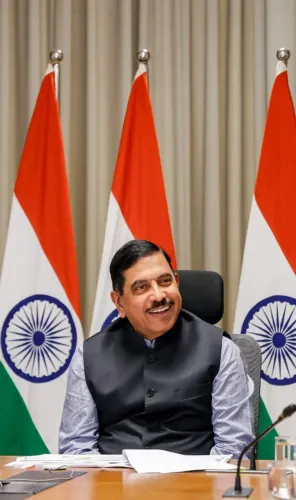
Pralhad Joshi meets Tata Sons chief N. Chandrasekaran on higher education

Synopsis
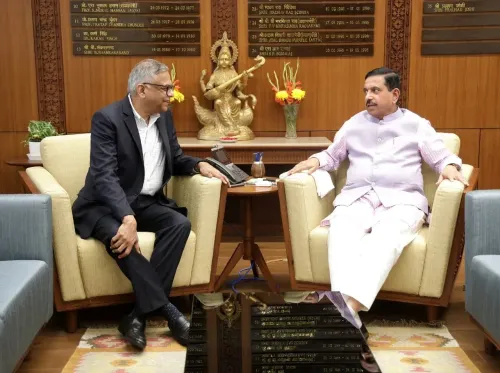
Union Minister Pralhad Joshi met Tata Sons Chairman N. Chandrasekaran — who also chairs IIM Lucknow's Board of Governors — on 22 October 2026 to discuss strategies for strengthening India's higher education ecosystem, reflecting the government's push to embed corporate expertise in premier institutional governance under NEP 2020.
Key Takeaways
Union Minister Pralhad Joshi met N.
Chandrasekaran , Chairman of Tata Sons and Board of Governors Chair at IIM Lucknow , on 22 October 2026 .
The discussion centred on 'key strategies to strengthen India's higher education ecosystem,' though specific outcomes were not disclosed.
Chandrasekaran's dual role — heading India's largest conglomerate and chairing an IIM board — reflects the IIM Act 2017 's mandate for industry representation in institutional governance.
IIM Lucknow , established in 1984 , is one of the country's six original Indian Institutes of Management.
The meeting aligns with National Education Policy 2020 's emphasis on industry participation in higher education governance and curriculum design.
Joshi posted in both English and Kannada, signalling outreach to a Karnataka constituency on a national policy issue.
A Tata Group titan and a Union Cabinet minister walked into a room to talk about India's classrooms — and the conversation points straight to the heart of National Education Policy 2020's most ambitious bet: pulling corporate India into the governance of its premier institutions. Union Consumer Affairs Minister Pralhad Joshi met N. Chandrasekaran, Chairman of Tata Sons and Chairman of the Board of Governors at IIM Lucknow, on Thursday, 22 October 2026, to discuss 'key strategies to strengthen India's higher education ecosystem.'
Posting in both English and Kannada on X, Joshi described the meeting as a discussion on strengthening higher education — ಭಾರತದ ಉನ್ನತ ಶಿಕ್ಷಣ ವ್ಯವಸ್ಥೆಯನ್ನು ಮತ್ತಷ್ಟು ಬಲಪಡಿಸುವ ಪ್ರಮು� ಕಾರ್ಯತಂತ್ರಗಳ ಕುರಿತು ('on key strategies to further strengthen India's higher education system'). The Kannada text underscores the minister's direct outreach to a Karnataka-rooted constituency on a national policy question.
Chandrasekaran at IIM Lucknow: industry at the governance table
N. Chandrasekaran is one of corporate India's most prominent figures — former CEO of Tata Consultancy Services and, since 2017, Chairman of Tata Sons, the holding company of India's largest conglomerate. His role as Chairman of the Board of Governors at IIM Lucknow is itself a product of deliberate policy design. The IIM Act 2017 explicitly mandated the inclusion of industry experts on institutional boards, handing management schools greater autonomy while embedding corporate experience into their decision-making at the top.
IIM Lucknow, established in 1984, is among the country's six original IIMs. With Chandrasekaran chairing its board, it sits at an interesting intersection: world-class management education, Tata Group's known investments in skill development, and a government pushing hard on NEP 2020's industry-linkage agenda.
NEP 2020 and the public-private push in management education
The meeting fits a recognisable pattern in India's post-NEP education landscape. National Education Policy 2020 specifically encourages industry participation not just in curriculum design but in institutional governance — moving well beyond the old model of occasional campus recruiters. The Indian government has steadily brought corporate executives into the boards of premier institutions, with the explicit goal of improving global competitiveness and labour-market alignment. What makes this meeting noteworthy is the combination of portfolios: Joshi holds neither the Education nor the Skill Development ministry. His Consumer Affairs and New and Renewable Energy mandates make the conversation with a management school chairman worth watching for any cross-sectoral threads — energy, sustainability, supply chain — that could find their way into curriculum or research collaboration.
The specific strategies discussed were not disclosed, and no formal outcomes or programme announcements accompanied the post.
Point of View
Not just co-operation. Chandrasekaran brings the combined weight of Tata Group's global footprint and India's most storied IT services legacy to a governance table that, a decade ago, was the exclusive domain of academics and bureaucrats. What makes the encounter politically interesting is Joshi's portfolio: a minister without an education brief seeking out an education governance conversation suggests either a cross-sectoral agenda — perhaps renewable energy or supply-chain research — or a broader signal that NEP 2020's industry-linkage push is being championed across the Cabinet, not just within the Education Ministry.
NationPress
22 Oct 2026
Frequently Asked Questions
Why did Pralhad Joshi meet N. Chandrasekaran?
Union Minister Pralhad Joshi met Tata Sons Chairman N. Chandrasekaran on 22 October 2026 to discuss strategies for strengthening India's higher education ecosystem, particularly in the context of Chandrasekaran's role as Chairman of the Board of Governors at IIM Lucknow.
What is N. Chandrasekaran's role at IIM Lucknow?
N. Chandrasekaran serves as Chairman of the Board of Governors at IIM Lucknow. Under the IIM Act 2017, industry experts like Chandrasekaran are mandated to sit on institutional boards to improve governance and industry alignment.
What is the IIM Act 2017?
The IIM Act 2017 grants greater autonomy to Indian Institutes of Management and requires the inclusion of industry experts on their boards of governors, reducing direct government control over their day-to-day academic and administrative decisions.
How does NEP 2020 relate to industry participation in IIMs?
National Education Policy 2020 specifically encourages corporate participation in higher education governance and curriculum design, making meetings like Joshi's with Chandrasekaran part of a deliberate policy effort to align premier institutions with industry needs and global competitiveness.
What portfolios does Union Minister Pralhad Joshi hold?
Pralhad Joshi is the Union Minister of Consumer Affairs, Food and Public Distribution, and Minister of New and Renewable Energy. He is a senior BJP leader from Karnataka.