Why is Pralhad Joshi Criticizing the Karnataka Government Over Ballot Paper Use?
Click to start listening
Synopsis
Union Minister Pralhad Joshi has voiced strong opposition to the Karnataka government's decision to use ballot papers for local body elections, arguing it undermines decades of electoral progress. He emphasizes the trust in EVMs and criticizes the backward shift in voting methods.
Key Takeaways
- Pralhad Joshi criticizes Karnataka's ballot paper decision.
- Karnataka was a leader in EVM technology.
- Public trust in EVMs remains strong.
- Ballot papers seen as a regression in electoral progress.
- Local body elections scheduled post-May 25.
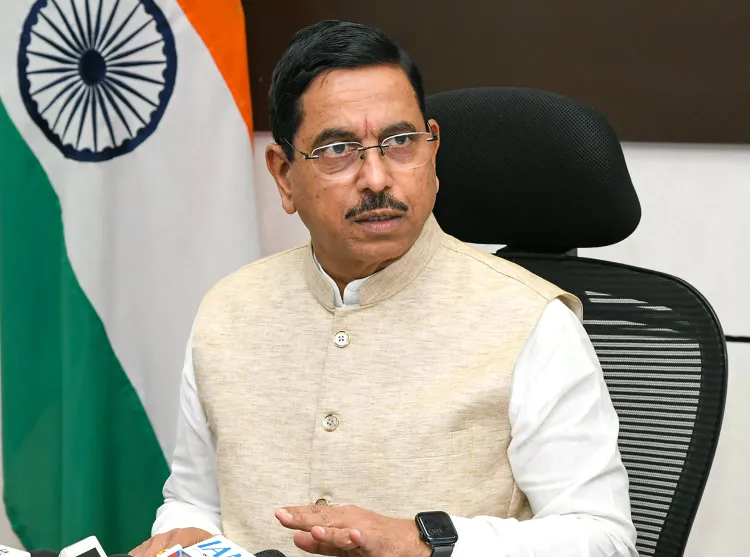
New Delhi, Jan 19 (NationPress) Union Minister for Food and Parliamentary Affairs Pralhad Joshi has vehemently condemned the Karnataka Congress-led government for its insistence on utilizing ballot papers in local body elections, labeling it a tragedy and a source of embarrassment.
He emphasized that Karnataka was a trailblazer in the EVM revolution, yet the Congress-led state government now stands as an impediment to advancement.
Joshi asserted that the decision by the State Election Commission to hold local body elections with ballot papers instead of EVMs represents a retrogressive move that threatens to undermine decades of electoral progress.
He characterized this decision as a step backwards that could derail the achievements made over the years.
He referenced a recent KAP (Knowledge, Attitude and Practice) survey conducted by a state government department, which clearly demonstrated that the public trusts EVMs.
Bengaluru was one of the first cities in India to experiment with EVMs in the late 1980s, and Karnataka officially embraced EVMs in the 1990s.
Returning to outdated voting methods is indeed unfortunate, he remarked.
Joshi noted that EVMs equipped with VVPAT have become integral to India’s electoral framework.
However, he accused the Karnataka government of disregarding these facts and opting for ballot papers to accommodate unfounded claims regarding electoral integrity.
He also mentioned that electoral malpractices at polling stations significantly diminished after the implementation of EVMs.
The recent KAP survey by a Karnataka state department further reaffirmed public trust in EVMs.
Karnataka has played a pivotal role in advancing India’s EVM revolution, and VVPAT-enabled EVMs have further fortified the nation's electoral system, he insisted.
By overlooking this legacy and choosing to revert to ballot papers merely to appease its leadership in Delhi, the Congress-led government has acted in a manner that is undeniably shameful, Joshi alleged.
It is noteworthy that the Karnataka State Election Commission (SEC) has declared that ballot papers will be utilized instead of electronic voting machines (EVMs) for the Bengaluru civic elections, which are set to occur post-May 25.
Karnataka State Election Commissioner G.S. Sangreshi made this announcement during a press conference on Monday after unveiling the draft voters’ list for elections within the Greater Bengaluru Authority (GBA) limits.
“Civic elections for the five newly established municipal corporations under the GBA will be conducted after May 25, utilizing ballot papers instead of electronic voting machines,” he stated.
The forthcoming elections for the GBA, district panchayats, taluk panchayats, and gram panchayats will also employ ballot papers, he confirmed.
Deputy Chief Minister and State Congress President D.K. Shivakumar mentioned that there is a proposal to conduct all local body elections, including the civic polls in Bengaluru, simultaneously.
“Our government has resolved to carry out district and taluk panchayat elections. The Chief Minister and ministers have indicated that the issues related to reservations for these elections will be addressed. Many have suggested that gram panchayat elections should also be held on party symbols, but no decision has been made in that regard yet. There is consideration for holding all these elections concurrently,” Shivakumar remarked.
When questioned about the choice of ballot papers over electronic voting machines for these local body elections, he replied: “I have also received information regarding this. It falls under the purview of the State Election Commission. There is nothing inherently wrong with using ballot papers. The most crucial aspect is that voting occurs.”
Point of View
It is essential to recognize the significance of Pralhad Joshi's criticism regarding the Karnataka government's decision. While the use of ballot papers may evoke nostalgia, it risks undermining the progress made by EVM technology in ensuring fair elections. The debate surrounding this issue reflects broader concerns about electoral integrity and public trust. It is crucial to approach this topic with a balanced perspective, acknowledging both historical practices and technological advancements.
NationPress
19/01/2026
Frequently Asked Questions
What prompted Pralhad Joshi's criticism of the Karnataka government?
Pralhad Joshi criticized the Karnataka government for deciding to use ballot papers instead of electronic voting machines (EVMs) for local body elections, calling it a regressive step.
What has been the public's response to EVMs according to recent surveys?
Recent surveys, including the KAP survey conducted by a state government department, indicate that the public largely trusts EVMs.
When will the local body elections in Karnataka be held?
The local body elections in Karnataka are scheduled to occur after May 25, with ballot papers being used for voting.
Who announced the use of ballot papers in the Karnataka elections?
The announcement regarding the use of ballot papers was made by Karnataka State Election Commissioner G.S. Sangreshi at a press conference.
What are the implications of reverting to ballot papers in elections?
Reverting to ballot papers may undermine the advancements made in electronic voting, potentially affecting public trust and the integrity of the electoral process.