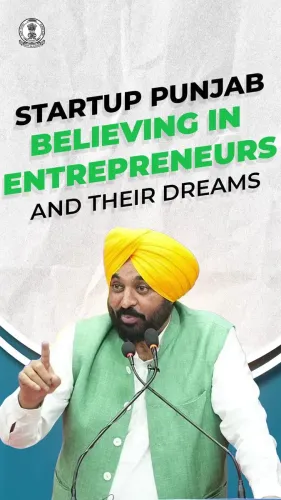
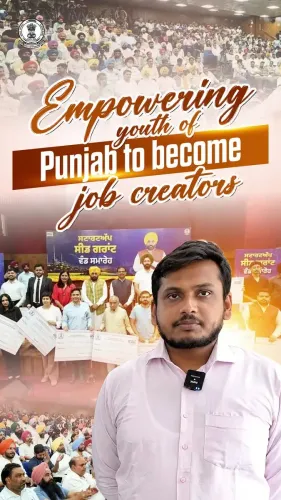
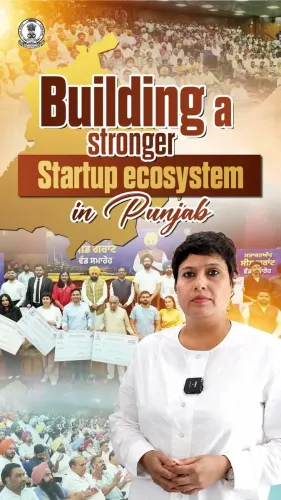
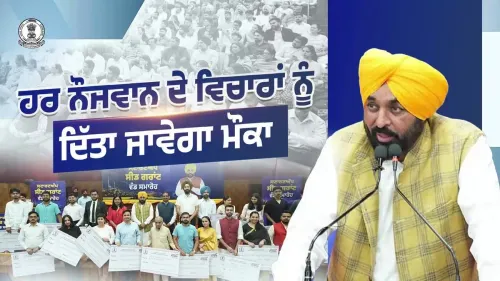
Punjab CMO Launches Business Blasters for Class 11-12 Students
Synopsis
Punjab's CMO announced Business Blasters as a mandatory Class 11-12 subject across nearly 3,800 schools — government and private — reaching over 2.68 lakh students with entrepreneurial education and seed funding access in the current academic year.
Key Takeaways
Business Blasters is now a mandatory subject for all Class 11 and 12 students in Punjab's government and private schools.
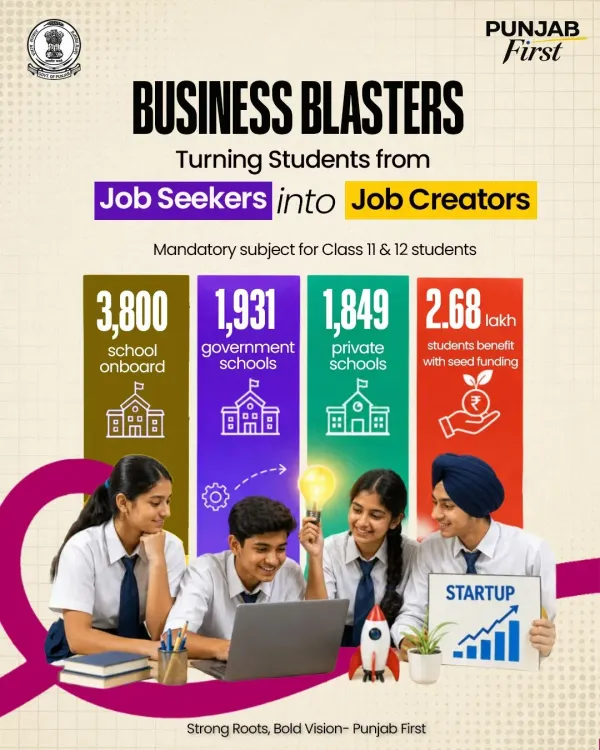
The programme has reached nearly 3,800 schools in the current academic year, including 1,931 government and 1,849 private schools.
More than 2.68 lakh students across Punjab are benefiting from the initiative this year.
The curriculum offers entrepreneurial education, practical experience, and access to seed funding .
The initiative is part of the Aam Aadmi Party government's broader education reform agenda under CM Bhagwant Mann , who took office in March 2022 .
The programme aligns with the National Education Policy 2020 's emphasis on vocational and multidisciplinary learning.
The Chief Minister's Office of Punjab on Thursday, 23 July 2026, announced the statewide expansion of the Punjab Young Entrepreneurs Program (Business Blasters), a mandatory entrepreneurship subject now covering all Class 11 and 12 students in both government and private schools across the state.
Context
The programme, which began as a pilot in a limited number of schools, has evolved into what the state government describes as a 'statewide movement.' In the current academic year, Business Blasters has reached nearly 3,800 schools — comprising 1,931 government schools and 1,849 private schools — benefiting more than 2.68 lakh students across Punjab. The curriculum combines entrepreneurial education, practical experience, and access to seed funding, with the stated aim of transforming students 'from job seekers into job creators.'
Policy Backdrop
The initiative sits within a broader education reform agenda pursued by the Aam Aadmi Party government under Chief Minister Bhagwant Mann since it assumed office in March 2022. The party had promised large-scale school upgrades and curriculum changes, drawing on governance experiences from its earlier tenure in Delhi. Making Business Blasters a mandatory subject — rather than an elective or co-curricular activity — marks a significant deepening of that commitment, embedding entrepreneurship into the formal assessment structure for senior secondary students.
The move also aligns with the National Education Policy 2020, which calls for multidisciplinary learning and the integration of vocational and life-skills modules at the secondary level. Central programmes such as Startup India, launched in 2016, have similarly sought to cultivate an entrepreneurial mindset among young Indians, and several states have since introduced their own school-level pilots to address youth unemployment and reduce dependence on government jobs.
Stakeholders and Impact
The most direct beneficiaries are Class 11 and 12 students — a cohort typically aged 16 to 18 — across Punjab's government and private school network. For students in rural and semi-urban districts, where agriculture has historically been the dominant livelihood, access to seed funding and structured entrepreneurial mentorship through a school subject represents a meaningful new pathway. Private school inclusion is also notable: by making the programme mandatory across both sectors, the state avoids the two-tier outcome often seen when entrepreneurship initiatives are limited to government institutions.
Teachers, school administrators, and the state education department are secondary stakeholders who will need to deliver the curriculum and assess student-led ventures — a requirement that will test institutional capacity and teacher training pipelines.
What's Next
The key question is whether student-led ventures seeded through the programme translate into measurable economic outcomes — new businesses, patents, or employment — beyond the classroom. Formal evaluation data and any dedicated budget allocation in the next state education department report will be closely watched. The government's decision to mandate the subject for all Class 11 and 12 students, rather than a select cohort, sets a high bar for delivery at scale and will test whether the model can sustain quality as it expands further.
Point of View
Punjab is staking its education credibility on measurable outcomes, not just reach numbers. The initiative fits a pattern of AAP-governed states using school-level programmes as flagship governance proof-points, but the true test will be whether seed funding and mentorship infrastructure can keep pace with a 2.68 lakh-student mandate. Independent evaluation of student venture outcomes will determine whether this becomes a replicable national model or a well-intentioned enrolment statistic.
NationPress
23 Jul 2026
Frequently Asked Questions
What is the Punjab Business Blasters programme?
Business Blasters, officially the Punjab Young Entrepreneurs Program, is a mandatory school subject introduced by the Punjab government for all Class 11 and 12 students. It provides entrepreneurial education, practical experience, and access to seed funding to help students become job creators rather than job seekers.
How many schools are covered under Business Blasters in Punjab?
In the current academic year, Business Blasters has been introduced in nearly 3,800 schools across Punjab, including 1,931 government schools and 1,849 private schools .
How many students benefit from Business Blasters in Punjab?
More than 2.68 lakh students across Punjab are enrolled in the Business Blasters programme in the current academic year.
Is Business Blasters compulsory in Punjab private schools?
Yes. The Punjab government has made Business Blasters a mandatory subject for Class 11 and 12 students in both government and private schools, not just state-run institutions.
How does Business Blasters relate to the National Education Policy 2020?
Business Blasters aligns with the National Education Policy 2020, which encourages multidisciplinary learning and the integration of vocational and entrepreneurship skills at the senior secondary level to address youth unemployment.