Punjab Govt Acquires Goindwal Sahib Plant for ₹1,080 Cr
Synopsis
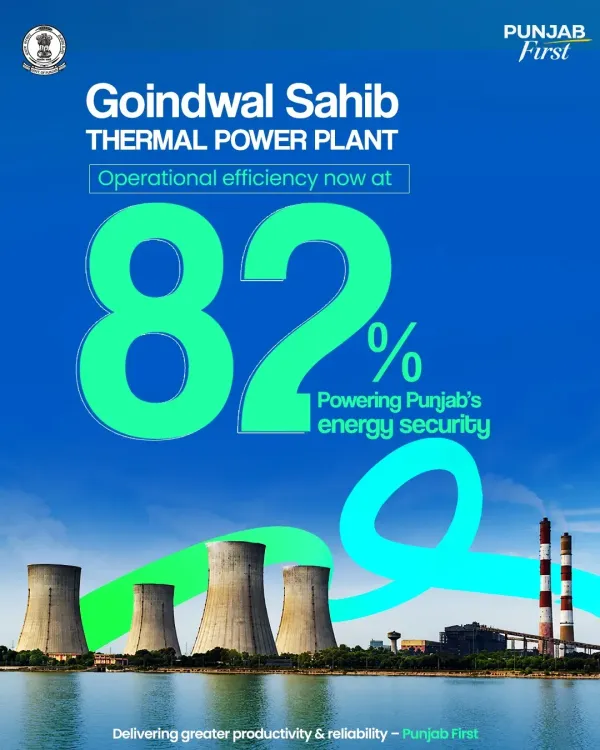
The Punjab government has acquired the 540 MW Goindwal Sahib Thermal Plant in Tarn Taran for ₹1,080 crore, reporting 82% operational efficiency since the takeover — a move the Bhagwant Mann administration frames as a structural fix for the state's chronic power-supply pressures.
Key Takeaways
The Punjab Government acquired the 540 MW Goindwal Sahib Thermal Plant for ₹1,080 crore .
The plant is located in Tarn Taran district , Punjab, and was previously under private ownership.
Operational efficiency has risen to 82% since the state takeover, according to the CMO.
The acquisition adds dedicated generation capacity to PSPCL 's portfolio.
The deal is part of a broader pattern of Indian state governments acquiring stressed private thermal assets to ensure grid stability.
Future budget allocations for plant modernisation and new power purchase agreements will determine the plant's long-term role in Punjab's energy mix.
A coal-fired power station that once sat under private ownership is now a state asset — and Punjab's government says the numbers are already moving in the right direction. The Chief Minister's Office of Punjab announced on Tuesday, August 11, 2026, that the state has acquired the 540 MW Goindwal Sahib Thermal Plant in Tarn Taran district for ₹1,080 crore, with operational efficiency climbing to 82% since the takeover.
A ₹1,080 crore bet on grid stability
The acquisition places a significant thermal asset directly under state control at a per-megawatt cost of ₹2 crore — a figure the government is framing as a value play for Punjab's power sector. The plant, located in Tarn Taran, adds dedicated generation capacity to the portfolio managed through PSPCL (Punjab State Power Corporation Limited), the state's principal power utility.
The Bhagwant Mann-led Aam Aadmi Party government has positioned the deal as a structural fix for a state that has long battled peak-demand shortfalls — particularly during the agricultural seasons when pump-set load surges across the state's canal-irrigated districts.
The 82% efficiency figure and what it signals
The government's claim of 82% operational efficiency post-acquisition is the headline metric here. In thermal power terms, a plant load factor above 80% is generally considered healthy for a coal-based unit — it suggests the plant is running close to its design capacity for most of the year rather than cycling down due to grid or fuel constraints.
Across India, state governments have periodically stepped in to acquire stressed or underperforming private thermal assets, particularly in high-subsidy states where private operators face payment risks from cash-strapped utilities. Punjab fits that profile: its power subsidies for agriculture and households have historically strained PSPCL's finances, making private investment in generation a difficult proposition.
What comes next for Goindwal Sahib
The immediate question is capital allocation — whether the state budget will earmark funds for plant modernisation to sustain and improve on that 82% efficiency figure over the medium term. Ageing coal-based infrastructure typically requires periodic investment in boilers, turbines, and emission controls to remain viable. Any new power purchase agreements or capacity addition targets that PSPCL announces in the coming months will indicate how central this plant is to Punjab's long-term generation strategy.
For Punjab's electricity consumers — from farmers running tubewells to industrial units in Ludhiana and Amritsar — a more reliable state-owned generation base means reduced dependence on expensive short-term power purchases from the open market, which tend to spike costs during summer and harvest peaks. That is the real dividend the government is promising. Whether the plant delivers it consistently is the test ahead.
Point of View
Owning generation capacity directly reduces exposure to volatile open-market power prices — a recurring budget pressure in high-subsidy states. The 82% efficiency claim, if sustained, would mark a genuine operational turnaround; but the harder test is whether Punjab can fund the modernisation that ageing coal infrastructure demands without crowding out other capital expenditure. This move is less a departure from the past and more an acceleration of a statist energy logic that Punjab has never fully abandoned.
NationPress
11 Aug 2026
Frequently Asked Questions
What is the Goindwal Sahib Thermal Plant?
The Goindwal Sahib Thermal Plant is a 540 MW coal-based power station located in Tarn Taran district, Punjab . It was previously under private ownership before being acquired by the Punjab Government.
How much did Punjab pay for the Goindwal Sahib plant?
The Punjab Government acquired the plant for ₹1,080 crore , which works out to approximately ₹2 crore per megawatt of installed capacity.
What is the operational efficiency of Goindwal Sahib plant after acquisition?
According to the Chief Minister's Office of Punjab, operational efficiency has risen to 82% since the state took over the plant — a figure considered healthy for a coal-based thermal unit.
Why is Punjab acquiring private power plants?
Punjab faces chronic peak-demand shortfalls, especially during agricultural seasons. Acquiring thermal assets gives the state direct control over generation, reducing dependence on expensive open-market power purchases and improving supply reliability for consumers.
Which body manages the Goindwal Sahib plant now?
The plant now falls under the state's power sector umbrella, managed through PSPCL (Punjab State Power Corporation Limited) , the principal state electricity utility.