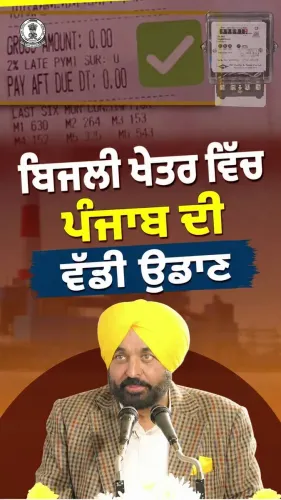
CM Mann's Punjab Govt Reaffirms 24-Hour Power to Farmers

Synopsis
The Chief Minister's Office of Punjab announced on July 7, 2026 that the Bhagwant Mann-led government is providing 24-hour electricity to farmers, reaffirming its commitment to a progressive, farmer-friendly Punjab ahead of the kharif season.
Key Takeaways
The Chief Minister's Office of Punjab posted on July 7, 2026 reaffirming round-the-clock power supply to farmers.
Chief Minister Bhagwant Singh Mann leads the AAP government that came to power in 2022 on a platform of uninterrupted agricultural electricity.
The 24-hour power supply targets farmers' irrigation tubewells, reducing diesel costs and improving crop reliability.
Punjab has a decades-long history of subsidised agricultural power, which AAP has continued and expanded under its farmer-welfare agenda.
Sustaining round-the-clock supply during peak kharif season demand will be the key test of the policy's on-ground effectiveness.
The announcement carries political weight ahead of the next Punjab assembly election, where agrarian welfare remains a central voter concern.
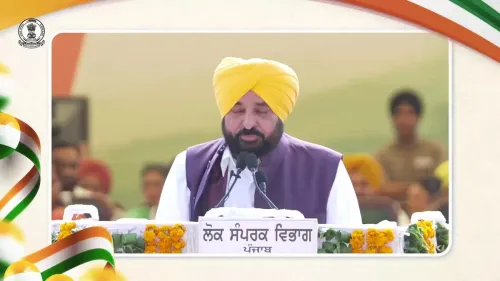
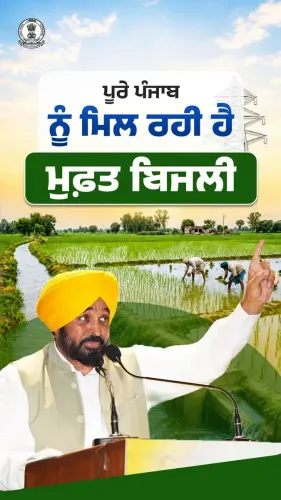
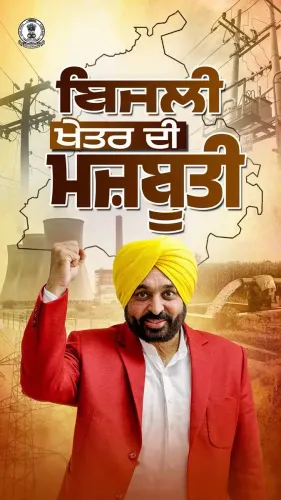
The Chief Minister's Office of Punjab reaffirmed on Tuesday, July 7, 2026, that the state government under Chief Minister Bhagwant Singh Mann is providing round-the-clock electricity to farmers as part of its commitment to building a progressive, farmer-friendly Punjab.
The post, shared in both Punjabi and English, stated: 'ਕਿਸਾਨਾਂ ਨੂੰ 24 ਘੰਟੇ ਬਿਜਲੀ ਪ੍ਰਦਾਨ ਕੀਤੀ ਜਾ ਰਹੀ ਹੈ' ['24-hour power supply is being provided to farmers'], adding that Punjab 'continues to stand strong in supporting and empowering the farming community.'
Context
Punjab is India's most agriculturally intensive state and a cornerstone of the country's food security, historically central to the Green Revolution. Reliable electricity for irrigation tubewells is critical for farmers during both kharif and rabi seasons. The Aam Aadmi Party (AAP) swept to power in the 2022 Punjab assembly elections on a platform that explicitly promised uninterrupted power to the farming community.
The announcement positions the Mann government's delivery on that pre-election commitment as an ongoing policy achievement, not merely a one-time measure.
Policy Backdrop
Subsidised or free agricultural electricity has been a fixture of Punjab's agrarian policy for decades, with earlier administrations also operating schemes for subsidised power to agricultural tubewells. The AAP manifesto of 2022 built on this lineage by promising free and uninterrupted supply, framing it as a direct benefit to farmers rather than a subsidy routed through utilities.
The broader national context matters too: the 2020-21 farm laws protests, which were centred in Punjab and Haryana, sharpened political competition around agrarian welfare across Indian states. Governments in agriculturally dominant states have since intensified messaging around farmer-support policies.
Stakeholders and Impact
The primary beneficiaries are Punjab's agricultural households, who depend on tubewell-fed irrigation for paddy and wheat cultivation. Continuous power supply reduces dependence on diesel-run pumps, lowering input costs and improving crop reliability during critical irrigation windows.
However, round-the-clock agricultural power supply also carries fiscal implications for the state exchequer and raises questions around groundwater depletion — a long-standing concern in Punjab's over-exploited aquifer zones. Balancing farmer income support against these structural pressures remains a central challenge for the administration.
What's Next
The government's ability to sustain 24-hour supply will be tested during the upcoming kharif season, when paddy irrigation demand peaks and grid stress is highest. State budget allocations for the power sector and official supply-reliability data will be key indicators of whether the commitment translates into consistent ground-level delivery.
With Punjab's next assembly election on the horizon, the Mann government's track record on farmer welfare — particularly power supply and procurement — is likely to remain a defining political metric.
Point of View
AAP seeks to pre-empt opposition claims of underperformance on agrarian welfare. The messaging also fits a broader AAP pattern of using social media to communicate direct-benefit policies directly to constituents, bypassing intermediary institutions. Whether the supply claim holds up under independent scrutiny during peak paddy season will determine how durable this political dividend proves to be.
NationPress
5 Oct 2026
Frequently Asked Questions
Is Punjab providing 24-hour free electricity to farmers?
The Punjab government under Chief Minister Bhagwant Mann has announced that it is providing 24-hour power supply to farmers as part of its farmer-welfare commitments. The AAP government's 2022 manifesto included a promise of uninterrupted agricultural electricity, and the CMO has reiterated this as an active policy in July 2026.
What is Bhagwant Mann's policy for Punjab farmers?
Chief Minister Bhagwant Mann's administration has focused on uninterrupted power supply for irrigation, crop procurement support, and positioning Punjab as a farmer-friendly state. The government frames these measures as part of its broader 'progressive Punjab' vision.
Why is 24-hour electricity important for Punjab farmers?
Punjab farmers rely heavily on electric tubewells for irrigation, especially during the kharif (paddy) and rabi (wheat) seasons. Round-the-clock power reduces dependence on costly diesel pumps and helps maintain consistent irrigation schedules, directly lowering input costs.
What did AAP promise Punjab farmers in the 2022 elections?
The Aam Aadmi Party's 2022 Punjab election manifesto included commitments to free or uninterrupted power supply for agricultural tubewells, among other farmer-welfare measures. This promise was a significant plank of AAP's campaign that helped it win a landslide majority.
What are the challenges of 24-hour agricultural power supply in Punjab?
Sustaining round-the-clock agricultural power places significant fiscal pressure on the state exchequer and can accelerate groundwater depletion, as continuous tubewell operation draws down Punjab's already over-exploited aquifers. Grid reliability during peak kharif demand remains the key operational challenge.