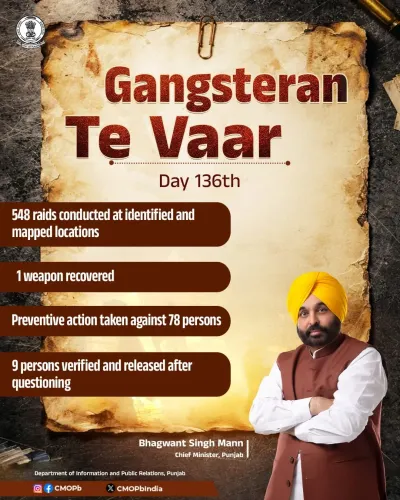
Punjab Police raids 543 locations on Day 279 of Gangsteran Te Vaar

Synopsis
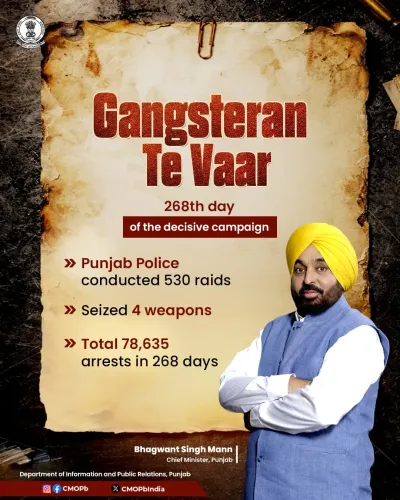
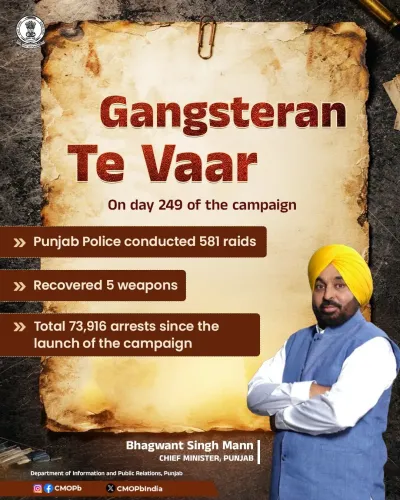
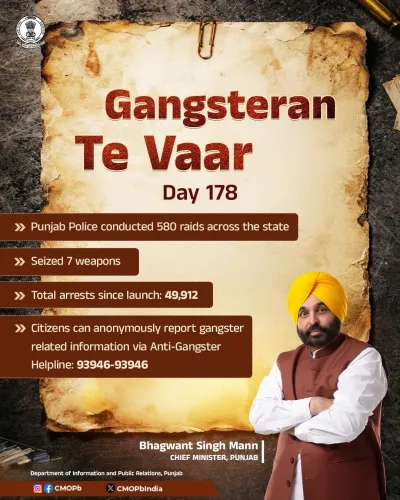
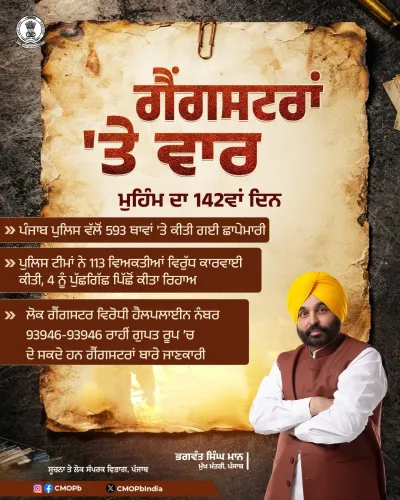
On Day 279 of 'Gangsteran Te Vaar', Punjab Police raided 543 mapped locations linked to gangster associates across the state, recovering two weapons and lifting the campaign's total arrests to 80,898, the Chief Minister's Office announced on 27 October 2026.
Key Takeaways
Punjab Police conducted 543 coordinated raids on Day 279 of the 'Gangsteran Te Vaar' anti-gangster campaign.
Police recovered 2 weapons during the Day 279 operations and made fresh arrests.
Cumulative arrests since the campaign's launch have reached 80,898 .
The campaign targets not just gang operatives but their wider associate networks through pre-identified and mapped locations.
The drive was launched under Chief Minister Bhagwant Mann's AAP government, which took office in March 2022.
The CMO is publicly reporting daily operational metrics, framing law-enforcement transparency as a governance commitment.
On the 279th consecutive day of Punjab's relentless anti-gang drive, police units fanned out across the state and hit 543 identified and mapped locations linked to gangster associates — a single-day operational sweep that underscores just how methodically the state is dismantling criminal networks. The Chief Minister's Office of Punjab announced on Tuesday, 27 October 2026 that fresh arrests were made alongside the recovery of two weapons, pushing the campaign's cumulative arrest tally to a staggering 80,898.
What 'Gangsteran Te Vaar' set out to do
The campaign — Gangsteran Te Vaar ('War on Gangsters') — was launched under Chief Minister Bhagwant Mann's AAP government, which came to power in March 2022 on a platform of cracking down hard on the organised crime, narcotics and extortion rackets that had festered in Punjab for well over a decade. The model is unusually systematic: police units do not merely respond to incidents, they pre-identify and map associate networks, then execute coordinated raids at scale. The 543-location sweep on Day 279 is a vivid illustration of that doctrine in practice.
Punjab has long grappled with inter-gang rivalries that spill into targeted killings, extortion calls to businessmen and a pipeline of weapons that flows back from drug-trafficking routes. Successive governments launched periodic drives, but critics noted those efforts tended to be reactive and short-lived. The current campaign's near-280-day run marks a deliberate departure from that pattern.
The arithmetic of 80,898 arrests
Nearly 81,000 arrests over nine months is a number that demands context. It includes not just hardened gang operatives but the wider ecosystem that enables them — harbourers, arms suppliers, financial facilitators and lookouts — consistent with the state's stated goal of mapping and dismantling associate networks rather than simply picking off individual criminals. Weapon recoveries at each stage, including the two arms seized on Day 279, feed intelligence that guides subsequent raids, creating a rolling pressure that the campaign's architects argue prevents gangs from regrouping.
The CMO's daily public reporting of raid counts and arrest figures is itself a governance signal: the state is treating transparency on law-enforcement metrics as a measure of political accountability, not just operational bookkeeping.
Pressure test for Punjab's policing model
The real question observers are watching is whether the sustained arrest tempo translates into measurable reductions in gang-related violence and extortion incidents on the ground. A campaign can accumulate impressive numbers; durable change shows up in crime statistics over the months ahead. With the drive now past 279 days and no announced end date, the Mann government appears committed to maintaining the pressure — keeping the operational clock running until the networks feel it where it counts.
Point of View
Publicly tracked anti-gang operations in recent Punjab history, moving beyond reactive policing toward a network-disruption doctrine. The near-daily public reporting of raid counts and arrest totals is a deliberate political choice by the Mann government — converting law-enforcement metrics into a visible accountability ledger. The critical test, however, lies not in arrest volume but in whether gang-related violence indicators begin to fall in a statistically meaningful way. If they do, the model could set a template for other high-crime states; if they plateau, questions will arise about whether mass arrests are actually hollowing out gang structures or merely pruning their edges.
NationPress
27 Oct 2026
Frequently Asked Questions
What is the 'Gangsteran Te Vaar' campaign in Punjab?
'Gangsteran Te Vaar' ('War on Gangsters') is a statewide anti-gangster drive launched by the Punjab government under Chief Minister Bhagwant Mann, targeting gangsters and their associates through coordinated police raids, arrests and weapons recovery across Punjab.
How many arrests have been made under Gangsteran Te Vaar so far?
As of Day 279 of the campaign — 27 October 2026 — total arrests have reached 80,898 since the drive's launch, according to the Chief Minister's Office of Punjab.
How many raids did Punjab Police conduct on Day 279?
Punjab Police conducted 543 raids at identified and mapped locations linked to gangster associates across the state on Day 279 of the campaign.
Who launched the Gangsteran Te Vaar campaign?
The campaign was launched by the AAP government led by Chief Minister Bhagwant Mann, who came to power in Punjab in March 2022 with a focus on combating organised crime and drug networks.
What weapons were recovered during Day 279 of the Punjab anti-gangster campaign?
Punjab Police recovered two weapons during the Day 279 operations of the 'Gangsteran Te Vaar' campaign on 27 October 2026.