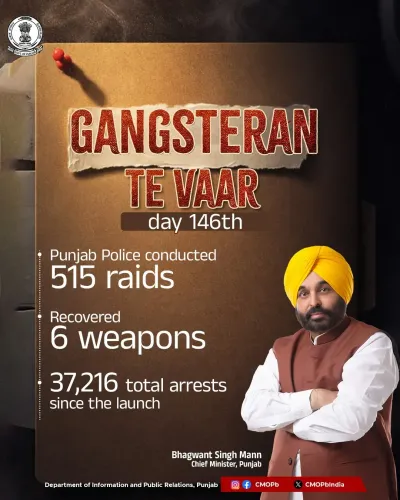
Punjab Police Raids 571 Locations on Day 143 of Gangsteran Te Vaar

Synopsis
On Day 143 of 'Gangsteran Te Vaar', Punjab Police simultaneously raided 571 mapped locations of gangster associates statewide, seizing six weapons. The operation raised the campaign's total arrests to 36,381, underscoring the AAP government's sustained push to dismantle organised crime networks in the state.
Key Takeaways
571 locations of gangster associates were raided simultaneously across Punjab on June 13, 2026 .
Six weapons were seized during the Day 143 operation of the 'Gangsteran Te Vaar' campaign.
Total arrests since the campaign's launch now stand at 36,381 .
The campaign uses pre-mapped, intelligence-identified locations for coordinated statewide raids.
The AAP government in Punjab launched the campaign following its 2022 election mandate to combat organised crime and drug networks.
Analysts will watch arrest-to-conviction ratios as the key indicator of the campaign's long-term effectiveness.
The Chief Minister's Office of Punjab announced on Saturday, June 13, 2026, that Punjab Police conducted simultaneous raids at 571 identified and mapped locations of gangster associates across the state on the 143rd day of the ongoing campaign 'Gangsteran Te Vaar' (ਗੈਂਗਸਟਰਾਂ 'ਤੇ ਵਾਰ — 'Strike Against Gangsters'). The operation resulted in multiple arrests and the seizure of six weapons, pushing the campaign's cumulative arrest count to 36,381.
Context
The official post from the CMO Punjab stated: 'On the 143rd day of the decisive campaign Gangsteran Te Vaar running in the state, Punjab Police carried out raids at 571 identified and mapped locations of gangster associates across the state. Police teams arrested individuals along with six weapons, bringing the total arrests since the launch of the campaign to 36,381.'
The coordinated nature of the operation — covering mapped locations simultaneously across the entire state — signals a data-driven enforcement model, with police intelligence pre-identifying and geo-mapping associate hideouts before executing raids in a single sweep.
Policy Backdrop
The Aam Aadmi Party government in Punjab, which came to power after the 2022 state elections, made cracking down on organised crime and drug syndicates a central governance commitment. The 'Gangsteran Te Vaar' campaign is the operational expression of that pledge, representing a sustained, day-by-day enforcement drive rather than a one-off action.
Punjab has historically faced challenges from gang networks, extortion rackets, and narcotics trafficking, partly enabled by cross-border smuggling routes. Successive state administrations have periodically launched large-scale coordinated raids, but the current campaign's daily cadence and cumulative tracking of arrests marks a more institutionalised approach to disrupting criminal ecosystems.
Stakeholders and Impact
The primary targets of the campaign are gangster associates — individuals who provide logistical, financial, or operational support to organised crime networks without necessarily being active gang members themselves. By mapping and raiding 571 such locations in a single day, Punjab Police aims to degrade the support infrastructure that allows gang operations to persist.
The cumulative arrest figure of 36,381 over 143 days indicates an average of over 250 arrests per day since the campaign's launch, a pace that, if sustained, would represent one of the most intensive organised-crime enforcement drives in the state's recent history. Residents in areas with known gang activity, as well as businesses targeted by extortion, are the intended beneficiaries of the crackdown.
What's Next
Analysts and civil-society groups are likely to watch for data on prosecution rates and conviction outcomes — a key measure of whether the volume of arrests translates into durable disruption of gang networks. The government has signalled no let-up in the campaign's tempo, and the daily public reporting via the CMO's official channels serves a dual function: operational accountability and a deterrence signal to criminal networks.
If the arrest-to-conviction pipeline proves robust, the Gangsteran Te Vaar model could be cited as a template for other states grappling with organised crime. Any proposed amendments to Punjab's laws on organised crime would be the next legislative milestone to watch.
Point of View
381 cumulative arrests over 143 days, the sheer volume signals institutional commitment, but also invites scrutiny: high arrest numbers without matching conviction data can reflect a wide net rather than surgical disruption. The focus on 'associates' rather than gang leaders suggests the campaign is targeting the ecosystem around organised crime, which is strategically sound but harder to measure in outcome terms. For the AAP administration, the campaign remains a flagship law-and-order deliverable ahead of future electoral cycles.
NationPress
20 Sept 2026
Frequently Asked Questions
What is the 'Gangsteran Te Vaar' campaign in Punjab?
'Gangsteran Te Vaar' (Strike Against Gangsters) is a statewide police campaign launched by the Punjab government to dismantle organised crime networks through coordinated daily raids, arrests, and weapon seizures targeting gangsters and their associates.
How many arrests have been made in the Gangsteran Te Vaar campaign so far?
As of Day 143 of the campaign on June 13, 2026, a total of 36,381 arrests have been made since the campaign's launch.
How many locations were raided by Punjab Police on June 13, 2026?
Punjab Police conducted raids at 571 identified and mapped locations of gangster associates across the state on June 13, 2026.
Which government launched the Gangsteran Te Vaar campaign in Punjab?
The Aam Aadmi Party government in Punjab, which came to power after the 2022 state elections, launched the campaign as part of its commitment to combating organised crime and drug syndicates.
What weapons were seized in the Day 143 Punjab Police operation?
Six weapons were seized by Punjab Police teams during the raids conducted on the 143rd day of the 'Gangsteran Te Vaar' campaign.