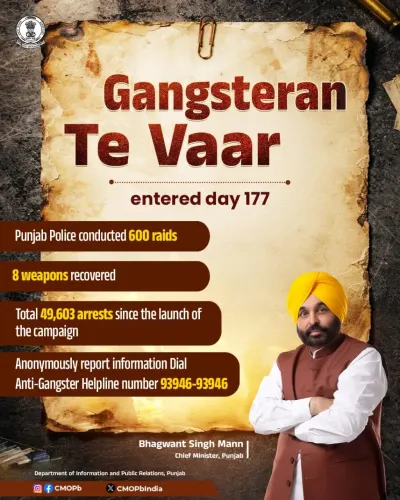
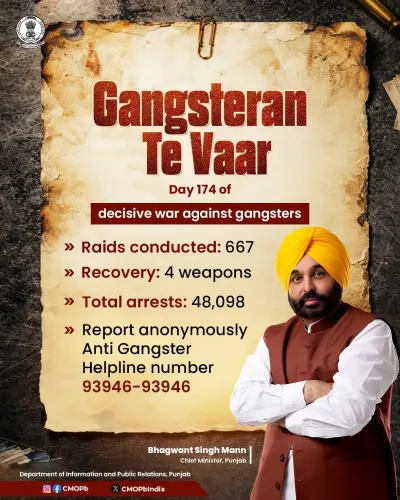
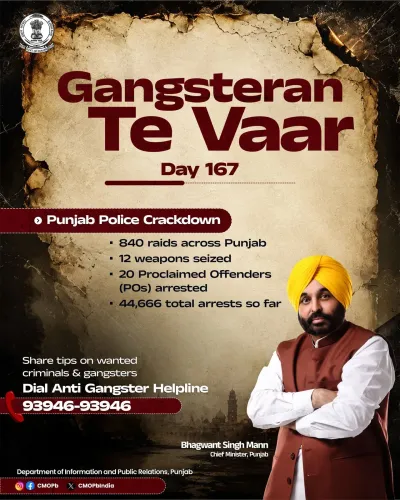
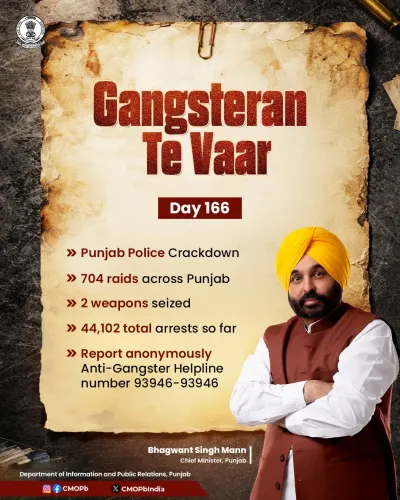
Punjab Police Conducts 555 Raids on Day 135 of 'Gangsteran Te Vaar'
Synopsis
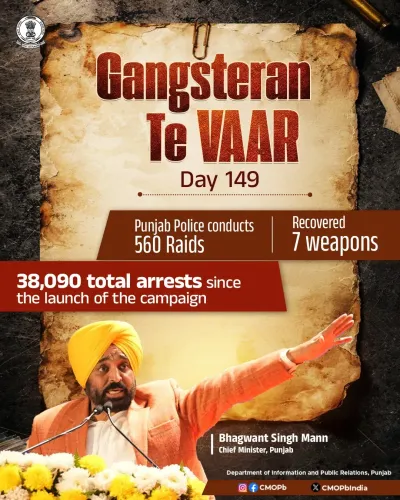
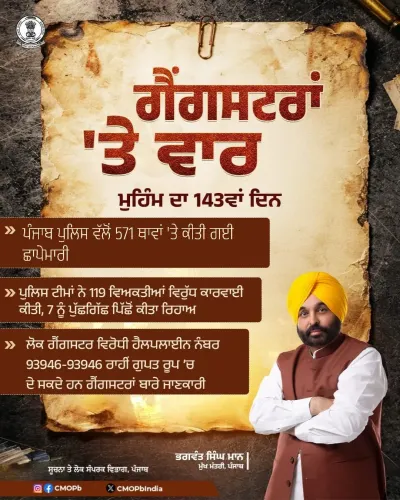
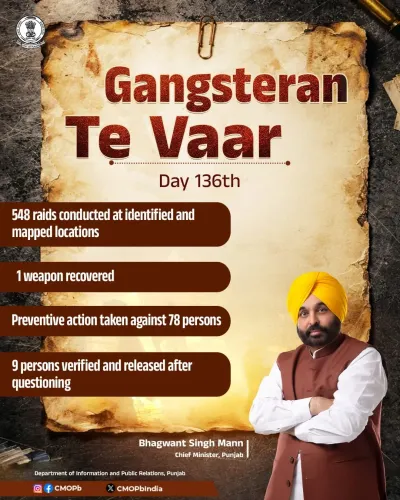
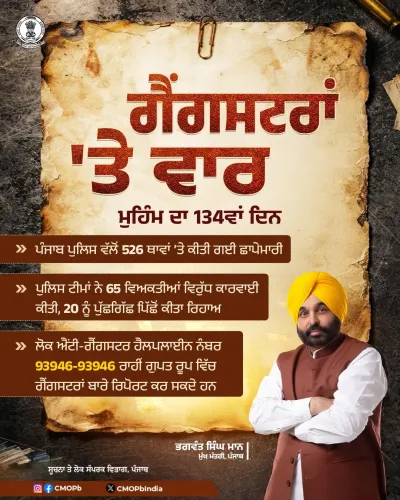
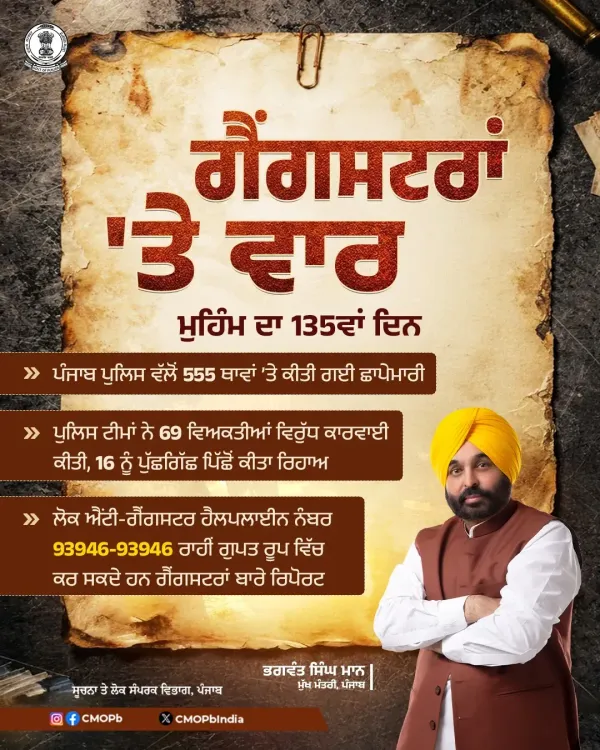
On day 135 of 'Gangsteran Te Vaar', Punjab Police simultaneously raided 555 mapped locations tied to gangster associates across the state, recovering six weapons and raising the campaign's total arrest count to 33,917, the Chief Minister's Office of Punjab announced on June 5, 2026.
Key Takeaways
555 simultaneous raids were conducted across Punjab on June 5, 2026 , the 135th day of the Gangsteran Te Vaar campaign.
All raid locations were pre-identified and mapped , reflecting an intelligence-led, data-driven operational approach.
Police recovered six weapons during the day's operations alongside multiple arrests.
Cumulative arrests since the campaign's launch have reached 33,917 .
The campaign targets gangster associates and logistical networks , not only top-tier figures.
The drive is a key governance commitment of the Bhagwant Mann -led Aam Aadmi Party government in Punjab.
Punjab Police conducted 555 simultaneous raids across the state on Friday, June 5, 2026, marking the 135th day of the ongoing anti-gangster campaign Gangsteran Te Vaar ('War on Gangsters'), the Chief Minister's Office of Punjab announced. The raids targeted identified and mapped locations linked to associates of gangsters, resulting in fresh arrests and weapons seizures that pushed the campaign's cumulative arrest tally to 33,917.
What Happened
Police teams fanned out across Punjab to simultaneously hit 555 pre-identified locations tied to gangster networks. The coordinated operation yielded arrests along with the recovery of six weapons, underscoring the campaign's continued focus on dismantling the operational infrastructure of organised crime rather than targeting only top-tier figures.
The CMO's post stated: 'ਸੂਬੇ ਵਿੱਚ ਚੱਲ ਰਹੀ ਫ਼ੈਸਲਾਕੁੰਨ ਮੁਹਿੰਮ' — translated, 'the decisive campaign underway in the state' — has now logged 33,917 total arrests since its launch.
Context
Punjab has long grappled with organised crime networks intertwined with drug trafficking and cross-border syndicates. Gang violence — ranging from extortion rackets to contract killings — has periodically destabilised law and order in the state, drawing political attention from successive governments.
After the 2022 state elections, the government led by Chief Minister Bhagwant Mann under the Aam Aadmi Party elevated action against the drug-gangster nexus to a central governance commitment. Gangsteran Te Vaar emerged as the operational expression of that pledge, combining intelligence-led mapping of associate networks with sustained, high-frequency raids.
Policy Backdrop
The campaign's defining feature is its data-driven methodology: locations are identified and mapped before raids are executed, shifting the approach from reactive policing to systematic network disruption. This model targets associates and logistical nodes — safe houses, financiers, weapons caches — rather than waiting to intercept kingpins directly.
Successive Punjab administrations have alternated between large-scale police operations and legislative measures, including asset attachment provisions, to address organised crime. The current drive represents the most sustained iteration of this pattern, with daily operational updates maintaining public accountability and deterrence signalling.
Stakeholders and Impact
For ordinary residents, the campaign's scale — nearly 34,000 arrests over 135 days — signals a prolonged pressure campaign on criminal ecosystems that have historically fuelled extortion and violence in local communities. Businesses and individuals who have faced gang-related threats stand as the primary intended beneficiaries.
For Punjab Police, sustaining the operational tempo requires significant coordination across districts. The emphasis on mapped locations suggests an intelligence architecture that, if maintained, could yield longer-term disruption of gang hierarchies beyond individual arrests.
What's Next
Daily operational updates from the CMO suggest the campaign will continue at pace, with each milestone used to signal governance momentum. Analysts will watch whether the volume of arrests translates into successful prosecutions and whether the Punjab Assembly moves on complementary legislation — such as stricter asset attachment provisions or enhanced anti-organised crime statutes — to consolidate the operational gains on the ground.
Point of View
917 arrests in 135 days signals institutional stamina, but the campaign's long-term credibility will hinge on conviction rates and whether disrupted networks reconstitute. The shift to mapping associate ecosystems rather than chasing kingpins alone represents a doctrinal evolution in Punjab's approach to organised crime — one that, if backed by prosecutorial follow-through, could set a replicable model for other states facing similar challenges.
NationPress
23 Sept 2026
Frequently Asked Questions
What is the Gangsteran Te Vaar campaign in Punjab?
'Gangsteran Te Vaar' (War on Gangsters) is an ongoing state-wide campaign by Punjab Police that uses intelligence-led mapping to conduct raids on locations linked to gangsters and their associates, aiming to dismantle organised crime networks across the state.
How many arrests have been made in the Gangsteran Te Vaar campaign so far?
As of June 5, 2026 — the campaign's 135th day — total arrests have reached 33,917 , according to the Chief Minister's Office of Punjab.
How many raids did Punjab Police conduct on June 5, 2026?
Punjab Police conducted 555 simultaneous raids on June 5, 2026, targeting pre-identified and mapped locations linked to gangster associates across the state.
Who launched the Gangsteran Te Vaar campaign?
The campaign was launched under the Bhagwant Mann -led Aam Aadmi Party government in Punjab, which made action against the drug-gangster nexus a central pledge after winning the 2022 state elections .
What weapons were recovered in the June 5 Punjab Police raids?
Punjab Police recovered six weapons during the raids conducted on June 5, 2026 as part of the Gangsteran Te Vaar campaign, alongside multiple arrests of gangster associates.