Punjab Police Hits 527 Locations on Day 277 of Gang Crackdown

Synopsis
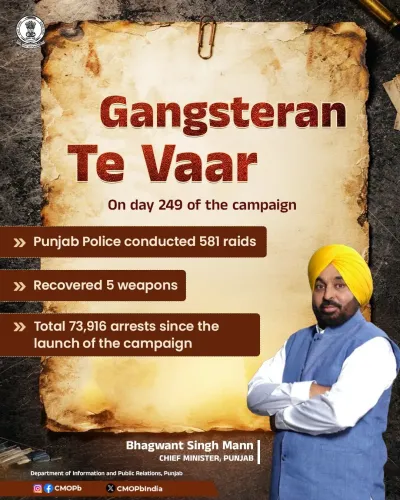
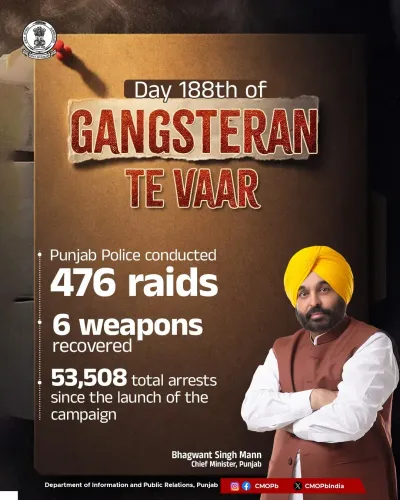
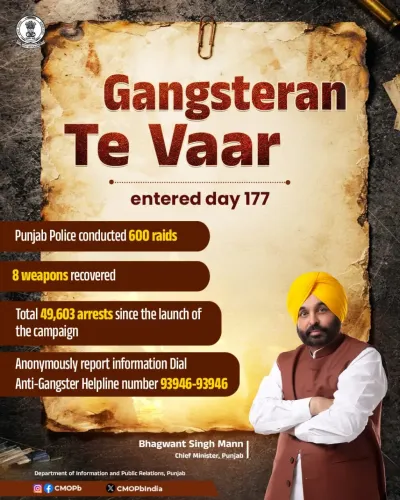
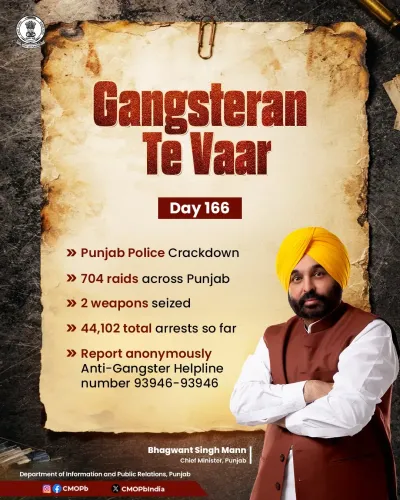
On Day 277 of the Gangsteran Te Vaar campaign, Punjab Police conducted 527 raids at mapped gangster-associate locations statewide, taking total arrests since the campaign's launch to 80,458, the Chief Minister's Office confirmed on 25 October 2026.
Key Takeaways
527 locations linked to gangster associates were raided across Punjab on a single day — Day 277 of the Gangsteran Te Vaar campaign.
Cumulative arrests since the campaign's launch have reached 80,458 .
The campaign was confirmed by the Chief Minister's Office of Punjab on 25 October 2026 .
Locations are 'identified and mapped' before raids, reflecting an intelligence-led enforcement model.
The operation sits within the AAP government's post-2022 election commitment to tackle organised crime and drug networks in Punjab .
Chief Minister Bhagwant Mann has framed anti-gang action as a core governance priority since taking office in March 2022 .
Eighty thousand arrests. More than half a million raids. On Day 277 of the Gangsteran Te Vaar ('Strike Against Gangsters') campaign, Punjab Police executed a single-day sweep across 527 identified and mapped locations linked to gangster associates across the state — a show of force that pushed the campaign's cumulative arrest tally to 80,458.
277 days, 527 raids — how the numbers stack up
The Chief Minister's Office of Punjab confirmed the milestone on Sunday, 25 October 2026, posting the update in both Punjabi and English. The operation's defining feature is its sustained, data-driven methodology: locations are 'identified and mapped' before teams move in, reflecting an intelligence-led approach rather than reactive policing. A single day yielding raids at over five hundred discrete addresses signals both the breadth of the network being targeted and the operational capacity Punjab Police has built up over the campaign's nine-month run.
The 'Gangsteran Te Vaar' campaign and its roots in AAP's 2022 mandate
Punjab has long wrestled with the convergence of the drug trade, inter-gang rivalries, and diaspora-linked criminal networks that operate across borders. When Chief Minister Bhagwant Mann led the Aam Aadmi Party to a landslide victory in the March 2022 state elections, cracking down on organised crime was placed front and centre of the governing agenda. Gangsteran Te Vaar emerged as the operationalised version of that promise — a continuous, publicly tracked campaign with daily metrics designed to demonstrate accountability as much as enforcement.
The decision to publish day-count, raid counts, and cumulative arrests in near-real time is itself a governance choice: it creates a public record that successive updates either build on or contradict. At 80,458 arrests since launch, the number has become a political data point for the AAP government as much as a law-enforcement statistic.
What sustained operations like this are designed to do
Across India, state governments facing organised-crime pressure have cycled through similar enforcement playbooks — bursts of raids followed by quieter intervals. What distinguishes the Gangsteran Te Vaar model, at least in its public presentation, is continuity: the campaign has not been declared over and relaunched; it has ticked forward day by day for the better part of a year. Criminologists and policing researchers generally note that disruption of associate networks — the logistics, safe-house, and financing layer around core gang figures — is as strategically significant as arresting the principals themselves. The targeting of 527 associate locations in a single day fits that theory of change.
Whether arrest volumes translate into durable reductions in gang activity, extortion incidents, or drug-linked violence will be the harder test that crime statistics, not press releases, will ultimately answer.
Point of View
Arrest tallies, day numbers — is as much a political communication strategy as a policing one, allowing the AAP government to make law-and-order progress legible to voters in real time. Reaching 80,458 arrests over 277 days is a striking volume, but the meaningful question for analysts is whether associate-network disruption is translating into measurable declines in extortion, targeted killings, or drug supply — metrics that are harder to tweet but more diagnostic of lasting impact. Punjab's transnational gang problem, with roots in Canada, Europe, and beyond, means no state-level operation alone can seal the network; coordination with central agencies and international partners remains the harder, less visible work. How the government presents the campaign's next milestone — and whether it publishes outcome data alongside arrest data — will signal whether this is enforcement or performance.
NationPress
25 Oct 2026
Frequently Asked Questions
What is the Gangsteran Te Vaar campaign in Punjab?
'Gangsteran Te Vaar' — meaning 'Strike Against Gangsters' in Punjabi — is a sustained statewide police campaign launched by the AAP government in Punjab to dismantle gangster networks through continuous raids and arrests. By Day 277 on 25 October 2026 , the campaign had recorded 80,458 total arrests .
How many raids did Punjab Police conduct on Day 277?
Punjab Police conducted 527 raids at identified and mapped locations linked to gangster associates across the state on Day 277 of the campaign, 25 October 2026 .
What is the total number of arrests in Punjab's anti-gangster campaign?
As of Day 277 of the Gangsteran Te Vaar campaign, total arrests since its launch stand at 80,458 , according to the Chief Minister's Office of Punjab .
Who launched the Gangsteran Te Vaar campaign?
The campaign was launched by the Punjab Police under the direction of the AAP government led by Chief Minister Bhagwant Mann , who took office in March 2022 with a mandate that prominently included tackling organised crime.
Why does Punjab have a gangster problem?
Punjab has historically faced challenges from the intersection of the drug trade, inter-gang rivalries, and diaspora-linked criminal networks operating from countries including Canada and parts of Europe. Successive state governments have run enforcement campaigns to disrupt these networks, with the current Gangsteran Te Vaar campaign being the most publicly tracked iteration.