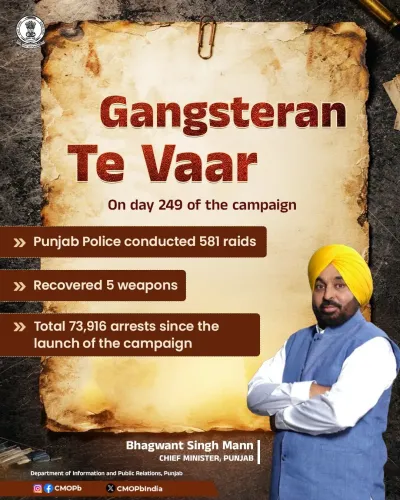
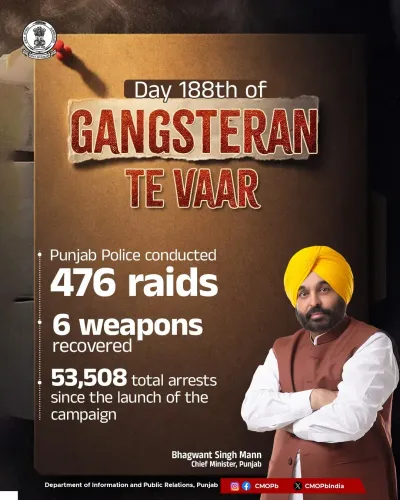
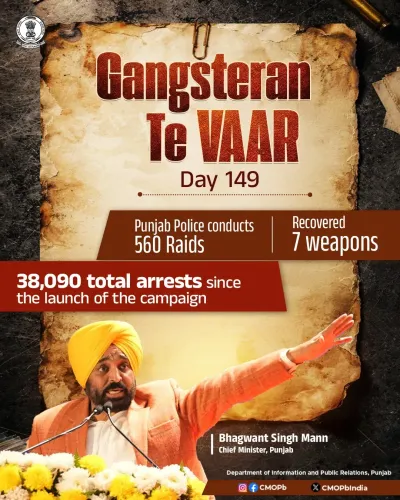
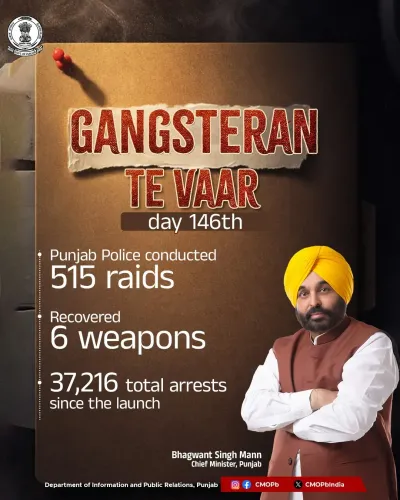
Punjab Police Hits Day 274 of 'Gangsteran Te Vaar'

Synopsis
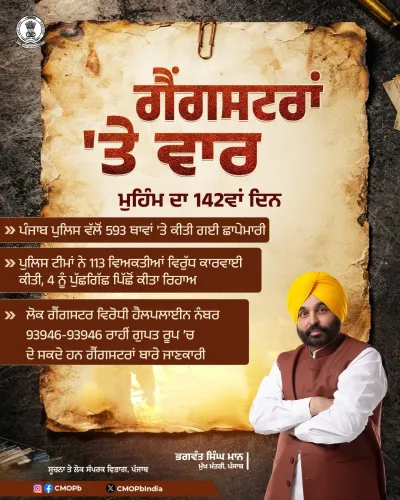
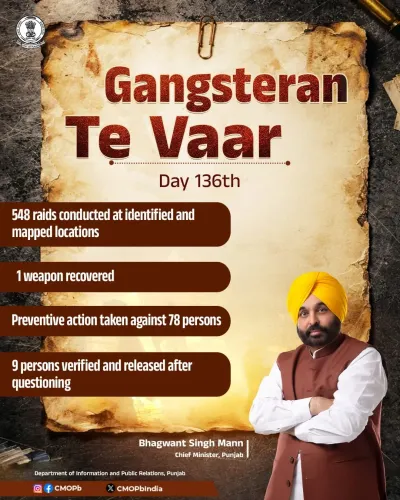
On Day 274 of Punjab's 'Gangsteran Te Vaar' anti-gangster campaign, police conducted 506 raids across the state, recovered four weapons, and pushed cumulative arrests to 79,868 — a milestone the Chief Minister's Office highlighted as evidence of an unrelenting law-and-order drive under CM Bhagwant Mann.
Key Takeaways
506 raids were conducted on Day 274 of the 'Gangsteran Te Vaar' campaign, targeting locations linked to gangster associates.
Four weapons were recovered in the single-day operation.
Cumulative arrests since the campaign's launch have reached 79,868 .
The campaign is part of a sustained anti-organised-crime push by the Bhagwant Mann -led AAP government in Punjab since 2022.
The operation follows an intelligence-driven, 'identified and mapped locations' model rather than reactive policing.
Punjab has historically faced gang rivalries intertwined with drug-trafficking networks, making sustained disruption a stated priority.
Nearly nine months into one of Punjab's most sustained anti-organised crime pushes, the numbers keep climbing — and the state is making sure everyone notices. On Day 274 of the 'Gangsteran Te Vaar' campaign, Punjab Police conducted 506 raids at locations mapped to gangster associates across the state, arresting individuals and recovering four weapons, as the Chief Minister's Office of Punjab announced on Thursday, 22 October 2026.
506 raids, four weapons, one relentless drumbeat
The single-day figure of 506 raids is not an aberration — it is the rhythm of a campaign that has now run without pause for more than 274 days. Each raid targets 'identified and mapped locations' linked to gangster networks, reflecting an intelligence-driven model rather than reactive policing. The latest day's recoveries pushed cumulative arrests to 79,868 since the campaign's launch, a figure that underlines both the scale of the operation and the depth of the organised-crime ecosystem it is dismantling.
The campaign's roots in Punjab's organised-crime problem
When Chief Minister Bhagwant Mann and the Aam Aadmi Party came to power in 2022, restoring public order was a centrepiece promise. Punjab had for years been a theatre of gang rivalries — networks intertwined with drug trafficking that fed extortion, targeted killings and cross-border criminal links. The 'Gangsteran Te Vaar' — loosely, 'Strike on Gangsters' — was the operational answer: a coordinated, state-wide surge that mapped known associates, raided their haunts systematically and recorded every arrest in a running public tally. The tally itself is political as much as it is operational, giving the government a daily proof-point of momentum.
What nearly 80,000 arrests signal about Punjab's crime geography
A cumulative arrest count touching 79,868 over less than ten months points to something the raw number alone cannot convey: the footprint of organised crime in the state was far wider than most public assessments acknowledged. Sustained, mapped raiding — rather than episodic crackdowns — is the tactical signature here. Weapons recovered on individual days may seem modest, but each firearm pulled off the street represents one fewer instrument available to networks that have previously used them against rivals, civilians and police personnel alike. The broader pattern analysts watch is whether disruption at the associate level eventually degrades command structures at the top.
Point of View
000 gives the administration a visceral number to campaign on. The real test, however, is whether disrupting associate networks translates into measurable reductions in gang-linked violence and drug supply — metrics that are harder to curate than daily raid tallies, and the ones opposition parties will probe as the next election cycle approaches.
NationPress
22 Oct 2026
Frequently Asked Questions
What is the 'Gangsteran Te Vaar' campaign in Punjab?
'Gangsteran Te Vaar' is a statewide Punjab Police campaign launched under Chief Minister Bhagwant Mann's government to dismantle organised crime and gangster networks through systematic, intelligence-led raids and arrests across the state.
How many arrests have been made in Gangsteran Te Vaar so far?
As of Day 274 of the campaign, 79,868 cumulative arrests have been made since the drive was launched, according to the Chief Minister's Office of Punjab.
How many raids did Punjab Police conduct on Day 274?
Punjab Police conducted 506 raids at identified locations linked to gangster associates on Day 274 of the campaign, also recovering four weapons.
Who launched the Gangsteran Te Vaar campaign?
The campaign was launched by the Punjab government under Chief Minister Bhagwant Mann of the Aam Aadmi Party, as part of a broader anti-organised crime and law-and-order drive that began after the 2022 assembly elections.
Why is Punjab facing a gangster problem?
Punjab has long confronted organised crime networks that are intertwined with drug trafficking, extortion, and gang rivalries. These networks expanded over several years and became a major public-order concern, prompting the current government's sustained crackdown.