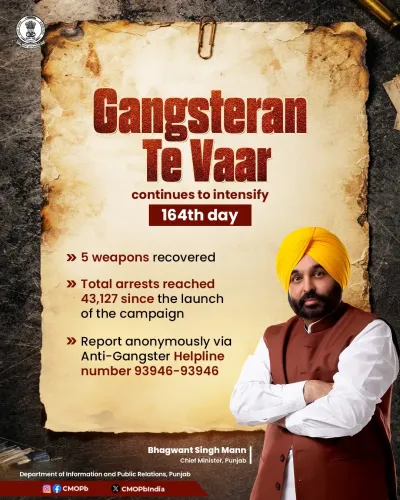
Punjab Police Hits Day 276 of 'Gangsteran Te Vaar' with 468 Raids

Synopsis
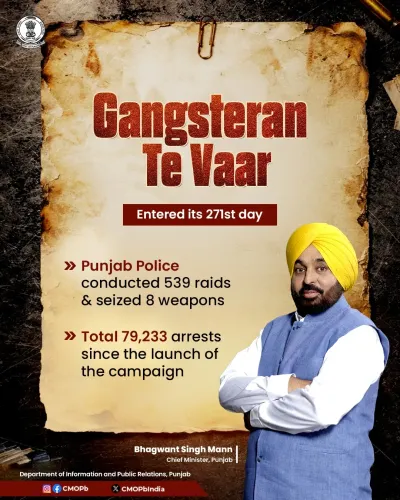
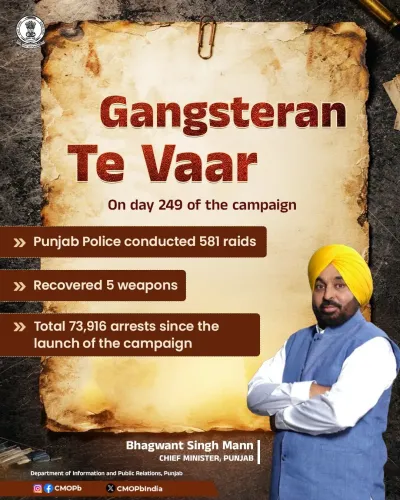
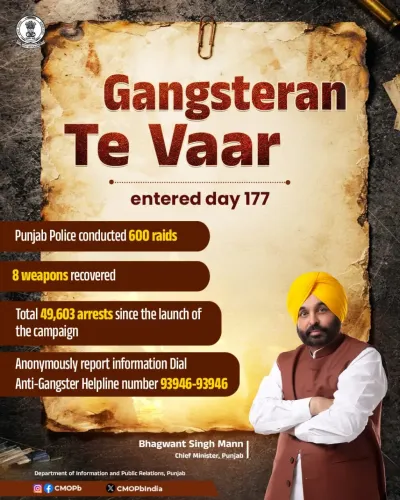
On Day 276 of 'Gangsteran Te Vaar', Punjab Police conducted 468 raids at gangster-linked locations, recovered seven weapons, and pushed the campaign's total arrests to 80,234, the Chief Minister's Office of Punjab announced on October 24, 2026.
Key Takeaways
468 raids were conducted on Day 276 of the 'Gangsteran Te Vaar' campaign at identified, intelligence-mapped locations.
Seven weapons were recovered during the Day 276 operations across Punjab.
Total arrests since the campaign's launch have reached 80,234 .
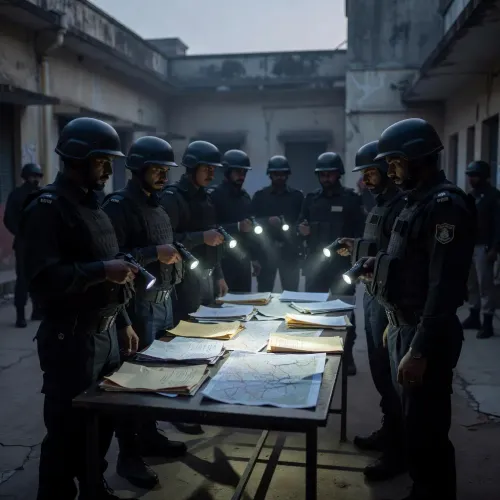
The campaign targets not just gangsters but their associates and support networks , using mapped intelligence for raid planning.
The drive was intensified after the 2022 Punjab assembly elections under Chief Minister Bhagwant Mann .
Punjab has long faced gang violence linked to extortion, targeted killings and drug trafficking, including networks operating from abroad.
Nearly nine months into a relentless offensive against organised crime, Punjab Police shows no sign of throttling back. On Day 276 of the 'Gangsteran Te Vaar' campaign, officers fanned out across the state conducting 468 raids at locations mapped to gangster associates — and walked away with seven more weapons off Punjab's streets.
80,234 arrests and counting
The single-day haul pushed the campaign's cumulative arrest total to 80,234 since its launch, according to a post by the Chief Minister's Office of Punjab on Saturday, October 24, 2026. That staggering number is the headline of a drive that has, day after day, sent police teams into identified networks — not random sweeps, but intelligence-mapped operations targeting associates who form the connective tissue of gangster organisations.
Seven weapons recovered on Day 276 alone. Each one, in the logic of this campaign, is a firearm that does not reach a hitman or an extortion crew. The cumulative effect of that math, multiplied across 276 days, is what the state government argues is fundamentally reshaping Punjab's security landscape.
Why 'Gangsteran Te Vaar' matters beyond the numbers
Punjab has wrestled for years with organised crime syndicates that blend extortion, targeted killings and drug trafficking into a single, brutally efficient enterprise. The problem deepened through the late 2010s and early 2020s, with gangsters operating from foreign soil — directing violence back home through encrypted messages and hired shooters.
When Chief Minister Bhagwant Mann and his government intensified anti-organised crime operations after the 2022 assembly elections, the stated objective was not just arrests but network dismantlement — mapping associates, seizing weapons, and cutting off the logistics that keep gangs functional. 'Gangsteran Te Vaar' (roughly, 'Strike Against Gangsters') operationalises that doctrine through sustained, daily police action rather than episodic crackdowns that historically allowed networks to reconstitute.
Raids, maps, and the infrastructure of enforcement
The operational detail in today's update is worth pausing on: raids at 'identified and mapped locations'. This language signals a shift from reactive policing to intelligence-led targeting, where each raid theoretically degrades a specific node in a gang's support structure. The consistency — 468 raids in a single day, across a state running its 276th consecutive day of operations — points to significant institutional bandwidth being committed to the effort.
Whether that bandwidth translates to lasting disruption of gang hierarchies, or whether networks adapt and regenerate, will be the harder question Punjab's government faces as the campaign continues. Updated crime statistics and any new legislative tools from the Punjab Assembly will be the next benchmarks to watch.
For now, the scoreboard reads 80,234 arrests, 276 days, zero pause. The campaign rolls on.
Point of View
Intelligence-led network degradation. Politically, the daily scoreboard of raids and arrests serves as a visible governance metric for the Bhagwant Mann administration, which came to power in 2022 partly on a law-and-order mandate. The critical test, however, is not arrest volume but structural disruption: whether mapped operations are genuinely dismantling gang hierarchies or whether networks are reconstituting faster than they are dismantled. As the campaign crosses 276 days, the demand for updated crime-rate data and legislative enforcement tools will intensify.
NationPress
24 Oct 2026
Frequently Asked Questions
What is the 'Gangsteran Te Vaar' campaign in Punjab?
'Gangsteran Te Vaar' — meaning 'Strike Against Gangsters' — is an ongoing Punjab Police campaign launched under the Bhagwant Mann government to dismantle organised crime networks through sustained, daily raids, arrests and weapons recovery across the state.
How many arrests have been made in Punjab's anti-gangster campaign?
As of Day 276 of the campaign, a total of 80,234 arrests have been made since the drive was launched, according to the Chief Minister's Office of Punjab.
How many raids did Punjab Police conduct on Day 276?
Punjab Police conducted 468 raids on Day 276, targeting identified and mapped locations linked to associates of gangsters across the state.
What weapons were recovered during the Day 276 raids?
Seven weapons were recovered by Punjab Police during the raids conducted on Day 276 of the 'Gangsteran Te Vaar' campaign.
Why has Punjab faced persistent gang violence?
Punjab has long struggled with organised gangster groups involved in extortion, targeted killings and drug trafficking, with some networks directing violence from abroad. Successive governments have launched police-led crackdowns, with the current campaign representing the most sustained iteration of this enforcement approach.