CM Assam Office Hails Purnima Barman's 2026 Wayfinder Award

Synopsis
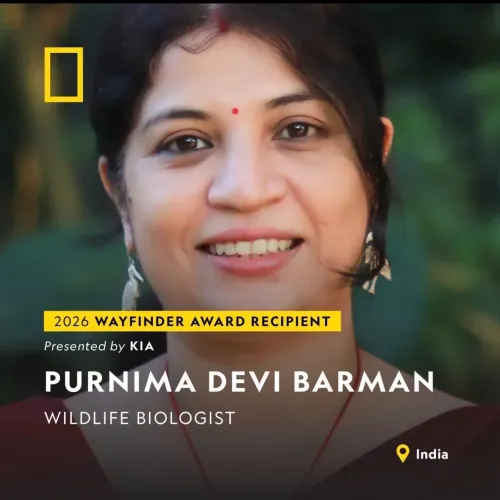
Assam conservationist Purnima Barman, known as the Hargila Crusader, has won the 2026 Wayfinder Award from the National Geographic Society for her community-driven campaign to protect the endangered greater adjutant stork. The Chief Minister's Office of Assam shared the recognition on 11 June 2026.
Key Takeaways
Purnima Barman has won the 2026 Wayfinder Award from the National Geographic Society for conservation leadership.
Barman is the founder of the Hargila Army , a rural women-led movement protecting the endangered greater adjutant stork in Assam .
The Chief Minister's Office of Assam amplified the recognition on 11 June 2026 .
Barman previously received the Whitley Award in 2017 for the same conservation model.
Aaranyak , a Guwahati -based NGO, has been a key institutional partner in the hargila conservation effort since the early 2010s.
The award highlights the growing global recognition of women-led, community-driven conservation programmes in India's biodiversity hotspots.
The Chief Minister's Office of Assam on Thursday, 11 June 2026 shared news of conservationist Purnima Barman winning the 2026 Wayfinder Award, presented by the National Geographic Society, for her decade-long campaign to protect the endangered greater adjutant stork — locally called the hargila — in Assam.
Context
Purnima Barman, widely known as the 'Hargila Crusader', is an Assam-based biologist and conservationist who built a grassroots movement — the Hargila Army — by mobilising rural women in wetland villages to guard nesting colonies of the greater adjutant stork. The bird, one of the world's rarest storks, finds one of its last significant breeding habitats in the floodplains and wetlands of Assam. Barman's model is distinctive for embedding conservation within the cultural and economic lives of local communities rather than relying on enforcement alone.
Policy Backdrop
The Wayfinder Award is an annual recognition by the National Geographic Society for emerging leaders working at the intersection of conservation, storytelling, and exploration. Barman's selection continues a pattern of international acknowledgement for her work: in 2017 she received the Whitley Award for the same community-based hargila protection model that the Wayfinder jury has now recognised. Guwahati-based biodiversity organisation Aaranyak has been a long-standing partner in these conservation efforts since the early 2010s, providing scientific and institutional support to the community-led initiative.
Successive Assam governments have supported such efforts through wetland protection notifications and partnerships with local non-governmental organisations since the mid-2000s. The work also aligns with India's commitments under the Convention on Biological Diversity and the Convention on Migratory Species, both of which call for community-inclusive approaches to species recovery.
Stakeholders and Impact
At the heart of the Hargila Army model are rural women from wetland communities in Assam who serve as frontline guardians of nesting trees and breeding sites. By integrating conservation with livelihood activities — including embroidery and cultural events themed around the stork — Barman's initiative has turned a once-persecuted bird into a symbol of local pride. The model is now cited internationally as a replicable template for women-led, community-driven species recovery in biodiversity hotspots.
The broader conservation community, including NGOs and state wildlife agencies, stands to benefit from the visibility that a National Geographic Society award brings, potentially attracting further research funding and policy attention to Assam's wetland ecosystems.
What's Next
Observers will watch whether the Assam state government responds to the award by announcing expanded funding or stronger legal protections for hargila nesting sites in an upcoming budget or legislative session. There is also the possibility of follow-on grants from the National Geographic Society that could help scale the Hargila Army model to other threatened species and wetland regions across India's northeast. The award reinforces the case for community conservation as a policy instrument, and could strengthen calls for greater state investment in Assam's wetland biodiversity corridors.
Point of View
The award strengthens the argument that India's biodiversity commitments under international conventions are best delivered through grassroots, not top-down, mechanisms.
NationPress
20 Sept 2026
Frequently Asked Questions
Who is Purnima Barman and why is she called the Hargila Crusader?
Purnima Barman is an Assamese biologist and conservationist who earned the title 'Hargila Crusader' by mobilising rural women to protect nesting colonies of the greater adjutant stork — called hargila in Assamese — one of the world's rarest storks found in Assam 's wetlands.
What is the Wayfinder Award?
The Wayfinder Award is an annual prize given by the National Geographic Society to emerging leaders in conservation, storytelling, and exploration who are making a significant impact in their fields.
What is the Hargila Army?
The Hargila Army is a community movement founded by Purnima Barman comprising rural women in Assam who guard nesting trees and breeding sites of the greater adjutant stork, integrating conservation with local livelihoods and cultural identity.
Has Purnima Barman won other conservation awards before?
Yes. Purnima Barman received the Whitley Award in 2017 for the same community-based hargila conservation model, making the 2026 Wayfinder Award the latest in a series of international recognitions for her work.
What role does the Assam government play in hargila conservation?
Successive Assam governments have supported wetland conservation through protection notifications and partnerships with local NGOs such as Aaranyak , and the Chief Minister's Office has publicly amplified Barman's international recognition.