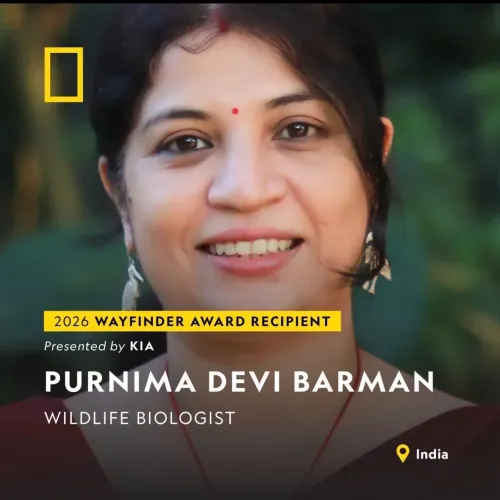
CM Assam Hails Purnima Devi Barman's Nat Geo Wayfinder Award
Synopsis
Assam's Chief Minister's Office has celebrated wildlife biologist Purnima Devi Barman's inclusion among 15 global recipients of the National Geographic Society's 2026 Wayfinder Award, honouring her community-led campaign to protect the endangered Greater Adjutant stork in the Brahmaputra floodplains.
Key Takeaways
Purnima Devi Barman has been named among 15 global changemakers honoured with the National Geographic Society's 2026 Wayfinder Award .
The Chief Minister's Office of Assam publicly celebrated the recognition on 10 June 2026 , calling it a proud moment for the state.
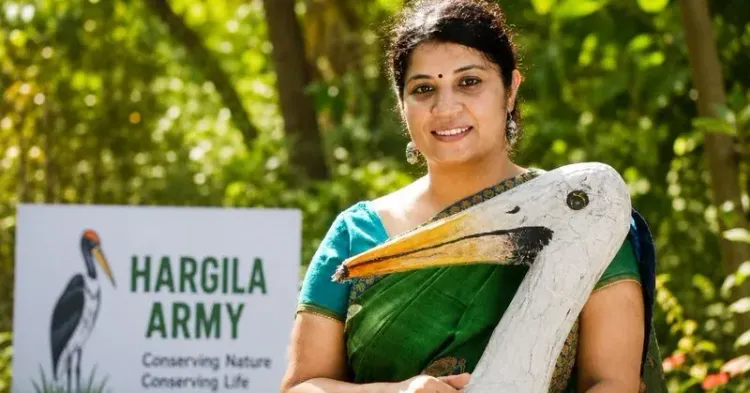
Barman is an Assam -based wildlife biologist best known for leading the Hargila Army , a women-led community initiative protecting the Greater Adjutant stork .
Her model integrates community mobilisation with scientific conservation, operating in villages around the Brahmaputra floodplains where formal protected-area coverage is limited.
The award reflects growing international recognition of grassroots, women-led conservation models originating in northeast India .
The recognition could catalyse expanded funding and state-level policy support for community wetland-protection programmes in Assam .
The Chief Minister's Office of Assam on Wednesday, 10 June 2026 celebrated wildlife biologist Purnima Devi Barman being named among the recipients of the National Geographic Society's 2026 Wayfinder Award, calling it a proud moment for the state and recognising her globally acclaimed conservation work.
Context
Purnima Devi Barman is an Assam-based wildlife biologist who has spent years building community-led movements to protect the Greater Adjutant stork (Leptoptilos dubius), one of the world's rarest large birds. Her approach centres on mobilising women in villages around Kamrup district to act as guardians of nesting trees and wetland habitats, creating a grassroots shield for a species that once faced severe population decline across its range in South and Southeast Asia.
The National Geographic Society's Wayfinder Award recognises individuals across the globe who are charting new paths in exploration, science, storytelling, and conservation. Being counted among 15 global changemakers honoured in the 2026 cycle places Barman in a cohort of internationally recognised practitioners whose work is deemed transformative in their fields.
Policy Backdrop
Assam's extensive wetlands and floodplains — including the Deepor Beel Wildlife Sanctuary and surrounding agricultural lowlands — form critical habitat corridors for endangered avian species. Formal protected-area frameworks alone have historically struggled to cover the dispersed nesting and foraging grounds of the Greater Adjutant, making community-based models like Barman's 'Hargila Army' — a women-led conservation group — especially significant for species recovery.
Grassroots conservation efforts in northeast India have gained increasing global visibility over the past decade, with international bodies and funding agencies documenting women-led community models as measurably effective in contexts where state enforcement has limited reach. Barman's recognition fits a broader pattern of the international conservation community validating the integration of traditional ecological knowledge with scientific monitoring in wetland and avian protection.
Stakeholders and Impact
The primary beneficiaries of Barman's work are the rural communities — particularly women — of the Brahmaputra floodplains who have been trained and empowered as frontline conservationists. The model has documented a measurable recovery in Greater Adjutant nesting numbers in the villages where the programme operates, demonstrating that species recovery and livelihood integration are not mutually exclusive.
For Assam as a state, the recognition carries diplomatic and reputational weight: it signals that community conservation originating in the Northeast is now benchmarked against global best practices. Conservation biologists and international non-governmental organisations working in the region are likely to draw on this visibility to attract further research partnerships and funding for similar wetland-species programmes.
What's Next
The spotlight from a high-profile international award typically opens pathways for expanded funding, cross-border collaborations, and state-level policy uptake. Observers will watch whether the Government of Assam moves to formally scale community wetland-protection models, and whether international conservation bodies follow the award with grants or technical partnerships aimed at replicating the Hargila Army framework in other biodiversity-rich districts of the Northeast.
Barman's recognition also adds momentum to a wider argument: that women-led, community-anchored conservation is not peripheral to mainstream environmental policy but central to durable species recovery in ecologically complex landscapes like the Brahmaputra basin.
Point of View
The recognition underscores a decade-long shift in how international conservation institutions evaluate impact: community agency and gender-inclusive models are no longer treated as supplementary to formal protected-area regimes but as primary drivers of species recovery. For northeast India, where ecological sensitivity and political marginalisation have long coexisted, Barman's global visibility represents a rare convergence of environmental and regional advocacy. The real test will be whether this award translates into concrete state investment in scaling the community wetland model, or remains a moment of ceremonial pride.
NationPress
23 Sept 2026
Frequently Asked Questions
Who is Purnima Devi Barman and why is she famous?
Purnima Devi Barman is an Assam-based wildlife biologist celebrated for founding the 'Hargila Army,' a women-led community movement that has helped recover populations of the endangered Greater Adjutant stork in the Brahmaputra floodplains of Assam.
What is the National Geographic Society Wayfinder Award?
The National Geographic Society's Wayfinder Award recognises individuals around the world who are pioneering new approaches in exploration, science, storytelling, and conservation; in 2026, 15 global changemakers were honoured with the award.
What is the Greater Adjutant stork and why does it need protection?
The Greater Adjutant (Leptoptilos dubius) is one of the world's rarest large birds, with a significant portion of its global population nesting in Assam's wetlands and agricultural lowlands; habitat loss and human disturbance have historically threatened its survival.
What is the Hargila Army in Assam?
The Hargila Army is a women-led grassroots conservation group founded by Purnima Devi Barman that trains and empowers rural women in Kamrup district to protect Greater Adjutant nesting trees and wetland habitats, and has been credited with measurable recovery in the bird's local population.
How did the Assam government respond to Purnima Devi Barman's Wayfinder Award?
The Chief Minister's Office of Assam posted on X on 10 June 2026, publicly celebrating the recognition and describing it as a proud moment for the state.