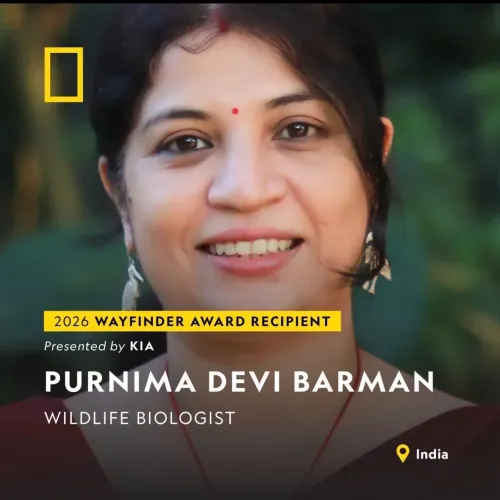
CM Assam Highlights Dr. Purnima Barman's NatGeo Conservation Feature

Synopsis
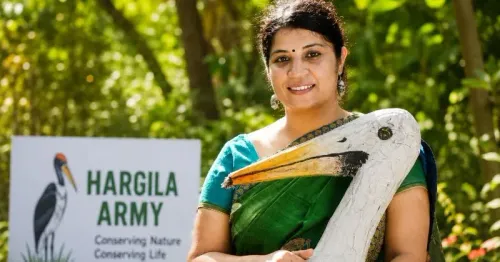
The Chief Minister's Office of Assam highlighted a National Geographic feature on Dr. Purnima Devi Barman, whose Hargila Army — a women-led volunteer network — has turned community conservation of the endangered Greater Adjutant stork into a globally recognised biodiversity model rooted in Assam's wetland villages.
Key Takeaways
The CMO Assam shared a National Geographic profile of Dr.
Purnima Devi Barman on 2 July 2026 , calling her work a global conservation model.
The Hargila Army is a women-led volunteer network founded by Dr.
Barman from the mid- 2000s to protect Greater Adjutant nesting sites in Assam .
The Greater Adjutant is one of the world's rarest storks, with key breeding colonies in Assam's wetland villages.
Barman has received a National Geographic Society grant and the Whitley Award for the Hargila conservation project.
The model integrates local customs and women's participation, and has been supported by the Assam state forest department.
Conservation experts see the initiative as a replicable template for wetland species recovery across South and Southeast Asia .
The Chief Minister's Office of Assam on Thursday, 2 July 2026 shared a National Geographic feature spotlighting Dr. Purnima Devi Barman, whose community-led campaign to save the Greater Adjutant stork — locally called Hargila — has been recognised as a global model for grassroots biodiversity protection.
Context
The post, shared from the official CMO Assam account, drew attention to a National Geographic profile of Dr. Barman, tagging her public handle @StorkSister. The office described how 'community-led conservation of the Greater Adjutant has emerged as a global model for protecting biodiversity,' amplifying the recognition of an Assamese conservationist whose work began in village wetlands more than two decades ago.
The Greater Adjutant (Leptoptilos dubius) is one of the world's rarest storks, with a significant breeding population concentrated in Assam's village trees and wetlands. Once widely persecuted, the bird's recovery is now closely tied to the volunteer network Dr. Barman built from the ground up.
Policy Backdrop
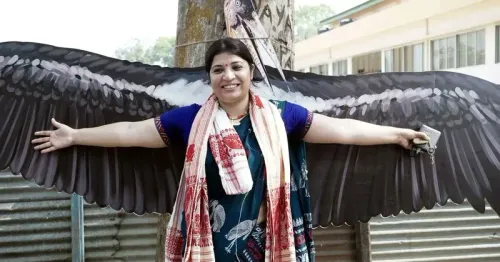
Dr. Barman founded the Hargila Army — a network of village women in Assam — from the mid-2000s onward to guard nesting sites, integrate local customs into conservation practice, and shift community perception of the stork from a bad omen to a symbol of pride. The initiative later drew support from the Assam state forest department, creating a participatory model that blends traditional knowledge with habitat protection.
International recognition followed: Dr. Barman received a National Geographic Society grant and the prestigious Whitley Award for the Hargila project, cementing the campaign's status as a benchmark for species-specific community conservation. These accolades placed Assam's wetland conservation on the global map at a time when India was scaling up commitments under the Convention on Biological Diversity.
India has increasingly promoted community-based approaches to endangered-species recovery, particularly in biodiversity-rich northeastern states. The Hargila model — women-led, culturally embedded, and measurably effective — parallels national wetland conservation programmes that favour participatory frameworks over purely regulatory enforcement.
Stakeholders and Impact
At the centre of the initiative are the village women of Assam's wetland communities, particularly around Dadara and Pacharia villages near Guwahati, where the largest nesting colonies exist. These women have transformed from bystanders to active custodians, using song, art, and social pressure to protect nesting trees and discourage hunting.
The broader beneficiary is the Greater Adjutant population itself: conservation estimates have shown a measurable increase in nesting pairs in areas where the Hargila Army operates. The model also provides a replicable template for other threatened wetland species across South and Southeast Asia.
The CMO Assam's decision to amplify the National Geographic feature signals the state government's intent to position Assam as a leader in community-driven environmental governance — a narrative with both ecological and political resonance ahead of ongoing debates on wetland policy and biodiversity targets.
What's Next
Conservation observers will watch whether the renewed spotlight on the Hargila Army accelerates replication of the model for other threatened storks or wetland-dependent species in Assam and neighbouring states. Any new state-level biodiversity policy announcements referencing community participation frameworks could draw directly on the credibility the Greater Adjutant campaign has built internationally.
With National Geographic's global reach now amplifying the story, the Hargila Army model may also attract fresh international funding and partnerships, potentially expanding Dr. Barman's network beyond Assam's borders and into broader South Asian wetland conservation efforts.
Point of View
The signal is that participatory models, not regulatory mandates, are Assam's preferred conservation identity. This aligns with a broader national shift toward community stewardship frameworks in environmental governance, which carry both ecological credibility and political goodwill. The global platform of National Geographic adds external validation that the state is keen to leverage for soft power in environmental diplomacy.
NationPress
1 Oct 2026
Frequently Asked Questions
Who is Dr. Purnima Devi Barman and why is she famous?
Dr. Purnima Devi Barman is an Assamese biologist and conservationist who founded the Hargila Army, a women-led volunteer network in Assam that protects the endangered Greater Adjutant stork. She has received international recognition including a National Geographic Society grant and the Whitley Award for her work.
What is the Hargila Army?
The Hargila Army is a community volunteer network of village women in Assam, initiated by Dr. Purnima Devi Barman, that safeguards Greater Adjutant stork nesting sites through local customs, awareness campaigns, and habitat protection. It is widely regarded as a successful grassroots biodiversity conservation model.
What is the Greater Adjutant stork and is it endangered?
The Greater Adjutant (Leptoptilos dubius) is one of the world's rarest storks, classified as endangered. Assam hosts a significant portion of its global breeding population, concentrated in wetland villages near Guwahati.
Why did National Geographic feature Dr. Purnima Barman?
National Geographic profiled Dr. Purnima Devi Barman because her Hargila Army model demonstrates how community-led, women-driven conservation can successfully protect an endangered species, making it a globally recognised example of grassroots biodiversity protection.
What did the CMO Assam post about the Greater Adjutant conservation?
The Chief Minister's Office of Assam shared a National Geographic video feature on 2 July 2026 highlighting Dr. Purnima Devi Barman's work, stating that community-led conservation of the Greater Adjutant has emerged as a global model for protecting biodiversity.