How Does Putin’s India Visit Impact Geopolitical Balance?
Synopsis
In a pivotal moment for international relations, Vladimir Putin's recent visit to India underscores a shift towards enhancing economic ties amidst geopolitical tension. With significant agreements reached on energy and trade, this summit reflects India's strategic autonomy in a complex global landscape. Discover the implications of this visit and its potential to reshape India's foreign policy.
Key Takeaways
Strengthened India-Russia economic ties Commitment to energy security Focus on counter-terrorism Strategic autonomy in foreign policy Future economic cooperation programs
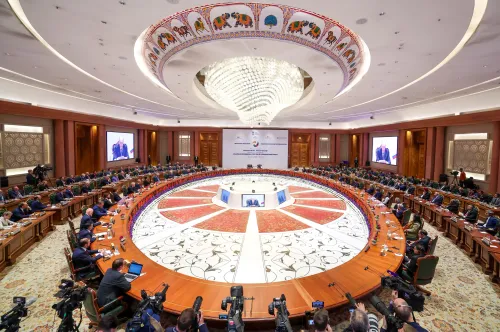
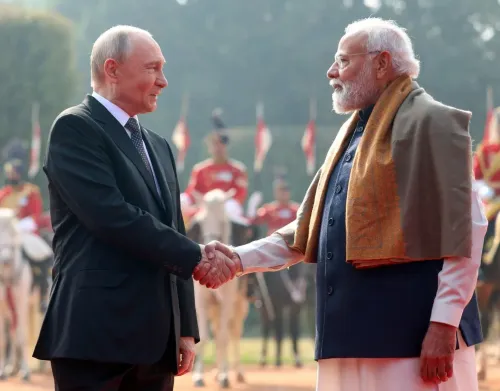
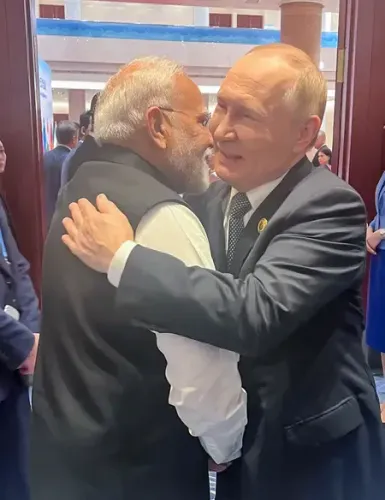
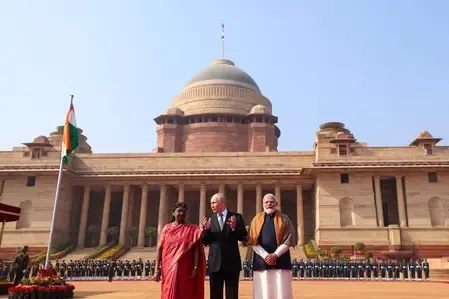
New Delhi, Dec 14 (NationPress) The recent summit between India and Russia marked the first visit of Vladimir Putin to India since the onset of the Ukraine-Russia military conflict. This meeting expanded beyond the enduring focus on defense and strategic ties, emphasizing the importance of economic and trade connections.
Putin’s visit must be viewed against the backdrop of Western powers, especially the US, urging India to reduce its oil imports from Russia, claiming it would deter Russia from continuing the conflict in Ukraine.
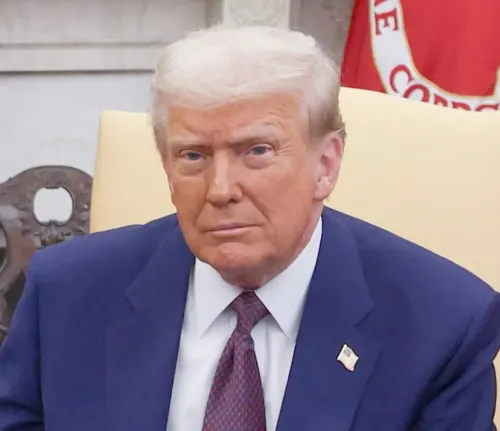
Prime Minister Modi stated that ‘enhancing our economic collaboration with Russia is a mutual priority’, serving as a response to the tariff pressure imposed by US President Trump.
During a press briefing after discussions with Putin, Modi remarked that ‘the India-Russia friendship has remained a constant guiding star for the past eighty years’, founded on ‘mutual respect and profound trust’ despite global fluctuations.
Putin highlighted the agreements reached to expand economic cooperation, affirming that both nations are ‘key partners’ in trade, investment, and technology. An Economic Cooperation Programme was launched to increase trade from the current 68 billion dollars to 100 billion by 2030, with the Prime Minister expressing optimism that this goal could be achieved ahead of schedule.
In light of US sanctions on Russian energy firms, Putin assured that Russia would continue to be ‘a dependable supplier of oil, gas, coal, and all necessary resources for the development of India’s energy sector’, subtly encouraging India to overlook US tariff pressures.
Identifying energy security as a crucial aspect of their bilateral partnership, Modi announced advancements in civil nuclear energy cooperation, emphasizing its significance in promoting clean energy objectives. Amid ongoing US efforts to facilitate a peaceful resolution to the Ukraine conflict, Modi conveyed India’s support for all initiatives aimed at a negotiated settlement, asserting that ‘India is not neutral but stands firmly on the side of peace’.
Putin notably mentioned that ‘Russia is collaborating with partners, including the US, to explore potential peaceful resolutions’ and expressed gratitude towards Modi for ‘focusing on the issue and joining efforts to find a solution’. However, the joint statement did not address the Ukraine crisis but did express concern regarding the humanitarian situation in Gaza, urging all parties to adhere to agreements regarding conflict cessation, humanitarian aid, and sustainable peace.
India and Russia finalized several agreements across critical sectors such as mobility, migration, and shipping. It appeared that Putin was at ease discussing the Ukraine situation, referencing US efforts possibly due to a rapport with Trump, who has been perceived as applying pressure on President Zelensky of Ukraine to concede on territorial matters.
Both nations agreed to establish a framework for the movement of skilled workers from India to Russia to satisfy Russia’s growing labor demands, particularly in IT, construction, and engineering. India announced a reciprocal offer of free 30-day employment-tourist visas for Russian nationals. Overall, as Foreign Secretary Vikram Misri stated in a press briefing, economic cooperation was the ‘driving force’ of Putin’s visit. He indicated that regulatory barriers would be promptly addressed to enhance Indian exports in sectors like pharmaceuticals, agriculture, and marine products to rectify the trade imbalance.
The subject of terrorism was a significant focus during the summit, with both parties declaring their commitment to a ‘zero tolerance policy’ on terrorism in the joint statement. Modi emphasized that India and Russia stand united in the fight against terrorism, highlighting that ‘whether it’s the terror incident in Pahalgam or the cowardly attack at Crocus City Hall in Moscow, the root cause is identical’. It’s worth noting that the attack in Jammu and Kashmir was executed by the Resistance Front (TRF), a proxy of the Lashkar-e-Taiba, while the assault on the Russian venue was claimed by ISIS-K, which operates on the Pakistan-Afghanistan border.
The joint statement asserted that ‘all acts of terrorism are criminal and unjustifiable, regardless of any ideological or religious motivations’. The two leaders supported coordinated actions against all UN-listed terrorist groups, including Al-Qaeda and the Islamic State, aimed at dismantling terrorist safe havens and eliminating funding channels. Counter-terrorism efforts unite major powers, including India, the US, and Russia, as Islamic radicalization is regarded as a shared threat.
India’s External Affairs Minister S. Jaishankar aptly summarized the outcomes of Putin’s visit by stating it reflected India’s freedom of choice and strategic autonomy amid US pressure to cut Russian oil and military purchases. He revealed that the summit resulted in a five-year economic program to diversify and balance trade, a mobility agreement, and initiatives to strengthen energy partnerships. He reiterated that India-Russia relations have remained among the most stable big-power partnerships and noted that India has relationships with all major nations, including the US, adding that ‘it is unreasonable for any country to expect a veto’ over how New Delhi manages its international relationships.
Jaishankar further remarked that Putin’s visit was, in many respects, about ‘reimagining the relationship’ as economic ties have not kept pace with defense and strategic collaborations. He observed that trade had become more central under Trump’s administration than in previous ones, which India recognized, leading to negotiations with the US to establish ‘a landing ground for our respective trade interests’. Clearly, India has exercised its sovereign right to maintain bilateral relationships with both Russia and the US in a manner that best serves national interests. Both India and Russia have benefitted from the outcomes of Putin’s visit.
(The writer is a former Director of the Intelligence Bureau)
Point of View
It is evident that the recent India-Russia summit represents a crucial moment in the dynamics of global diplomacy. While balancing relationships with both Russia and the US, India is asserting its strategic autonomy, demonstrating a commitment to mutual economic growth and stability. This visit not only highlights India's role as a key player on the world stage but also reinforces its dedication to peace and cooperation amidst ongoing global challenges.
NationPress
19 Sept 2026
Frequently Asked Questions
What were the main outcomes of Putin's visit to India?
The main outcomes included agreements to enhance economic cooperation, a commitment to increase bilateral trade from 68 billion to 100 billion dollars by 2030, and discussions on energy security and counter-terrorism.
How does this visit affect India's relationship with the US?
The visit demonstrates India's strategic autonomy, as it seeks to maintain strong ties with both Russia and the US, despite US pressure to limit oil imports from Russia.
What role does energy security play in India-Russia relations?
Energy security is a vital aspect of the bilateral partnership, with Russia pledging to be a reliable supplier of oil and gas to support India's growing energy needs.
What stance did India take regarding the Ukraine conflict?
India expressed its support for peaceful resolutions to the Ukraine conflict, emphasizing that it stands on the side of peace while acknowledging its strategic interests.
What is the significance of the joint statement issued after the summit?
The joint statement highlighted a shared commitment to a 'zero tolerance policy' on terrorism and underscored the importance of cooperation against UN-listed terrorist groups.