Does Russian President Putin’s Visit Indicate India's Resistance to Western Influence?
Synopsis
Russian President Putin’s recent visit to India marks a pivotal moment, signaling a shift away from Western influence over India's strategic choices. As geopolitical tensions rise, India asserts its independence, reaffirming strong ties with Russia while navigating its complex relationships with global powers.
Key Takeaways
Putin's visit signals a shift in India's foreign policy.
India maintains strong defense ties with Russia .
India's energy security is bolstered through Russian supplies.
India seeks to balance relations with both Russia and the US .
The visit highlights India's strategic autonomy on the global stage.
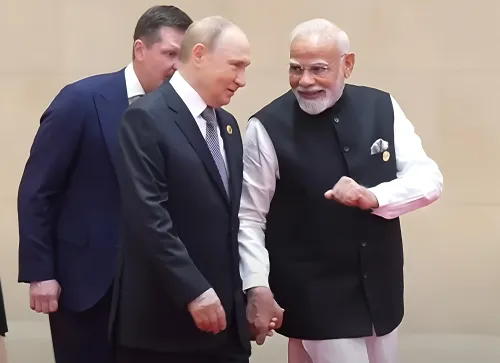
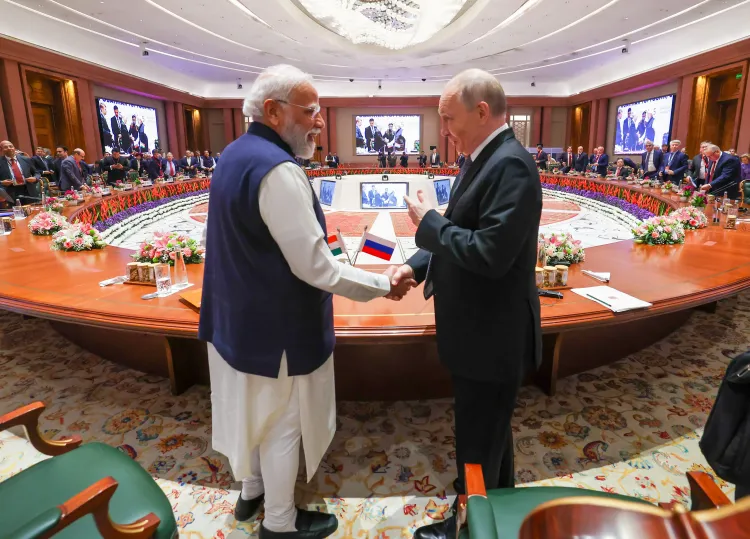
Moscow/New Delhi, Dec 6 (NationPress) The recent diplomatic trip by Russian President Vladimir Putin to India delivered a definitive signal that the era of Western dominance over India's strategic decisions has come to an end, as outlined in a report released on Saturday.
This visit also emphasized that India will not jeopardize its longstanding relationship with Russia to satisfy US interests.
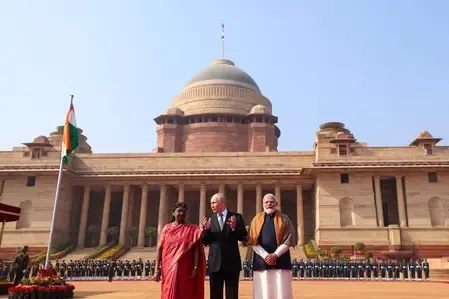
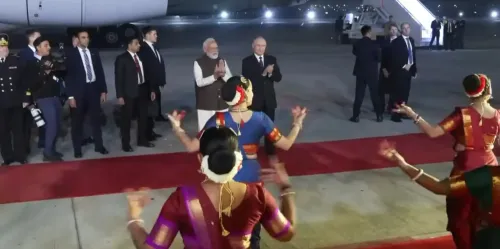
The report stated, “Putin’s State Visit to India for the 23rd India‑Russia Annual Summit arrives at a critical juncture where three strategic pressures converge on New Delhi: Western sanctions against Moscow, intensifying US–China rivalry in the Indo-Pacific, and a fragile India–US trade and technology partnership. By welcoming Putin with full ceremonial honors – at Rajghat, Rashtrapati Bhavan, and through an extensive schedule of delegation-level discussions – India has sent a clear message that Russia continues to be a primary partner, not an outdated relationship to be quietly dismissed under Western influence,” the report elaborated.
This symbolism is significant as it counters the prevalent notion in many Western capitals that India would eventually align with sanctions and coalition warfare. Instead, New Delhi is showcasing a different model: a pivotal democracy that collaborates closely with the US while maintaining substantial independence with Russia and the Global South,” the report stated.
Moreover, the summit's defense communications reveal that India has no intention of diminishing military ties with Russia merely to alleviate US concerns.
“Currently, India still acquires approximately two-thirds of its major defense platforms from Russia, and Moscow continues to supply S‑400 air defense systems that form the backbone of India’s air and missile defense against both China and Pakistan. The 2025 agenda is evolving beyond a simple buyer-seller dynamic to encompass co-development, joint research, manufacturing partnerships, maintenance and overhaul hubs, and advanced projects in engines, hypersonics, and unmanned systems,” it emphasized.
On the energy front, Putin conveyed a clear message in Delhi: Russia will remain a consistent supplier of discounted crude oil and other fuels to India, insulating energy ties from geopolitical frictions.
Rather than interpreting India’s relationship with Russia as a measure of reliability, the US should recognize it as part of New Delhi’s broader strategy to mitigate over-dependence on any single global power.
“India gains from Russian influence in Central Asia and its historical defense support, while simultaneously engaging with the US for high-end semiconductors, aerospace collaboration, and maritime balancing in the Indo-Pacific. Forcing India to sever the Russian component of this triangle will not lead to a closer alignment with America; instead, it risks pushing New Delhi back towards a more traditional non-alignment, which could dilute US influence,” noted the report.
Point of View
The visit of President Putin to India is not only a reaffirmation of India's commitment to maintaining a balanced foreign policy but also a strategic maneuver to ensure national interests are prioritized over external pressures. This approach reflects India's long-standing values of non-alignment, which remain relevant in today’s multipolar world.
NationPress
27 Sept 2026
Frequently Asked Questions
What does Putin's visit signify for India?
Putin's visit underscores India's independence from Western influence, reaffirming strong ties with Russia amid global geopolitical tensions.
How does this impact India's defense strategy?
The visit solidifies India's defense partnership with Russia, ensuring continued access to essential military equipment and technology.
What are the implications for US-India relations?
While India cooperates with the US, it emphasizes a balanced approach, resisting pressure to sever ties with Russia.