Raghav Chadha hails new TRAI rules on prepaid mobile plans
Synopsis
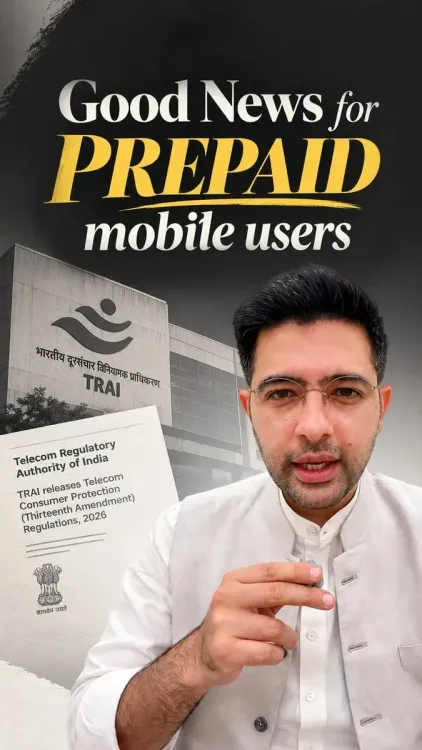
The Government of India and TRAI have notified the Telecom Consumer Protection (Thirteenth Amendment) Regulations, 2026, introducing 30-day recharge validity plans, voice-and-SMS-only tiers, and affordable low-budget options for India's prepaid mobile consumers.
Key Takeaways
The Telecom Consumer Protection (Thirteenth Amendment) Regulations, 2026 have been officially notified by the Government of India and TRAI.
30-day recharge plans will now be available, reducing the annual recharge count from 13 to 12 by aligning plans with the calendar month.
Dedicated voice-and-SMS-only plans will be offered for users who do not require mobile data.
The amendment mandates affordable plan options specifically for low-budget consumers whose primary need is basic voice calling.
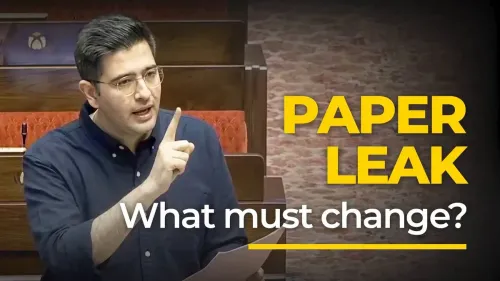
AAP Rajya Sabha MP Raghav Chadha raised consumer concerns on this issue in Parliament on 11 March before the amendment was finalised.
The amendment builds on TRAI's foundational Telecom Consumers Protection Regulations, 2012 , marking its thirteenth revision.
India's 280 million-plus prepaid mobile subscribers just got a meaningful upgrade to their recharge calendar — and a specific parliamentary push helped make it happen. AAP Rajya Sabha MP Raghav Chadha on Sunday, 27 September 2026, welcomed the Government of India's notification of the Telecom Consumer Protection (Thirteenth Amendment) Regulations, 2026, crediting the reform to sustained consumer feedback and a formal intervention he made in Parliament.
What the Thirteenth Amendment actually changes
The new regulations introduce three concrete shifts for prepaid users. First, 30-day validity recharge plans will now be available — replacing the prevailing 28-day cycle that forced subscribers to pay for 13 recharges in a 12-month year, adding one extra billing cycle's cost annually. Second, voice-and-SMS-only plans will be offered for consumers who do not need mobile data, a category that includes tens of millions of elderly and rural users priced out of bundled data packs. Third, the amendment mandates more affordable options for low-budget consumers whose primary need is basic voice connectivity.
Chadha noted that constituents had directly flagged these concerns to him. 'Many of you had shared your concerns with me about limited and inflexible recharge options,' he wrote, adding that he raised the issue in Parliament on 11 March seeking 'greater choice and more affordable options for consumers.'
TRAI's long road to tariff flexibility
The Telecom Regulatory Authority of India (TRAI) first codified baseline rules on tariff transparency and recharge validity through the Telecom Consumers Protection Regulations, 2012. In the years since, India's prepaid market ballooned under fierce competition among major operators, yet the 28-day billing cycle — an industry-wide convention — persisted, generating quiet but widespread consumer frustration. The Thirteenth Amendment represents TRAI's most direct acknowledgement yet that the cycle mismatch between a telecom 'month' and a calendar month was a structural consumer burden, not a trivial technicality.
The regulation also signals a policy shift toward unbundled, need-based plans — a departure from the all-in-one voice-data-SMS bundles that have dominated the market since the 4G revolution of the mid-2010s. For the user who wants a phone that simply rings and texts, that shift is overdue.
Parliament to policy: tracing the intervention
Chadha's acknowledgement of his 11 March parliamentary intervention is notable because it maps a traceable line from a legislator's floor-level question to a regulatory amendment — a relatively rare, visible example of parliamentary input influencing a telecom regulator's output. He was careful to express gratitude to both the Government and TRAI, framing the outcome as a collaborative resolution rather than a political win.
The real test now shifts to the operators. Whether 30-day plans and voice-only tiers actually reach consumers at accessible price points — or get buried beneath aggressive upselling — will depend on how quickly telecom companies comply and how closely TRAI monitors uptake. Regulators writing rules is one chapter; consumers actually choosing them is another.
Point of View
It was a commercial convenience that quietly transferred cost to subscribers. TRAI's move toward unbundled voice-only and 30-day plans reflects a broader regulatory trend of disaggregating telecom tariffs to serve India's lower-income and elderly users who have long been collateral casualties of data-bundle dominance. The legislative-to-regulatory pathway Chadha has highlighted — a March parliamentary intervention feeding into a September notification — will be watched closely by other MPs seeking similar accountability from sector regulators. The credibility of the amendment, however, rests entirely on operator compliance and the price points at which the new plans are actually offered.
NationPress
27 Sept 2026
Frequently Asked Questions
What is the TRAI Thirteenth Amendment 2026 for prepaid users?
The Telecom Consumer Protection (Thirteenth Amendment) Regulations, 2026 introduce 30-day validity recharge plans, voice-and-SMS-only options, and more affordable plans for low-budget prepaid mobile consumers in India.
Why did prepaid users need 13 recharges a year before this amendment?
Most prepaid plans carried a 28-day validity period rather than a full calendar month, which meant subscribers had to recharge 13 times in a 12-month year, paying one extra cycle's cost annually.
What did Raghav Chadha do to push for prepaid mobile reform?
AAP Rajya Sabha MP Raghav Chadha raised the issue of limited and inflexible prepaid recharge options in Parliament on 11 March, seeking greater consumer choice and more affordable plans before TRAI finalised the amendment.
Who benefits most from the new voice-and-SMS-only mobile plans?
Elderly users, rural consumers, and low-income subscribers who need basic voice calling but do not use mobile data will benefit most, as the new plans allow them to avoid paying for bundled data they do not need.
When will the new 30-day prepaid plans be available in India?
The regulations have been notified as of September 2026; the timeline for telecom operators to roll out compliant 30-day and voice-only plans will depend on operator compliance schedules and TRAI's monitoring directives.