Rahul Gandhi Accuses EC of 'Seat Chori' in Rajya Sabha Polls

Synopsis
Rahul Gandhi accused the Election Commission of 'Seat Chori', alleging Congress candidate Meenakshi Natarajan's Rajya Sabha nomination was cancelled on a frivolous BJP objection while BJP-backed Parimal Nathwani received an extension despite a defective form, calling it a pattern of electoral manipulation.
Key Takeaways
Rahul Gandhi on June 11, 2026 , accused the Election Commission of India of procedural bias in recent Rajya Sabha elections.
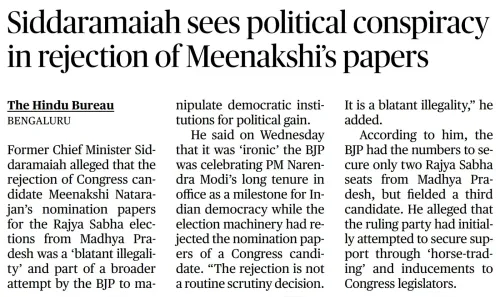
Congress candidate Meenakshi Natarajan 's nomination was reportedly cancelled despite complete documentation and no pending disqualifying cases.
BJP-backed independent Parimal Nathwani allegedly submitted a defective form with his own name wrong and missing mandatory disclosures, yet received an extension to correct errors.
Gandhi alleged the EC 'tried to evade' a Congress meeting request and offered no explanation when the meeting finally took place.
Gandhi framed the episode as 'Seat Chori', extending his earlier vocabulary of 'Vote Chori' and 'Sarkar Chori' to describe what he calls systematic electoral manipulation.
Biennial Rajya Sabha elections are scheduled across multiple states later in 2026 , making the procedural dispute politically significant.
Congress leader and Leader of the Opposition Rahul Gandhi on Thursday, June 11, 2026, launched a sharp attack on the Election Commission of India, alleging that the constitutional body cancelled the Rajya Sabha nomination of Congress candidate Meenakshi Natarajan on a 'frivolous' objection while granting an extension to a BJP-backed candidate who submitted a defective form. Gandhi framed the episode as 'Seat Chori' — the latest in what he described as a pattern of electoral manipulation by the ruling party in concert with the poll body.
Context
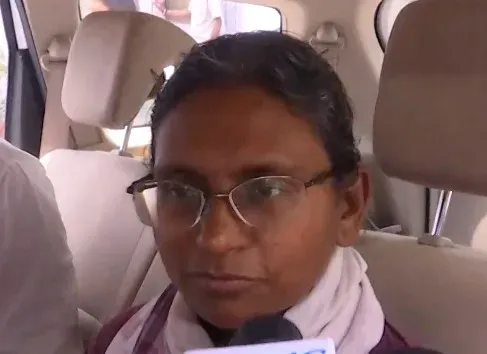
In a post on X, Gandhi alleged that Meenakshi Natarajan, a former Lok Sabha MP from Madhya Pradesh fielded by the Congress for the Rajya Sabha, had her nomination cancelled despite submitting all required documents and having no pending disqualifying cases. He contrasted this with the treatment of Parimal Nathwani, described as a BJP-backed independent, who Gandhi alleged got his own name wrong on the nomination form and skipped multiple mandatory disclosures — yet received an extension from the Election Commission to rectify the errors.
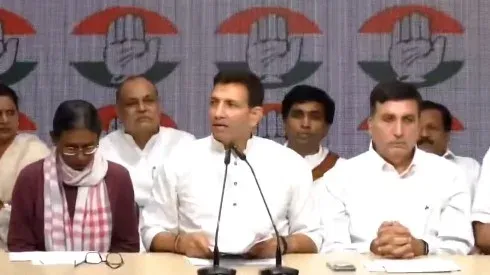
Gandhi wrote: 'Same Election Commission. Two candidates. One was disqualified without even a hearing. The other was rewarded despite not following the rules.' He also alleged that when the Congress sought a meeting with the Commission, 'the EC first tried to evade us. When we finally met, they did not say one word.'
Policy Backdrop
Rajya Sabha elections are indirect polls conducted under the Representation of the People Act, 1951, with elected members of state legislative assemblies casting votes. Nomination scrutiny and rejection procedures are governed by this Act and subsequent amendments, giving returning officers — operating under EC supervision — significant discretionary authority to accept, query, or reject nomination papers.
The Election Commission of India, a constitutional body established under Article 324, has faced sustained criticism from opposition parties over perceived procedural asymmetry in both direct and indirect elections, particularly in states where the BJP commands legislative majorities that determine Rajya Sabha outcomes. Debates over the autonomy and appointment process of election commissioners have intensified in recent years, with the opposition arguing that the body's independence has been compromised.
Gandhi's post uses the phrase 'BJP-EC jugalbandi' — a Hindi musical term for a duet — to allege coordinated action between the ruling party and the poll body, extending his earlier formulations of 'Vote Chori' (vote theft) and 'Sarkar Chori' (government theft) into what he now terms 'Seat Chori' (seat theft).
Stakeholders and Impact
The immediate stakeholder is Meenakshi Natarajan, whose Rajya Sabha candidacy was reportedly nullified, denying the Congress a potential upper-house seat. For the party, the loss of even a single Rajya Sabha seat carries legislative weight given the BJP's dominance in several state assemblies that send members to the upper house.
Broader opposition parties watching the episode may draw their own conclusions about the risks of fielding candidates in states where they are numerically weaker. State legislators who are the actual voters in Rajya Sabha polls are also directly implicated, as the integrity of the nomination process shapes which names ultimately appear on the ballot.
The Election Commission has not, as of the time of this report, issued a public response to Gandhi's specific allegations.
What's Next
Gandhi closed his post with a pointed warning: 'Expect to see much more of this — because for the BJP, it is far easier to fix the election than to win it.' The Congress is likely to escalate the matter, potentially through a formal petition before the Supreme Court or a renewed demand for an EC hearing, given the party's stated frustration at the Commission's silence during their meeting.
With biennial Rajya Sabha elections scheduled across multiple states later in 2026, the procedural questions raised by this episode — around nomination scrutiny standards and equal treatment of candidates — are set to remain at the centre of the opposition's campaign against what it characterises as institutional capture by the ruling party.
Point of View
Named episode — the Natarajan-Nathwani contrast — at the centre of the charge, he moves the argument from abstract institutional critique to a concrete, verifiable grievance, which is harder to dismiss. The allegation of differential scrutiny in nomination proceedings strikes at the foundational principle of equal treatment under electoral law, and if substantiated, would represent a serious procedural failure. With Rajya Sabha elections pending in several states, the Congress is clearly signalling that it intends to contest not just the votes but the rules of the contest itself.
NationPress
20 Sept 2026
Frequently Asked Questions
What is 'Seat Chori' that Rahul Gandhi is talking about?
'Seat Chori' is a phrase coined by Rahul Gandhi to allege that the Election Commission, acting in concert with the BJP, denied the Congress a Rajya Sabha seat by cancelling the nomination of its candidate Meenakshi Natarajan on what he calls a frivolous objection, while allowing a BJP-backed candidate to correct a defective form.
Why was Meenakshi Natarajan's Rajya Sabha nomination cancelled?
According to Rahul Gandhi's post, the Election Commission cancelled Meenakshi Natarajan's nomination following an objection raised by the BJP, even though she had submitted all required documents and had no pending disqualifying cases. The specific official grounds cited by the EC have not been publicly detailed in available records.
Who is Parimal Nathwani and what is the allegation against him?
Parimal Nathwani is an industrialist and former Rajya Sabha member described as a BJP-backed independent candidate. Rahul Gandhi alleged that Nathwani got his own name wrong on the nomination form and skipped multiple mandatory disclosures, yet received an extension from the Election Commission to correct all errors.
How are Rajya Sabha elections conducted in India?
Rajya Sabha elections are indirect polls in which elected members of state legislative assemblies vote to choose representatives to the upper house of Parliament. They are governed by the Representation of the People Act, 1951, and conducted under the supervision of the Election Commission of India.
What action is the Congress party likely to take after this allegation?
Gandhi's post suggests the Congress will continue to press the Election Commission for answers and may approach the Supreme Court with a formal petition challenging the nomination orders, given that the party says the EC offered no explanation during their meeting.