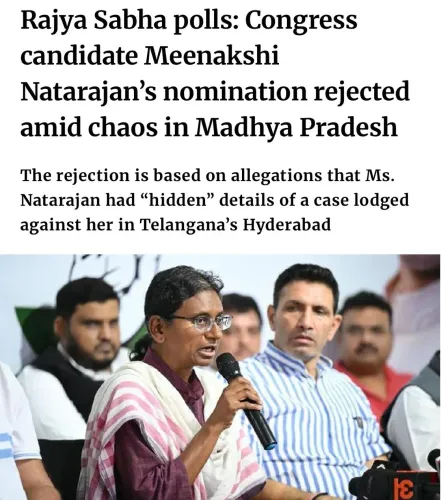
Congress alleges BJP-EC collusion in MP Rajya Sabha polls, calls Natarajan rejection 'seat chori'
Synopsis
Congress has accused the BJP and Election Commission of colluding to knock out senior leader Meenakshi Natarajan from the Madhya Pradesh Rajya Sabha race — alleging her nomination was rejected on legally untenable grounds while a BJP-linked candidate's defective papers in Jharkhand sailed through. The party calls it 'seat chori', raising pointed questions about the ECI's consistency.
Key Takeaways
The Congress alleged BJP-ECI collusion in the rejection of Meenakshi Natarajan 's Rajya Sabha nomination in Madhya Pradesh on 12 June .
The Returning Officer rejected Natarajan's nomination citing alleged non-disclosure of a criminal case in her Form 26 affidavit.
Congress argues no court had taken cognisance of any offence against Natarajan, making the 'Not Applicable' response legally valid under BNSS provisions.
The party alleged double standards , claiming Parimal Nathwani 's defective nomination in Jharkhand was accepted after the Returning Officer allowed clarifications.
Congress cited a 1973 Supreme Court ruling holding that Returning Officers cannot permit rectification of substantial defects during scrutiny.
The BJP and ECI had not publicly responded to the allegations at the time of reporting.
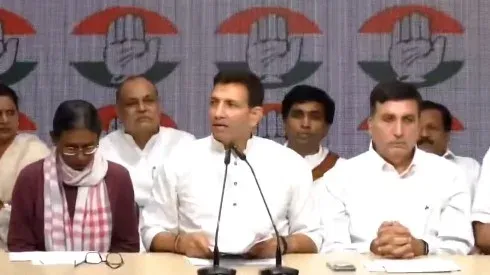
The Indian National Congress on Friday, 12 June launched a sharp attack on the Bharatiya Janata Party (BJP) and the Election Commission of India (ECI), alleging deliberate collusion in the rejection of senior leader Meenakshi Natarajan's nomination for the Rajya Sabha elections in Madhya Pradesh. The party described the move as 'seat chori' — a direct theft of a parliamentary seat — and demanded accountability from the poll body.
The Nomination Rejection
According to the Congress, Natarajan's nomination was rejected by the Returning Officer on grounds the party called 'flawed and unreasonable' — specifically, an alleged non-disclosure of a criminal case in her election affidavit under Form 26. The Congress maintained that no criminal case is currently pending against Natarajan and that no court has taken cognisance of any offence against her.
The party argued that Form 26 requires candidates to disclose only those criminal cases in which charges have been framed or a court has taken cognisance of an offence. Since neither condition was reportedly met in Natarajan's case, the Congress said her response of 'Not Applicable' in the relevant section was legally valid. It further cited provisions of the Bharatiya Nagarik Suraksha Sanhita (BNSS), asserting that the magistrate had merely issued a notice for an opportunity of hearing and had not initiated criminal proceedings.
Why Congress Sees Political Motive
The Congress alleged that the BJP did not possess sufficient numbers in the Madhya Pradesh Legislative Assembly to secure a third Rajya Sabha seat through a straight contest, and therefore resorted to what it termed 'underhand tactics' to eliminate a rival candidate from the race. The framing is significant: if accurate, it suggests the rejection was not a procedural safeguard but an electoral manoeuvre.
This comes amid longstanding Opposition concerns about the neutrality of election administration in closely contested Rajya Sabha polls, where first-preference vote arithmetic can be decisive.
The Jharkhand Comparison
The Congress sharpened its 'double standards' charge by pointing to the treatment of Rajya Sabha candidate Parimal Nathwani in Jharkhand. The party alleged that Nathwani's nomination papers contained multiple defects — including discrepancies in the name mentioned in the affidavit, incomplete responses in Form 26, and omissions relating to asset and tax disclosures. Despite these alleged shortcomings, the Returning Officer in Jharkhand reportedly allowed clarifications and accepted the nomination.
Notably, the Congress cited a Supreme Court judgment in Prahladdas Khandelwal vs Narendra Kumar Salave (1973), which it contended holds that Returning Officers are not empowered to permit candidates to rectify substantial defects during scrutiny — an argument it used to undercut the Jharkhand precedent while simultaneously highlighting the inconsistency.
Congress Statement
'The BJP and the ECI are partners in crime in this latest instance of seat chori,' the party said in an official statement. The phrasing reflects the Congress's intent to frame this not as an administrative dispute but as a coordinated political operation.
What Happens Next
The Congress has not yet disclosed whether it intends to challenge the Returning Officer's decision before the Election Commission or approach a court. A legal challenge, if filed, would likely focus on whether the private complaint cited by the Returning Officer met the threshold for mandatory disclosure under Form 26. The BJP and the Election Commission of India had not issued a public response to the allegations at the time of reporting.
Point of View
It exposes a troubling inconsistency in how Returning Officers apply Form 26 rules across states, which is precisely the kind of procedural unevenness that erodes institutional trust. But the Congress has also cited the 1973 Supreme Court ruling to argue that Nathwani's clarifications should never have been allowed — which, if true, undermines its own implied demand that Natarajan be given the same latitude. The real accountability question is not which candidate was treated more generously, but whether the Election Commission has a uniform, published standard for what constitutes a disclosable criminal case under Form 26 — and if not, why not.
NationPress
19 Sept 2026
Frequently Asked Questions
Why was Meenakshi Natarajan's Rajya Sabha nomination rejected?
The Returning Officer rejected Meenakshi Natarajan's nomination for the Madhya Pradesh Rajya Sabha election, citing alleged non-disclosure of a criminal case in her Form 26 affidavit. The Congress disputes this, arguing that no court had taken cognisance of any offence against her, making disclosure legally unnecessary.
What is 'seat chori' and why is Congress using the term?
'Seat chori' literally means 'seat theft' — the Congress used the phrase to allege that the BJP, lacking sufficient assembly numbers to win a third Rajya Sabha seat outright, engineered the rejection of a rival candidate to secure the seat through procedural means rather than votes.
What is the Jharkhand double-standards allegation?
The Congress alleged that Rajya Sabha candidate Parimal Nathwani's nomination in Jharkhand contained multiple defects — name discrepancies, incomplete Form 26 responses, and asset/tax omission — yet the Returning Officer there allowed clarifications and accepted the papers, unlike in Madhya Pradesh.
What does Form 26 require candidates to disclose?
Form 26 requires candidates to disclose criminal cases in which charges have been framed or a court has taken cognisance of an offence. The Congress argues that since neither condition applied to Natarajan — the matter involved only a private complaint with a magistrate's notice — her 'Not Applicable' response was legally correct.
What legal action is the Congress likely to take?
The Congress had not announced a specific legal challenge at the time of reporting. Any challenge would likely focus on whether the private complaint cited by the Returning Officer met the threshold for mandatory disclosure under Form 26, and could be filed before the Election Commission or a court.