CM Siddaramaiah Calls Natarajan Nomination Rejection Illegal
Synopsis
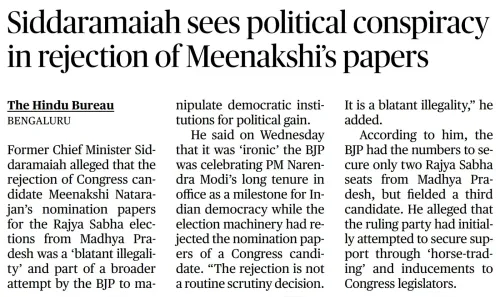
Karnataka CM Siddaramaiah on 10 June 2026 accused the BJP of orchestrating the illegal rejection of Congress candidate Meenakshi Natarajan's Rajya Sabha nomination from Madhya Pradesh, alleging horse-trading attempts and misuse of election machinery to manufacture a parliamentary majority.
Key Takeaways
Karnataka CM Siddaramaiah called the rejection of Meenakshi Natarajan 's Rajya Sabha nomination from Madhya Pradesh a 'blatant illegality' on 10 June 2026 .
The Congress alleged the nomination was rejected on grounds of an undisclosed criminal case, arguing a private complaint without court cognizance does not constitute a criminal case under the Representation of the People Act, 1951 .
Siddaramaiah claimed the BJP first fielded a third candidate despite having numbers for only two seats, then allegedly attempted to buy Congress legislators before using the Returning Officer to reject Natarajan's papers.
The Congress has pledged to challenge the rejection 'in every democratic avenue,' with potential petitions expected before the Madhya Pradesh High Court or Election Commission of India .
Siddaramaiah linked the episode to the BJP's Special Intensive Revision (SIR) of electoral rolls, framing both as part of a broader strategy to build 'artificial numbers in Parliament.'
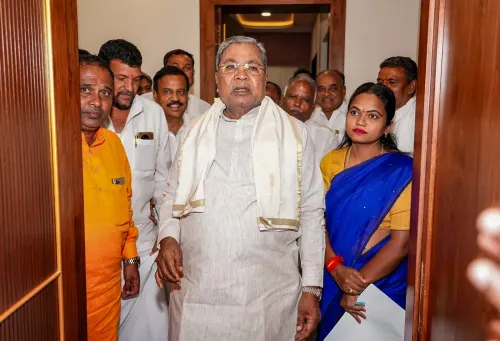
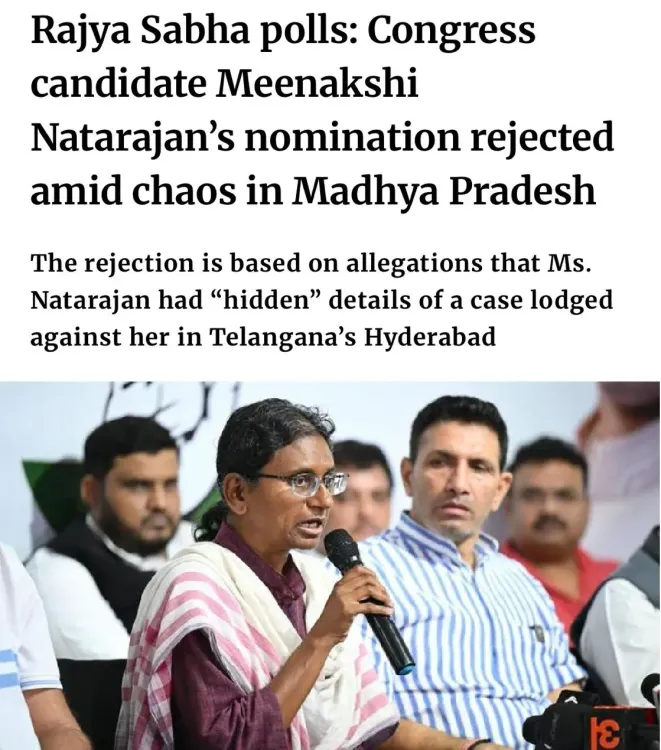
Karnataka Chief Minister Siddaramaiah on Wednesday, 10 June 2026, sharply condemned the rejection of Indian National Congress candidate Ms. Meenakshi Natarajan's nomination for the Rajya Sabha election from Madhya Pradesh, calling it a 'blatant illegality and a clear political conspiracy' orchestrated by the Bharatiya Janata Party.
Context
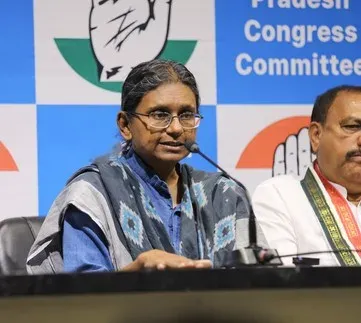
The rejection came on a day the BJP was publicly marking what Siddaramaiah described as a 'cooked-up milestone' for Prime Minister Narendra Modi's tenure — a framing the Congress leader called 'peak irony.' Meenakshi Natarajan, a former Lok Sabha MP from Mandsaur, Madhya Pradesh, had been fielded by the Congress for one of the Madhya Pradesh Rajya Sabha seats being contested in the biennial elections.
According to Siddaramaiah, the Returning Officer rejected Natarajan's nomination on grounds of an undisclosed criminal case. The Congress leader argued this was legally untenable, stating: 'A private complaint does not become a criminal case unless the court takes cognizance. A mere notice from a court is not a criminal case and need not be disclosed.'
Policy Backdrop
The legal position Siddaramaiah cited draws from the Representation of the People Act, 1951, which governs disclosure requirements in nomination papers, and from a line of Supreme Court judgments from the 2000s and 2010s that established a court must take cognizance of a complaint before it constitutes a 'criminal case' requiring disclosure by a candidate.
Siddaramaiah alleged that despite this settled legal position being placed before the Returning Officer, the nomination was still rejected — a sequence he said demonstrated the decision was 'politically driven to help the BJP manufacture a victory it could not win honestly.'
The Congress leader also alleged prior attempts at horse-trading: 'Despite having numbers to win only two Rajya Sabha seats from Madhya Pradesh, the BJP first fielded a third candidate. It then tried horse-trading by offering huge money to Congress legislators.' He claimed those efforts failed because Congress MLAs stood united, after which the nomination was rejected.
Stakeholders and Impact
Meenakshi Natarajan, tagged directly in the post as @MNatarajanINC, is the immediate party affected. Her disqualification from the contest, if upheld, would effectively hand the BJP a seat the Congress believes it had the legislative numbers to contest.
The episode has broader implications for Congress MLAs in Madhya Pradesh, whose votes in a Rajya Sabha election are cast by secret ballot under a preferential system, making them targets in horse-trading allegations during close contests. Siddaramaiah situated the incident within what he called a 'larger design' — linking it to the BJP's Special Intensive Revision (SIR) of electoral rolls, which the Congress has separately characterised as 'vote theft.'
'Whether by manipulating voters, breaking parties, buying loyalty, misusing institutions or stealing seats, the BJP's aim is the same: to create artificial numbers in Parliament,' Siddaramaiah wrote, arguing those numbers were needed to pass 'anti-democratic and anti-constitutional laws without resistance.'
What's Next
Siddaramaiah pledged that the Indian National Congress would 'strongly oppose this assault on democracy and the Constitution' and fight the decision 'in every democratic avenue.' Legal observers will watch for any petition filed before the Madhya Pradesh High Court or a complaint to the Election Commission of India challenging the Returning Officer's order.
The outcome of the Madhya Pradesh Rajya Sabha election and any judicial review of the nomination rejection will serve as a test of whether the legal standard on criminal-case disclosure — as articulated by the Supreme Court — is enforced uniformly by election authorities across states.
Point of View
If legally unsustainable under the settled cognizance standard, would represent a significant procedural flashpoint in an already polarised election cycle. Siddaramaiah's framing — connecting a single Returning Officer's decision to a systemic project of 'seat theft' — is a deliberate escalation designed to unify Congress legislators and build a national narrative ahead of any legal challenge. The invocation of the SIR controversy alongside Rajya Sabha horse-trading allegations signals Congress's intent to contest not just this seat but the BJP's broader institutional conduct. How swiftly and firmly the Election Commission or judiciary responds will shape the credibility of both sides' claims about the health of Indian democratic institutions.
NationPress
13 Sept 2026
Frequently Asked Questions
Why was Meenakshi Natarajan's Rajya Sabha nomination rejected?
According to Congress and CM Siddaramaiah, the Returning Officer rejected her nomination citing an undisclosed criminal case. The Congress contests this, arguing that a private complaint against a candidate does not constitute a criminal case unless a court has taken cognizance of it — a standard established under the Representation of the People Act, 1951, and Supreme Court rulings.
What is the legal rule on disclosing criminal cases in election nominations?
Under the Representation of the People Act, 1951, and subsequent Supreme Court judgments, a candidate must disclose pending criminal cases in which a court has taken cognizance. A private complaint or a mere court notice, without the court formally taking up the case, does not qualify as a criminal case requiring disclosure.
Who is Meenakshi Natarajan?
Meenakshi Natarajan is a senior Congress politician and former Lok Sabha MP from Mandsaur, Madhya Pradesh. She was nominated by the Indian National Congress for a Rajya Sabha seat from Madhya Pradesh in the 2026 biennial elections.
What is horse-trading in Rajya Sabha elections?
Horse-trading refers to the alleged practice of a party inducing legislators of rival parties — through financial or other inducements — to vote against their party's official candidate in a Rajya Sabha election. Rajya Sabha members are elected by state legislative assemblies using a single transferable vote system.
What is the Special Intensive Revision (SIR) that Siddaramaiah mentioned?
The Special Intensive Revision (SIR) is an electoral roll revision exercise conducted by election authorities. The Congress has alleged that SIR has been used to delete or manipulate voter entries in ways that benefit the BJP, and Siddaramaiah linked it to broader accusations of institutional misuse during elections.