CM Siddaramaiah Slams ECI Over Meenakshi Natarajan Nomination Rejection
Synopsis
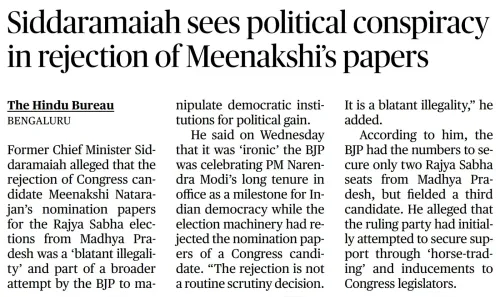
Karnataka CM Siddaramaiah accused the Election Commission of India of illegally rejecting Congress leader Meenakshi Natarajan's Rajya Sabha nomination from Madhya Pradesh, alleging BJP engineered the rejection after its attempt to poach Congress legislators failed.
Key Takeaways
Karnataka CM Siddaramaiah alleged on June 10, 2026 that the ECI rejected Meenakshi Natarajan 's Rajya Sabha nomination from Madhya Pradesh at the BJP's behest.
He argued Natarajan had no criminal cases against her and that a court show-cause notice does not legally require disclosure in a nomination affidavit under ECI guidelines.
Siddaramaiah alleged the BJP fielded a third candidate despite having numbers for only two seats , planning to win the third through legislator poaching.
He claimed Congress MLAs remained united, blocking horse-trading, after which the nomination rejection became the BJP's fallback strategy.
The Karnataka CM called the rejection 'completely contrary to law' and described it as ECI providing indirect assistance to the BJP.
Congress is expected to explore legal remedies before the Madhya Pradesh High Court or the Supreme Court of India .
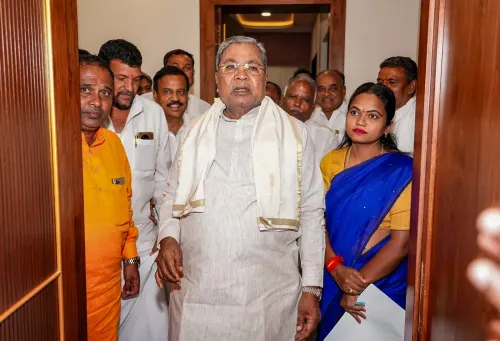
Karnataka Chief Minister Siddaramaiah on Wednesday, June 10, 2026, launched a sharp attack on the Election Commission of India (ECI) and the Bharatiya Janata Party (BJP), alleging that the rejection of Congress leader Meenakshi Natarajan's nomination for a Madhya Pradesh Rajya Sabha seat was an act of deliberate electoral fraud orchestrated at the behest of the ruling party at the Centre.
Context
Siddaramaiah posted a lengthy statement in Kannada on X, asserting that the BJP's celebration of Prime Minister Narendra Modi's longevity in office amounted to 'the biggest mockery of democracy.' He cited the rejection of Natarajan's nomination as a 'glaring example' of the state of India's democracy under the Modi administration.
In his words, 'ಇದು ಸ್ಪಷ್ಟ ಚುನಾವಣಾ ಅಕ್ರಮ ಹಾಗೂ ರಾಜಕೀಯ ಷಡ್ಯಂತ್ರ' ('This is a clear electoral malpractice and a political conspiracy'). He alleged that the ECI, which he described as being 'in the grip' of Modi, rejected Natarajan's papers despite there being no defect in her nomination filing process.
Policy Backdrop
Under the Representation of the People Act, 1951, returning officers have the authority to scrutinise and reject nomination papers on specific, defined grounds. Siddaramaiah argued that Natarajan faced only a court show-cause notice — not a criminal conviction or a registered criminal case — and that ECI guidelines themselves do not require such a notice to be disclosed in an affidavit.
He contended that 'a private complaint does not become a criminal case,' and that the rejection was therefore 'completely contrary to law.' The Congress leader alleged the ECI acted not independently but as an instrument to help the BJP win a seat it could not secure through legitimate means.
Rajya Sabha elections in states with tight legislative arithmetic have historically been flashpoints for disputes over nomination scrutiny, alleged inducements to legislators, and questions about institutional independence — a pattern Siddaramaiah invoked to frame this episode as part of a broader trend.
Stakeholders and Impact
Siddaramaiah alleged that the BJP fielded a third candidate from Madhya Pradesh despite having the numerical strength to elect only two candidates, with the intent of engineering a win through 'horse-trading' — poaching Congress legislators with large sums of money. He claimed Congress MLAs held together, foiling that plan, after which the nomination rejection became the BJP's 'last weapon.'
The post further alleged that the BJP's methods of electoral manipulation include 'misleading voters, splitting regional parties, horse-trading, misusing independent institutions, and seat theft,' with the stated goal of building an artificial majority in the Lok Sabha to pass what he called 'anti-democracy and anti-Constitution bills' without opposition.
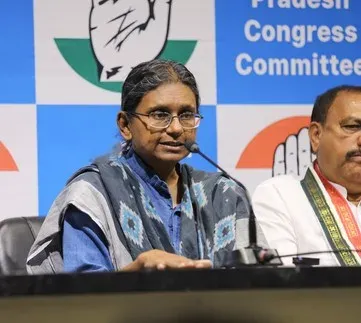
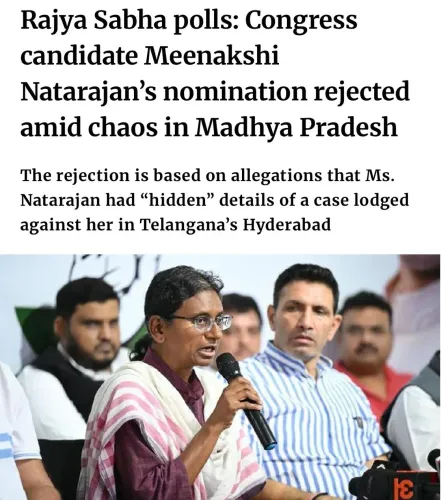
Meenakshi Natarajan, a former two-term Lok Sabha member from Mandsaur and a prominent Congress voice on constitutional matters, was the candidate whose disqualification triggered the controversy. Her supporters and the Congress party have maintained that her paperwork was in order.
What's Next
Siddaramaiah declared that his party would 'strongly oppose every attack on democracy and the Constitution' and would 'stand with the citizens of the country and fight against every injustice.' Legal observers note that the Congress could challenge the rejection order before the Madhya Pradesh High Court or the Supreme Court of India.
The formal declaration of results for the Madhya Pradesh Rajya Sabha seats by the Election Commission will be closely watched, as any legal petition filed before that declaration could seek a stay on the election process. The episode is likely to intensify the Congress-BJP confrontation over institutional independence in the run-up to upcoming electoral cycles.
Point of View
He grounds the allegation in legal specificity rather than rhetoric alone, which gives the charge greater traction with legally aware audiences. The timing, framed against BJP celebrations of Modi's tenure, is a deliberate attempt to counter a positive BJP news cycle with a democratic-backsliding counter-narrative. This episode fits a broader Congress strategy of contesting not just electoral outcomes but the legitimacy of the processes that produce them, a pattern that has intensified since 2022.
NationPress
26 Oct 2026
Frequently Asked Questions
Why was Meenakshi Natarajan's Rajya Sabha nomination rejected?
According to Karnataka CM Siddaramaiah, the Election Commission of India rejected her nomination on grounds he describes as fabricated, claiming she had only received a court show-cause notice — not a criminal case — which ECI guidelines do not require to be declared in a nomination affidavit. The ECI's official grounds for rejection have not been independently verified.
Who is Meenakshi Natarajan?
Meenakshi Natarajan is a senior Congress leader from Madhya Pradesh , a former two-term Lok Sabha member from Mandsaur, and a prominent party voice on constitutional issues. She was fielded by the Congress for a Rajya Sabha seat from Madhya Pradesh.
What is horse-trading in the context of Rajya Sabha elections?
Horse-trading refers to the alleged practice of offering money or other inducements to legislators to vote against their party's official candidate in a Rajya Sabha election. Siddaramaiah alleged the BJP attempted this in Madhya Pradesh to elect a third candidate despite lacking the required legislative numbers.
Can the Congress party legally challenge the nomination rejection?
Yes. Under Indian election law, a candidate whose nomination is rejected can challenge the decision before the Madhya Pradesh High Court or the Supreme Court of India . Legal observers expect Congress to pursue such a petition before the formal declaration of results.
What does the Representation of the People Act say about nomination rejection?
The Representation of the People Act, 1951 specifies defined grounds on which a returning officer may reject nomination papers during scrutiny. Siddaramaiah's post argues that none of those defined grounds applied to Natarajan's case, making the rejection illegal.